
As a “filler” to apologise for not being active in this blog for nearly a month (due to another project I had done!), I would like to try and warm up my writing for the upcoming month ahead. For this, I would like to give a try on writing a listicle which tackles 1 trend – Landfill Indie. It’s a term which refers to a wave of British indie/alternative rock bands which peaked in the 2000s following the acclaim of the Strokes and the White Stripes from the United States. These two bands in turn have formed the opportunity for the Arctic Monkeys and the Libertines (to a lesser extent) to make independent garage rock one of the hottest fads in Britain. Yet, while the latter band alongside contemporaries like Franz Ferdinand as well as Bloc Party have shown a clear cut in their songwriting, the wave of imitators and similar names that came after struggle to stay in the spotlight to say the least…
A handful of names like the Libertines as well as the Editors and the Kooks are regarded as sharing the kind of zing that allows the Arctic Monkeys to prevail both critically and commercially. Yet, while the forefront band’s simpler song structures at the time of Whatever People Say I Am, That’s What I’m Not lend credence to witty remarks and crunchy guitar riffs, the others’ style has neither the charm nor the subtle craftiness needed for their music to stand the test of time. Many of the names especially offer at best rudimentary garage rock singles that are soon looked back on not with nostalgia, but as proto-slop that lacks the nuances that allow classics to flourish. This marks what many would call the “Landfill Indie” and it’s commonplace in the United Kingdom throughout the second half of the 2000s.
Yet, not all “Landfill Indie” songs are bad in and of themselves. Several singles are worth the credibility owing to the sharper songwriting or more distinctive flair that deviates from the Arctic Monkeys even if they do become easy radio fillers. They stand perhaps not as an all-time great so much as a glimpse into a what-if where the bands aren’t shackled by the get-rich schemes of chasing commercial hits. One where they could at least focus on honing their artistic talents to showcase their very best. This listicle will contain what I deem to be the top 5 songs within the “Landfill Indie” trend which highlights more punch compared to the usual. There are diamonds under the rough after all as the saying goes. In terms of the range, I would go between 2000 to 2013 as they represent a period where British rock music is at their most popular – including the more mediocre ones.
5: Two Door Cinema Club – What You Know
Two Door Cinema Club comes through near the end of the “Landfill Indie” period, yet the style that they have shown proves just about familiar enough with the usual lot to be considered as part of it. The tinge of electronica proves to not be enough to pull them out of what is largely a mediocre artistic trajectory that is never able to elevate them out of their breakthrough in 2010.
They do at least have ‘What You Know’ which sticks out for one major reason. Their lyricism doesn’t exactly have the kind of nuance needed to diversify beyond being in love. The vocal singing has a definite accent to help stand out, but it doesn’t quite possess the fervour needed to maintain attention. A lot of the song’s qualities appear to not have anything of worth to make itself stand out from the rest – except its brilliant guitarworks. The interplay proves to be the defining characteristic that is needed to uplift the entirety of the single and it keeps you hooked all the way throughout. Many pop bands wish they could possess the riffs as in sync and riveting as the ones that lead singer/rhythm guitarist Alex Trimble and lead guitarist Sam Halliday had conjured up for their top single.
4: Kaiser Chiefs – I Predict a Riot
Kaiser Chiefs might be a three-hit wonder, but their two hits have caught the British charts by storm. One of their most notable singles ‘Ruby’ supposedly involves developing feelings for a person called Ruby although its skeletal lyrics prove wholly dull and unengaging outside of its chanting of names. Another, ‘Oh My God’ touches on the realisation of not wanting a life that is lived that lacks the quirky anxieties and derealised subtext that’s better expressed on Talking Head’s ‘Once in a Lifetime’ more than 20 years prior.
If there is 1 song that is worth the shoutout, ‘I Predict a Riot’ might well be one. With a riveting tempo comparable to Franz Ferdinand, the lyrical focus is on the paranoia of living as a lower-class citizen especially in dealing with growing antisocial hooligans who tend to be active at night. The lines are brief and colloquial without stepping away from the vividness of encountering dodgy individuals hanging around at night. The vocalising for the pre-chorus might prove itself unnecessary, but it feels as though it’s on the backseat compared to the energetic fears of nighttime adventures.
‘I Predict a Riot’ ages a tad bit like fine wine in retrospect in relation to the UK. Many news increasingly draws attention to growing antisocial attitudes not only at night, but even throughout the day with many disillusioned teenagers opting to skip school to harass strangers who are minding their own business. In the most extreme case, race riots even run amok over the last few years over claims of “immigration concerns” which tends to involve threatening foreign-born or other ethnic minorities who are not White Brits. The song’s paranoia seems befitting even if its tune might be inappropriate for the ethnic polarisation that’s been settling in.
3: Scouting for Girls – Love How It Hurts
Scouting for Girls is the name that best defines the mental arrhythmia that pretentious music nerds like myself might have whenever the term “Landfill Indie” comes up. Their style is a largely barebone kind of rock which feels too cookie-cutter for its good. Expect there to be the verse-chorus-verse song structure without even an ounce of small subversions (the lyrics not remotely eloquent) and the themes to consist of twee puppy love without any further examination. ‘She’s So Lovely’ is the best-known example of that in how the repetition comes off as consistently grating and the songwriting being shown as shallow although, credit where it’s due, there’s a teasing of infidelity to uncover once you look through the upbeat instrumentation.
‘Love How It Hurts’ however could be best described as highlighting the best of Scouting for Girls in terms of how the lovesick focus can come off as sincere. Even through the lacklustre lyrics and swoony chamber instrumentation, the song has a weight in how it tackles the unreciprocated love through the ways it plays with its textures and volume and the small bits of juxtaposition that elevate the melodrama. The verse for instance is reliant on the instrumentation being led more by its percussive rhythm from the piano and the drum while the chorus saw the two instruments thud as if to signify the heartbeat rising from the confession.
The lyrics, while by no means a masterpiece, have helped to add more charm to the song in its seeming sincerity. Its plainness is by most means a disadvantage and it shouldn’t come as a surprise that there are more fanciful ways to express your romantic feelings. All that being said, it allows some of the lines to stick out harder than it should’ve which further adds to the allure of the song’s fleeting love. ‘For you I’d have run to the ends of the Earth’ and ‘It’s the most beautiful pain in the world’ are corny for sure out of context but the instrumentation grants it the emotional weight needed to make it come off as authentic even in spite of its wholly unoriginal premise.
2: The Fratellis – Whistle for the Choir
“Well, it’s a big, big city and it’s always the same / Can never be too pretty, tell me your name” goes the beginning of one of the Fratellis’s most recognisable songs. The band, originated in Glasgow, Scotland, always tended to stick with the aesthetic of the pulp magazines during the early 20th Century. Their history as a whole best mirrors the trend of the “Landfill Indie” with their founding in 2005, their commercial breakthrough and peak a year after, and later on their gradual fade into obscurity outside of their national home country following 2013’s We Need Medicine. At least for the time being, their success was nice to have while it lasted.
Listeners are most likely going to recognise them for ‘Chelsea Dagger’ in which its tune became an anthemic part of sport culture. For me personally, one song that sticks out is ‘Whistle for the Choir’ which is very much based on love at first sight. Yet, it’s the kind of first love that is especially attached to the urban pubs that it’s inseparable from. The voice by lead singer Jon Lawler (his stage surname being Fratelli) remarks on his newfound romance from his implied inebriation all the while being baffled at how his love interest is single despite her looks. Note the patronisations that are otherwise playful from ‘Oh you’re a silly girl’ to ‘But you’re a stupid girl’ which plays with the stereotype of a dumb bimbo without downplaying the love he has for her.
Another aspect of the song’s charm lies in the jovial playing of the instruments. The acoustic guitar helps to keep much of the music natural and grounded in the bubbling romance that appears fantastical. The electric guitar that chimes in the chorus ticks closer to the love materialising. And the mandolin that explodes in the last minute of the song officiates the relationship in a way that proves cathartic to the genuine feelings held. The song might be cheesy at heart, but it does mean what it says.
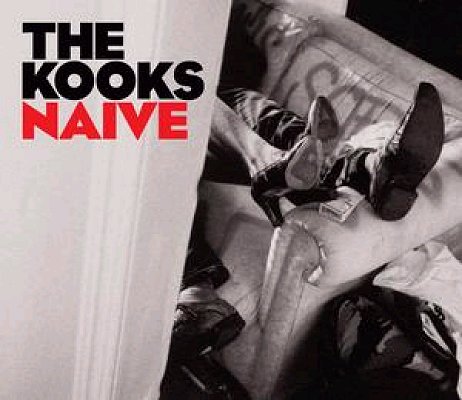
1: The Kooks – Naïve
The Kooks at least do enjoy some bit of recognition over the score of years since their founding in 2004. They are certifiably pop in their music which renders any prospect of artistic credibility a challenge to be taken seriously. They have numerous singles with one of their most well-known being the romantically jocose ‘She Moves in Her Own Way’ that’s since been played in many shows. Like Scouting for Girls, they have a kind of music that’s wholly addicted to love with little variety surrounding how it’s been represented. Like the Fratellis, they feel as though they are wholly in debt to the aesthetic of the past with their musical style being more similar to the British Invasion of the 1960s. Unlike the two however, the Kooks prove to be sharp in their craft with a tune that rivals even with the best in the country at the time – ‘Naïve’
‘Naïve’ is a song that puts infidelity to the center. The lyrics tackle the singing voice by Luke Pritchard being in shock that his girlfriend is cheating on him. He proves himself to be in denial over the extent of she’s seeing another person over him as he repeats the song title over and over again as though he wishes that she’s under a spell. (“How could this be done / By such a smiling sweetheart? / Oh, and your sweet and pretty face”). He feels like a prey in the long term over his love interest’s seeming infidelity that could spiral her out of his life and the vocal delivery gets you into the adolescent/young adult angst over the breaching of the relationship.
The instrumentation marks another key aspect behind the appeal of the song. The guitar riff contains a lot of staccatos in its notes which makes for an intensifying episode of paranoia over the prospect of being cheated on. The hi-hats in the beginning is comparable to the keg that is about to explode over the imploding relationship and as the full drum kit rolls along, the percussion highlights the spiralling loss of control over the bond. The way that the song progresses leaves little room for rest as the everyday living worsens over the infidelity being a very real possibility.
Yet, because there’s no coherent narrative to elaborate on what happens, we are only left with the perspective of a youngster who feels that he might be cheated on. Here, there’s a sense of unreliable narration going on over whether he is the naive one in the relationship over his denialism. The single never sought to try and answer it however and we’re instead left with the bubbling anxieties that come with being in love. The outro best sums up the blinding effects that the feeling is sure to carry with it: “Just don’t let me down, just don’t let me down / Hold on to your kite”.


Leave a Reply