
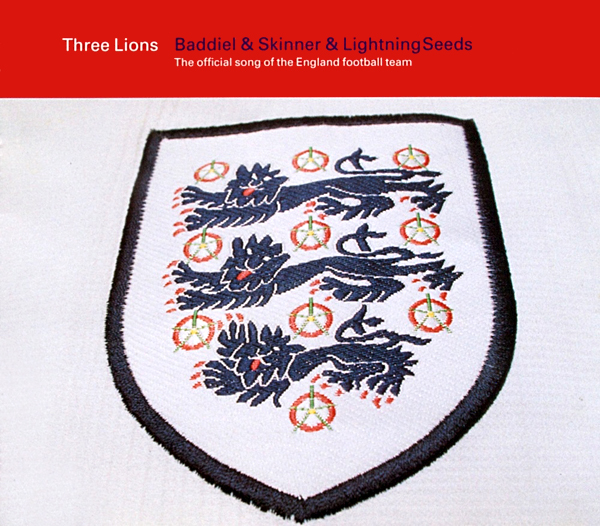
The de-facto anthem of England’s football culture rings on 30 years after its release even if it comes off as corny to the sports.
At the end of May in 1996, a single by British comedians David Baddiel and Frank Skinner with collaboration from the Lightning Seeds was released with instant public love. ‘Three Lions’ was written as a football anthem that contrasts the shortcomings of England’s football teams with the highs of the past. The chorus “Three lions on a shirt / Jules Rimet still gleaming / Thirty years of hurt / Never stopped me dreaming” best sums up the hopeful belief that the national team could one day claim the top trophy while the refrain “It’s coming home” becomes a popular chant.
Like many chart toppers, you always tend to find contrarians who dislike the song for its upbeat melodrama. Get into a RateYourMusic forum or comment section and you’ll be met with criticisms about how cheesily sentimental the chorus is or how outdated it feels as of now. I would personally concede that I tend to dislike a good number of top 10 hits throughout the year should I find it to lack any creativity or artistry in the music. Needless to say, I am openly pretentious. ‘Three Lions’ should come off as being a tune that I can’t bring myself to like and given my political and social views, I might at best find its patriotism annoying. I wouldn’t even say that I’m into football all that much; my go-to events for spectating tend to go to esports or horseracing in an ironic sense.
I can’t help myself to get back to the song whenever the FIFA World Cup is on and even in all its controversies regarding sportswashing or corruption am I reminded of the potential. The promise of the fairy tale narrative to further clarify. England’s football team tends to easily sit in the upper echelons of international performances even though they tend to choke when the stakes are at their highest. Yet, the dreaming never stops for the prospective second World Cup win. For ‘Three Lions’, I do think its status as one of the most iconic football songs in the country might help to add to the palpitating ambition.
The first aspect surrounding the song’s success rests in its use of samples in line with its Britpop tropes. ‘Three Lions’ was released in the peak of the genre and movement back in the mid-1990s when the likes of Oasis were at their commercial peak. The song itself might not have matched the songwriting wit of Pulp’s Jarvis Crocker, nor the glamorous flamboyance of Suede’s Brett Anderson, and most certainly not the twinkle of experimentation that Blur’s Damon Albarn has shown. What Baddiel and Skinner did exhibit however is contextualisation; the use of lyricism to justify the song’s existence through its relation to England’s football history.
From the very beginning with the comments from pundit Alan Hansen and footballer Trever Brooking following England’s failed qualification to the 1994 World Cup, the contrast is set with the refrain of “It’s coming home”. The earworm is simple and at times annoying with the patriotic undertones, but it works as an optimistic pushback against the cynicism. Few might remember the additional sample of broadcaster Jimmy Hill’s blunter remark on the failed qualification and it’s arguably deliberate. Negativity does not and should not overshadow the idealism that makes the dream worth believing in.
The second aspect rests in the economy of description. To hammer onward the desire for success, failures are often treated with a handwave. Note the first verse which described England’s infamous tendency to choke under pressure compared to the smooth transition towards the vividness of the chorus over finally claiming the trophy – “Jules Rimet still gleaming”. Or the second verse which sought to highlight individual showings that even explain the “Oh so nears” that the national team are in a perpetual limbo over. The bridge particularly displays the brilliance in a “show, don’t tell” manner through samples of commentating over decisive wins be it a rare volley score or goalkeeper Gordon Banks’s clutch save in the 1970 World Cup.
Through linking the history of England’s football success to the present, ‘Three Lions’ conjures up the football team’s journey as an epic drama. It’s full of ups and downs that appeal to fans of all ages from elderly people who have long followed the team to children who are getting into the sport over its simple rules and addictive physical engagement. It’s easy to root for other football teams like Brazil’s for their long records of dominance much in the same way that Counter-Strike fans are bound to Vitality or Natus Vincere due to their coffers of championships. It’s gratifying however to root for the dark horse or the local team. Those whose past might not look as shiny as the top contenders but are just as capable of putting on the greatest of performances on a good day. It’s what makes upset wins all the more beautiful.
The third and final aspect behind ‘Three Lions’ being a clear staple in England’s football culture rests in its surprisingly sophisticated production and instrumentation. The song never takes itself serious and yet is capable of glitzing its open support in a way that feels comparable with the Beach Boys. The beginning opens with the common time signature of the harpsichord that’s like ‘God Only Knows’ and it lingers in the background especially during the chorus. The rock instrumentation that’s typical of the Britpop genre adds a layer of humility to the song without completely overriding the harpsichord as to maintain the rags-to-riches promise from the win. And the vocal harmony’s devaluation of pitch-perfect singing makes for much-needed accessibility and relatability that can’t work should you get Freddie Mercury to sing the song instead.
The textures of the song make for a common man’s anthem. It is neither luxurious nor does it come off as rudimentary. It’s a song that’s tinkered for fans to never stop believing in the dream of England winning the World Cup and its appeal is aimed to be vast. ‘Three Lions’ isn’t supposed to be a cult indie classic that I spent so much of my time listening to so much as it is a unifying tool to get the nation rooting. If not the belting of “It’s coming home”, then the humming of the main melody is a sure sign of a fan who remains optimistic of their favourite’s chances.
‘Three Lions’ is a pop song that’s tailored almost perfectly to be a football staple. The catchiness and the harpsichord makes for a mainstream hit that, even 30 years on, are regularly sung by fans all around the United Kingdom while periodically appearing in the charts. It might not be the best of its time for certain, but that is secondary compared to its intent. Its specialisation in football patriotism ensures that it will remain a beloved piece among the fanbase for decades to come. As long as England continues on with claiming their second Jules Rimet (metaphorically speaking, the original trophy is now gone and replaced with a new one for those who aren’t tuned in with football history), decades of hurt will never stop the dreaming.


Leave a Reply