
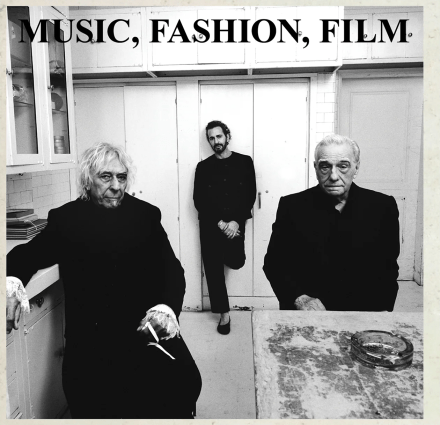
In a left turn away from conventional electropop through guitar usage, the British diva eschews slick quality in favour of rocking authenticity.
By the time she released Music, Fashion, Film, Charlotte Aitchinson was on top of the world. Under her stage name of Charli XCX, her last seven albums show an upward trajectory as she sinks her teeth into perfecting the electropop formula to the point of popularising hyperpop with 2019’s Charli and 2020’s How I’m Feeling Now. Her 2024 release Brat cements her status as one of the defining mainstream stars of the decade with its virality especially swamping through the summer season. And a few months ago her soundtrack for the recently released film Wuthering Heights came out to further help with reinterpreting the original novel through a more modern outlook.
Music, Fashion, Film sticks out with big anticipation given that it’s by one of the best pop artists of the decade and given her more boundary-pushing style of electropop, it’s a big point of speculation on where she’ll go. There is a big key context to keep in mind with the album however and it’s the title. Charli XCX is branching off in her career since last year to act in movies like Faces of Death while also doing some producing with the most prominent being her mockumentary The Moment. She also dipped her toes into cosmetics as the US ambassador for Valentino Beauty back in 2024 and as publicised as her fashion tastes are, this year saw her be more gleeful in posing for British Vogue’s May cover.
For a pop star, Charli XCX stands out for her authenticity and refusal to be categorised into an archetype. She builds on her popularity to allow her to go for projects and interests that liberates her from being pigeon-holed into being known as a singer-songwriter with success. An interview with GQ Magazine best exemplifies this flexibility through her friendship with the late Sophie Xeon who inspired her creativity and her quotation on how artists aren’t simply about the medium they make their works through, but more so the culture they are in. If Brat embodies Charli XCX as the musical zeitgeist of the 2020s, Music, Fashion, Film portrays Charlotte Aitchinson trying to find herself in the wider entertainment industry.
The album’s sound is still electro at its core; the main producers are A.G. Cook and Finn “Easyfun” Keane who previously worked on Charli’s other works under the PC Music umbrella. What makes Music, Fashion, Film stand out however is that it’s more abrasive not in the sense of sheer glitchiness or pop cliche maximalism, but rather through more overt rock genre sprinklings. This means simple-chord riffs that interplay with vibrating tones in ‘Rock Music’, ‘SS26’ having distinctively smooth basslines that don’t come off as programmed, and punk-like distortion that emanates from ‘Persona’. These examples are part of a wider range of contrasts with the usual electropop characteristics as if to highlight Charli XCX’s internal conflicts over her image as she branches off to other works.
And it’s the point of identity that sits well in the heart of the album. Charli XCX wants to carry on the dissonance between her preferences of partying and sex compared to her self-doubt regarding how authentic she is to herself. ‘Wink Wink’ is the song that best displays the dynamic as the chorus is a tongue-in-cheek bit of flirting which contrasts with the verses that contrast casually sexual remarks with sarcastic declarations that she’s grown up beyond that point. There is a bittersweet subtext underneath the satirical take on the idea of artists maturing however in that however much she wants to prove her sexual freedom, she struggles to divorce herself from the “bad girl” image that she’s typically portrayed as. Similarly, ‘I’m Afraid’ demonstrates the conflict between her marriage with the 1975’s drummer George Daniel and her calling as a music artist while ‘Magic Metal Montana’ is an earnest ode to A.G. Cook in a Sprechselang-like vocal performance.
Music, Fashion, Film has its interesting ideas and themes to try and explore. Yet, because Charli XCX sought to try and make a notable divergence from her past stylings while trying to still highlight her true self as is the case on Brat, there’s a lot of hiccups in the execution. For every one solid moment in the track that best exemplifies the thesis of the record, there are two moments that at best comes off as awkward and at worst extravagant to everything that the music artist intends. Be it unfunny in humour, honestly childish, or pretentious even if genuine, the record is divisive for several good reasons.
There are three songs in particular that stick out as the more egregious in highlighting the flaws of the album. ‘2007’ has a sexual undertone even if it’s ultimately about Charli XCX’s initial splash of stardom through the early years of social media which feels strange especially given that she would’ve been 15 years old then. There’s also the extra bit of subtext as well that younger entertainment figures like child actors often have publicised incidents in their adult lives following their youth and how early internet personalities like Shane Dawson or Pewdiepie face controversies over reactionary comments or weird attitudes toward underaged fans.
Additionally, ‘Yeah’ proves itself to be very much one of the blandest tracks in the album with its minimalist lyrics and punky electronic rock music structure that lacks the deprecating catchiness of Blur’s ‘Song 2’. It simply is repetitive to the point of gratiness. ‘Card Declined’ at least has a more riveting instrumentation through the bass-boosted guitar feedback to punctuate the consumerist mindset. It too proves itself shallow for its interest in mocking chasing trends over an open door for introspection over celebritydom and wealth. ‘Nothing Lasts Forever featuring David Cronenberg’ offers one last flash of look into authenticity with its examination of why art is valourised as the legacy of its creator when the creator themself wouldn’t be alive to see the full extent of its influence. While this affirms Charli XCX’s creative freedom, the theme is inhibited through its repetitive chorus and David Cronenberg’s ending monologue, impactful as it is, is ghastly without any brakes to stop reminding you of your mortality.
Should there be one major highlight in Music, Fashion, Film that is worth raising, ‘Camera’ is the single that best defines the key theme of the album – the delicate balance between artistry, personal life, and freedom. From the scintillating guitar riff that serves as the leading beat to the palpitating synths for the chorus, there’s tension to be felt. And with the lyrics that document acting as an escapism away from your main roles (“‘Cause it’s the only way to feel like I’m not actually me.”), the song stands out like a sucker punch in its representation of fame, self-expression, and anxiety. It’s a standout track so noteworthy that it could rank with even the likes of ‘365’, ‘Gone’, and ‘Vroom Vroom’ as the best of Charli XCX’s.
Music, Fashion, Film is an experiment that proves itself to be fascinating in the wider web of Charli XCX’s discography. Released in a time when she’s divulging away from pop in favour of different modes of expression as a creative, the record stands as a herald for what could be coming. She finds liberty in indulging her imaginative passions without the weight of expectation anchoring her away from whatever her vision or her interests might be. This is shown in the album as while its premise is fascinating and the rock incorporation shows itself to be potent, much of it is jagged in terms of quality. It doesn’t ultimately matter where she’ll go in the future given that she scored a home run in Brat and How I’m Feeling Now. Her fans will certainly enjoy the record; casual listeners might otherwise be as puzzled (perhaps more so) as they are bewildered by its intent.


Leave a comment