
Creativity compliments the fluidity of the mind so when AIs like ChatGPT are asked to generate creative works, it lacks intent and adaptiveness.
This is a thought that just came up in my head as I try to motivate myself to try and write up another article. I doubt that it’s an original thought and that there’s a good chance that a philosopher from the past had already come up with a similar theory with a more thorough argument to underline their case. It is however a pretty crucial point in thinking about art in the time of artificial intelligence being commonplace. How deep-learning generative types like ChatGPT or Midjourney are utilised more specifically to help with creative writing exercises or creating images that match with the requisites set by the prompter. As the creative industry stands out as being among the most affected in terms of layoffs in recent years, genAI are gradually adopted as replacements regardless of their actual usefulness.
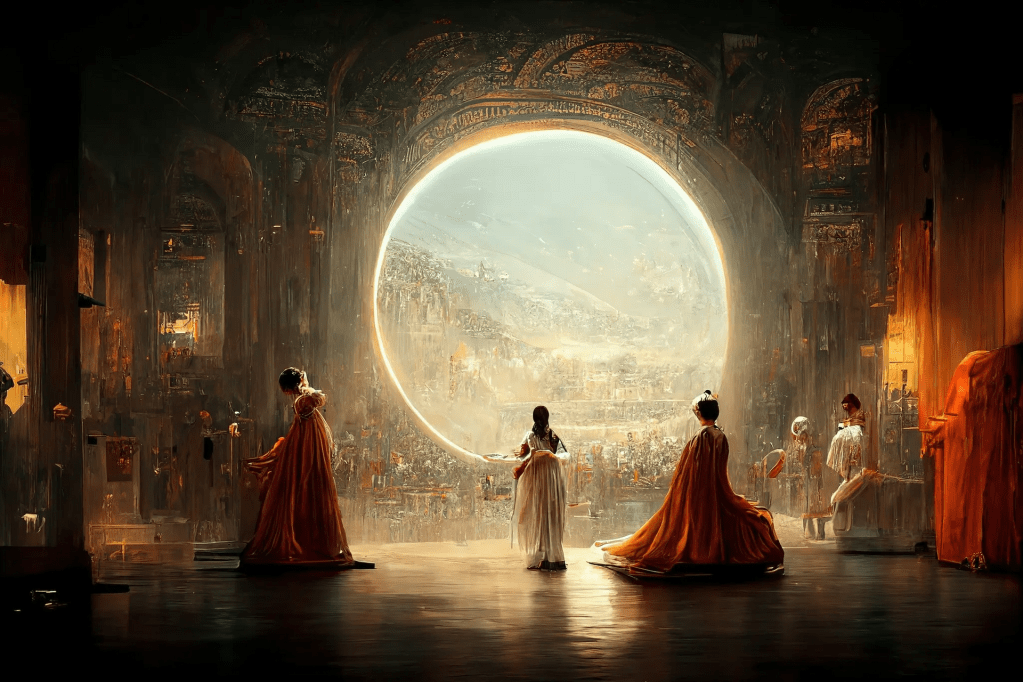
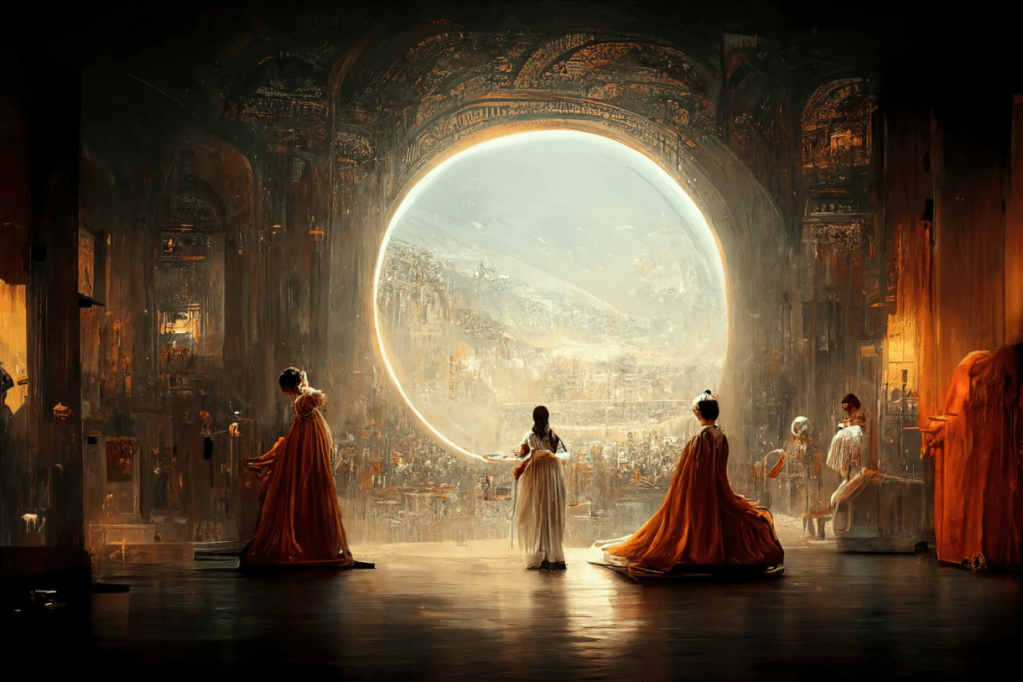
In 2022, an image made in Midjourney called Théâtre D’opéra Spatial won the Colorado State Fair’s annual contest for digital arts by rising creatives. The prompter, Jason M. Allen, sought to register a copyright claim over it with little success owing to how much of the work is made by AI. Meanwhile, the image was subject to a social media discourse over the use of AI in creating art and its future effects on the creative industry. Anxiety fuels the engagement with the work – and it’s not related to the themes or symbolisms expressed within it at all.
Théâtre D’opéra Spatial feels lacking in substance despite its grand presentation and its aesthetic reminiscent of Victorian paintings. Allen mentioned that working on the piece takes a long time and has turned to many prompts over the course of a few days to get the image he wants according to a CNN article. Note that all the way throughout the process are there little disruptions in trying to tailor the image to his liking. How there’s no sudden “eureka” moment in polishing up the image beyond Victorian-style space opera premises where he feels incentivised to add more or change certain aspects around to make it feel more whole.
If you look at the artwork, you may find that as beautiful as it looks, there’s little within the image that sticks out aside from the portal in the middle. The composition between the figures come off as ghastly without any sign on what their role is within what looks to be an orchestra. The infamous tendency for smaller details to become increasingly blurred and fuzzy in AI-generated works is made apparent in how much the musicians blend with one another and with no distinguishing musical instrument of any kind. There’s no clarity on what the central portal shows; all we know is it peers over to a different world. What state it is in, it’s too foggy for us to make into detail. Théâtre D’opéra Spatial looks beautiful, but that’s all there is to it and that will be its only legacy in the years to come.
What struck me in the midst of thinking about the use of AI in art and creative works is that because it lacks the organic thought process that us humans tend to have, its use goes no further than beyond appearance. Just as Allen’s generated art piece looks pretty yet shallow in its deeper symbolism, AI is incapable of conjuring up anything that demands its creator to think about the significance of what they’re making nor rewards its audience for engaging with why each piece is where it’s at.
Many of the best artistic works throughout human history involve at the very least a more intimate emphasis on a key theme, item, or imagery to show its importance. The Epic of Gilgamesh, written in around 20th Century BC at the earliest, made mortality its main theme in presenting its titular protagonist go on a journey to live forever before his perils led him to appreciate his life. William Shakespeare’s 1606 tragedy Macbeth used blood as its central symbol to punctuate the eponymous Macbeth and his wife’s guilt in killing their King Duncan for power and its psychological vividness soon leads to their death as tyrants. And you have artistic genres in paintings like vanitas which sought to remind viewers of the inevitability of death.
And over the course of the last few decades, new mediums like film, television, and video games allow for new artistic expressions to be made as other ones like music saw differing disciplines to making them. However, the clear accessibility to updates surrounding them now through expanding news and journalism allows us to get a better grasp in the process of creating them. Film and television especially showcases the fluidity in creating through its collaborative nature and longer production time. The 2008-2013 acclaimed crime drama Breaking Bad, for one example, was originally planning on killing off its deuteragonist Jesse Pinkman at the end of its first season only to let him live throughout the whole show due to his actor Aaron Paul’s performance.
Meanwhile, games like The Last of Us Part II are subjected to controversies over its different production decisions without the constraints set from the original. Namely, how directors like Neil Druckmann have thought of making the supporting character Tess the main antagonist only to change her role around because of how hard it fits into the overarching plotline. Comparatively, The Last of Us Part II saw criticisms over what several fans have deemed to be retcons that conflict with the central themes and presentation previously explored.
Or, should we look into music, the numerous instances of albums that are especially inspired by lived experiences. East Coast rap group A Tribe Called Quest released their final album We Got It from Here… Thank You 4 Your Service in 2016 with one of the key events in the recording sessions being the passing of their member Malik “Phife Dawg” Taylor which led to the creation of songs like ‘The Donald’ being made in his memory. A Crow Looked at Me is a 2017 meditative folk record by Phil Elverum under his project of Mount Eerie which is driven by the diagnosis and later passing of his wife Geneviève Castrée from pancreatic cancer. You can even point to something as recently as Porter Robinson’s SMILE! :D as a notable example of an album that’s inspired by personal experiences which inform so much of the creative process.
AI-generated works can’t create artworks because once you look beyond the pleasant-looking appearance, there’s no substance to enquire about. It lacks the subtext to justify its intent, the spontaneity to make for an abrupt change to substantiate itself, it doesn’t possess the actual process of which it disseminates and reconstructs its sources into a whole that engages with both the creator and the audience. You can feed ChatGPT dozens of classic jazz records like Miles Davis’s A Kind of Blue and it’ll churn out hot shit because it’s unable to understand the potency of improvisation to heighten certain parts within a composition.
Between 2016 and 2019, a robotic sculpture by Sun Yuan and Peng Yu called Can’t Help Myself was running with public acclaim. Depicting an automated arm trying to futilely sweep up the fluid towards its core with constant struggle, many came to relate to the artwork for its work which makes no progress at all. It works on display at a time of rapid technological improvement and increasing disillusionment with ordinary day-to-day living. Much like Théâtre D’opéra Spatial, Can’t Help Myself is an artwork that’s dependent on the use of technology itself to will itself. Yet, it resonates because audiences can identify and relate to its key themes and premises; they’re invited by its two creators to question modern living. Théâtre D’opéra Spatial has none because it’s made entirely in technology and thus works as well as someone like Adolf Hitler’s paintings as bluntly as I can put it.


Leave a comment