
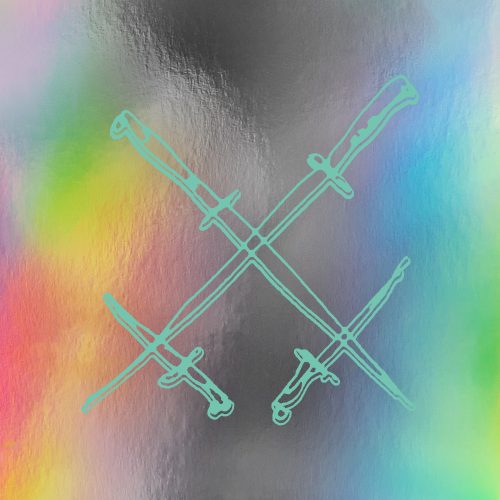
The eminent Californian avant-rock band steps into psychedelic territory with wondrous and heartrending results on mortality.
For the uninitiated, Xiu Xiu is a band from California fronted by Jamie Stewart who, since 2002, had risen to fame for their discomfitingly experimental style. Diverse in the specific aspects of their songwriting as noted by their stripped-down cover of Tracy Chapman’s ‘Fast Car’, they are nonetheless most noted as key names in Post-Industrial music. The band’s signature output includes 2003’s A Promise with its provocative cover art and electronic production, Plays the Music of Twin Peaks from 2016 that was inspired by the soundtrack of David Lynch’s TV masterpiece, and Girl with a Basket of Fruit in 2019 which never relents on its post-industrial direction.
For Stewart, despite their success in their music, they have always been open about their queer identity. They might not have spent a lot of time in industrial music, but they have always held close to their heart the chaotic, risque, and oftentimes decadent ethos. They stated in an interview with the Quietus’s Claire Biddles that their lead single ‘Common Loon’ embraces being a “cuckoo” and how it’s fine to be such in a world. The hopefulness in accepting the madness of our lives is the thesis in 13” Frank Belthrame Stiletto with Bison Horn Grips (shortened for this article as 13” Frank Belthrame). While the lyrics and music on their own continue to be disorientating and graphically suggestive, they somehow come off as if they’re at peace with one another once they work in tandem with each other.
Take for instance ‘Arp Omni’, the opener which pursues an idealised love interest as a ecclesiastical being whose significance would have offered a Promethean, existential meaning to living. However, the sluggish vibrato of the violins and the creeping dissonance of the individual guitar notes emanates a certain tension towards the whole song and therefore sets our expectations toward the rest of the album. The ending which builds on the feedback from the cymbals and the toms lend the way towards ‘Maestro One Chord’ which combines the Post-Industrial inventiveness with trip hop’s downtempo beat. Instead of fear, the track calls toward accepting both death and the unexisting afterlife that many would have hoped. It places our mortality within the limitless universe and it is this recognition that demands our stoicism. In a similar fashion music-wise, ‘Pale Flower’ mixes German phrases with rejections of “imagination, luxury, revelation, [and] art” before a solo drum performance from band member David Kendrick.
A major part of 13” Frank Belthrame’s psychedelic impression is its constant layering of vocals, abrupt flips in the structure, and stereo-aural production. It relies on the studio itself as a definite instrument for memorability. ‘Veneficium’ echoes the crooning vocals from Stewart, the riff went from mono to the right for unexplainable reasons, the electronic notes sputter out as synths or in conjunction with the hi-hats at the end. The guitar dissonance in ‘Sleep Blvd.’ comes exclusively from the right for the explosive chorus in contrast with the tinge of drone that barely elevates the minimalism of the verses. Not only that, but Stewart’s singing picks up in the mixing process to add to the disorientation. ‘T.D.F.T.W’ blends in the backing vocals from long-time band member and multi-instrumentalist Angela Seo within the frizzled feedback of the repetitive guitar notes and electric tonal shifts. It feels chaotic and with how the three tracks respectively deal with the feeling of being trapped, sexual deviancy, and redemption, it blends well with the overarching emphasis of death.
This certain dissonance and production emphasis continues to grow even if it might reach the point of detriment. In ‘Bobby Bland’, the Post-Industrial embrace of mechanical ringing is mixed with digitally muffled grunts and drones between the first two verse’s mortification of living. This not only makes the track itself feel a bit too on-the-nose with its attempt at making the prospect of life come off as being too fetishistic in its nihilism, but the psychedelic focus might even feel inappropriate to the themes of the track. It adds too much life to what amounts to the treatise on the cyclic disgust of human beings. It was this that neuters the closure in ‘Piña, Coconut and Cherry’ which calls back to the romanticisation of ‘Arp Omni’ through jade-tinted glasses. It goes back to the Deconstructed Club aesthetic of ‘Maestro One Chord’ without the backing of absurdism; the problem isn’t so much the closure on obsessive love as it is the closure on our inevitable deaths.
Stewart has both the concept and the experience in line to make for one of the band’s most exciting materials and on some level, they did succeed in doing so. The experiences with Industrial music making meant that there is a lot more to be done in making 13” Frank Belthrame feel isolated in highlighting the futility of life. The combination of that with a bit of dance rhythm adds a smidge of black comedy even for how much it lives up to the Quietus interview’s notion of accepting life when death is inevitable. In the last leg however, 13” Frank Belthrame falters in their execution, the blending between the futile pursuit of life’s meaning and the instrumentation begins to crumble. It was through this notion that means that while the production will excite and delight fans of both experimental music and Xiu Xiu, its cynicism might not have as much depth as it would have liked.


Leave a Reply