
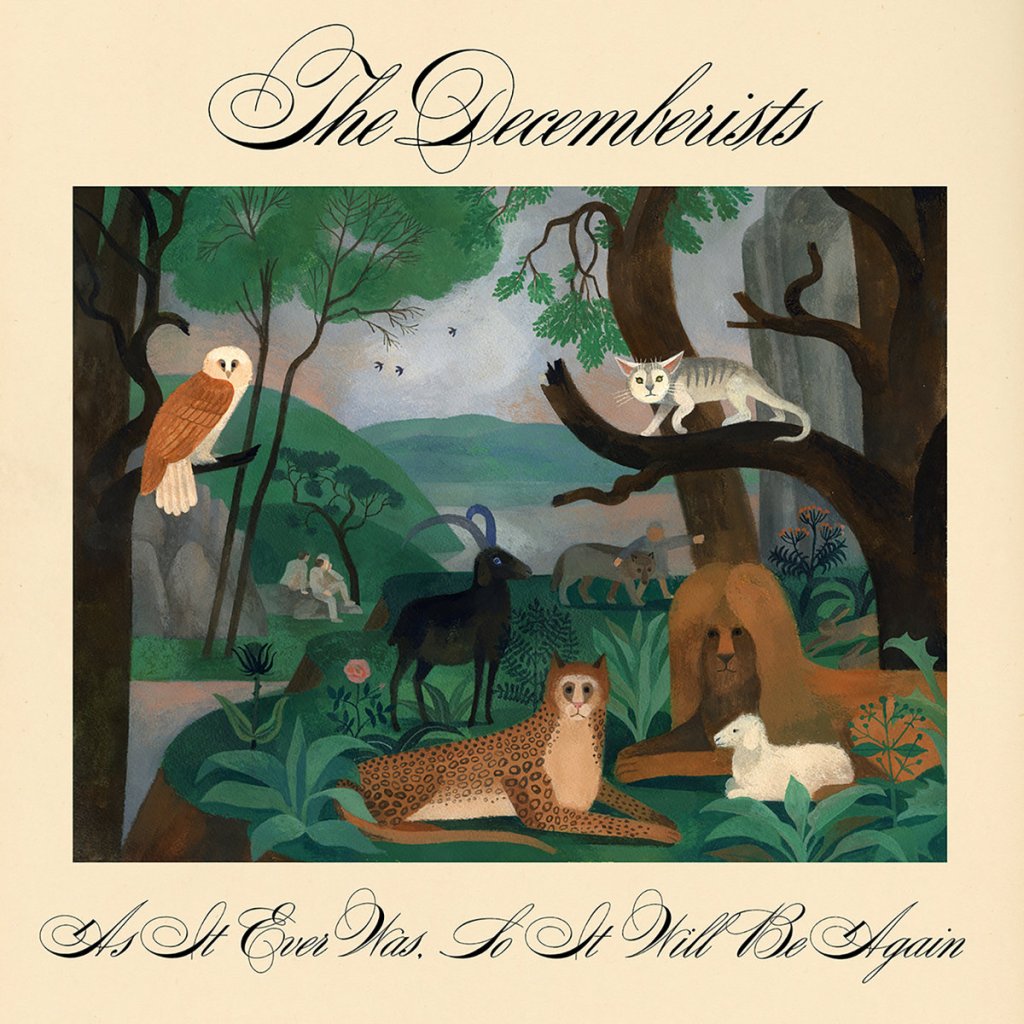
One of the top folk rock bands in Oregon comes out with a new record after six years’ worth of waiting. It could’ve been worse, I suppose?
For those who might not keep up with Oregon’s music scene, the Decemberists is regarded as one of the most highly respected names when it comes to indie folk rock. With Colin Meloy to lead the charge as the singer-songwriter/frontman, the band grew to notoriety for their love for concept albums which draw inspiration from folklore and history. This is the case with the release of 2006’s The Crane Wife; an epic folk odyssey which not only makes references to the eponymous classic Japanese fairy tale. It additionally makes do with Shakespeare, the Irish Troubles, the Bible, and the War in Afghanistan in its own fairy tale-like manner. All that with accordions, horns, harmonicas, and more with a varying harmony with the backing vocals to great emotive impact. Suffice to say, it’s easily one of the top records of that year.
Following the relatively mid reactions to 2018’s I’ll Be Your Girl, the Decemberists spent their time touring before making As It Ever Was, So It Will Be Again throughout 2023. Now, the album is finally out in all its glory. That is at least in providing new materials for the fanbase to listen to and enjoy. Sticking with storytelling as the groundwork for their songwriting, many of the tracks rely on narration to anchor the music. Tracks like ‘Long White Veil’, ‘Don’t Go to the Woods’, and ‘The Black Maria’ all contain elaborate lyrics that aim to mythologise marriage, the feeling of being lost, and authoritarianism. The backing banjos and guitar strums add a certain elegiac weight to the mentioned songs as Meloy’s singing turns towards a grander sense of hopelessness. Even in the relative optimism of ‘Long White Veil’ with its higher musical key, one can’t help but suspect that the spouse was long gone in reality by the time the marriage sets in. Credit where it’s due, Meloy’s knack at playing with the mood between his lyrics and composition didn’t fetter too much.
The album sought to flex its array of styles and instrumentation to highlight the more musically progressive side of the Decemberists. ‘Burial Ground’ takes on a soft rock riff and jangly kind of percussion in its tale of death. “So, contract malaria, meet at the burial ground!” goes the multisyllabic, melodic rhymes of Meloy in summing up the grim reality of the afterlife with some of the most upbeat instances of Americana instrumental playing one would have suspected. In comes the brassy horns from ‘Oh No!’ with its tejano groove and faded guitar in the background or the patriotic pianos and inglorious symphony of ‘America Made Me’ which accentuates the atmosphere. Unfortunately, much of the process feels a bit flat as much of the song structure, while it might vary with each performance on the instrument, feels a bit stagnant in the sense that it relies on following the verse-chorus-verse pattern. This gives the unfortunate side effect of making the tracks come off largely as being a bit too samey.
Perhaps my biggest complaint regarding As It Ever Was, So It Will Be Again is its production. More specifically, its mixing feels all too murky to help add substance to Meloy’s epics and with the instrumentation coming off as a bit more dull than it should have, the album feels lifeless. Take the attempted triumph of ‘Tell Me What’s on Your Mind’ where the combination of the fade-out outro and the muted backing vocals undermine the nostalgic search for reconnection. Or, from a different angle, consider the hodgepodge of bass, guitars, percussion, and other assortments in ‘The Reapers’ which blunts the tension. Among one of the biggest out-there takes is ‘Born to the Morning’ and ‘Never Satisfied’ where the fuzzy vocals, electronic addition, and electric guitar use makes the track feel like a Wilco d-side. These are the aspects that I don’t like at all and while I do appreciate the Decemberists’ focus on expanding the horizon of their musicianship, the latter two weak cuts show that adhering to folk would at least add a bit more cohesion.
Among the more complimentary side of the album comes from the minimalistic deep cuts that rely simply on Meloy’s singing and his guitar. One of the best songs is ‘William Fitzwilliam’ which documents the life of a character that Meloy once read from a historical fiction novel. There’s a certain aesthetic comparable to a fairy tale or a folklore in recounting one of the more overlooked figures in the life of King Henry the VIII of England, especially one who is his bastard son. ‘All I Want is You’ sees the backing vocal from Jenny Conlee be at its most pronounced which is a cute touch as it’s ultimately a love song that announces its sense of unconditional love.
‘Joan of the Garden’ is supposed to be the definitive cornerstone of the album, the epic that should weave the whole tracklist together into a thesis statement. While I would give props to the Biblical feelings that were present in narrating the impact that the titular Joan of Arc has as a Christian figure, the lengthy interludes feel befuddled in its ambitions. The instrumental sections are stretched out with its reliance on trying to build up its guitars and organs into a crescendo, yet the mixing pre-emptively neuters any ecclesiastical impression one would have gotten from it. The transition to a more droney second part that lasts for seven minutes roughly is questionable to say the least. Not only does it feel out-of-place compared to the rest of the album, but it is offensively boring. When you hit the climatic arc which highlights the grotesque reality of Joan’s legacy as a military leader, the full-on rock section feels inappropriate. It doesn’t bring into attention the senselessness of religious violence but rather unintentionally mythologizes it instead. Just in a way that’s like heavy metal I suppose…
As It Ever Was, So It Will Be Again ultimately feels as if it tries too hard to make itself stand out as a certain comeback. While there’s no doubt that the poetry of Meloy’s writing has yet to wither down, it does feel unpolished in both maintaining balance between diversifying and staying true to its roots and in how to make its sounds more pronounced. Much can be said when the best moments in the whole album isn’t some epic solo or a thunderous cacophony, but rather a seemingly quaint stab at contemporary folk. No layers of sound outside of a two-voice harmony or a subtle horn, just some fingerpicking and a tale. Maybe Meloy could think of John Darnielle’s early days for one moment and experiment more with stripped-back music?


Leave a Reply