
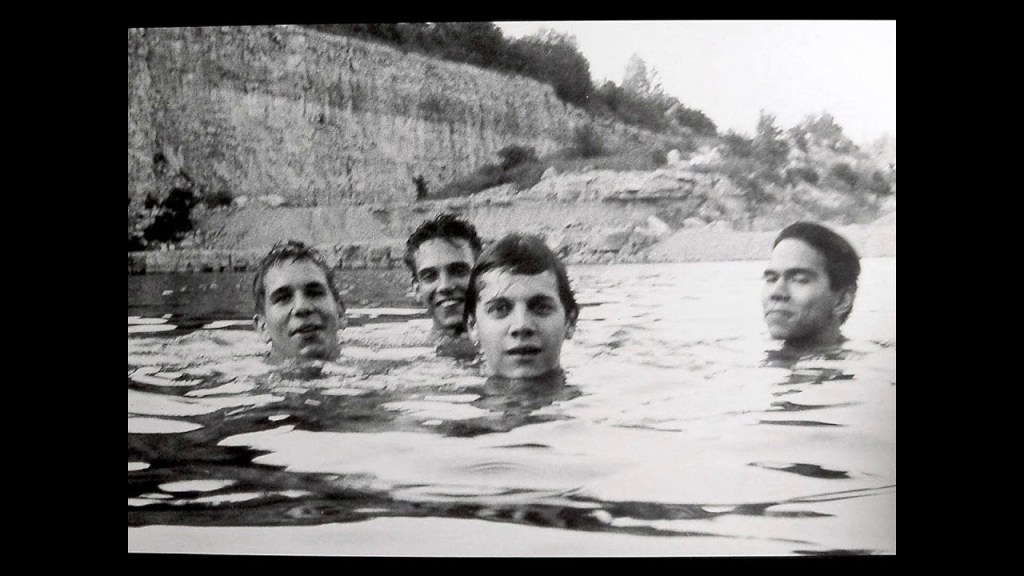
30 Years have passed since the release of Spiderland by Slint – one of the most important records for pioneering Post-Rock, for its unique melancholy takes & for its instrumental prowess thanks in part to its guitar rhythms & drumming.
In 1990, a group of young adults from Louisville, Kentucky have made a post-hardcore album that, even compared to many of its contemporaries, was notably avant-garde in its musical direction. Veering away from the aggression of its roots, the syncopated guitar lines are clean but atmospheric, the distortion effects of the guitars are more in relation with the abrupt loud-quiet dynamics like the Pixies & most of the lyrics were both narrative-driven & spoken out rather than sung or shouted. Alongside the unusual time signatures that was frequently shifted back & forth, many of the album’s characteristics have been used before, but never combined into a way where social anxiety & depression is expressed much like the band’s sophormore & final record. Little press was generated around the record, rumours arose that much of the content was inspired by a brush with death & with the deteriorating mental health of one of the musicians who checks in to a mental hospital just after the album’s completion, there is next to no commercial incentive for the record. Released a year after with the band no longer existing, it would’ve been just an unorthodox blip in the sea of obscure releases.
However, the rave review by seminal figure in the hardcore scene Steve Albini in Melody Maker where he predicted that ‘In 10 years it will be a landmark and you’ll have to scramble to buy a copy then’ would foreshadow the cataclysmic impact of the record. Fast forward to now & many would agree that Slint’s Spiderland is one of the most important records in the underground scene. Many praise it for creating a new genre entirely – some even jokes about how you could call it ‘post-everything’ for how ahead of its time it is & with the publishing of Rolling Stones’ updated 500 greatest albums of all time in 2020, the omission of Spiderland is among the biggest complaints around the wave of controversy.
Lasting just under 40 minutes, the record contains 6 tracks – each of which covers different subject matters but would eventually add to a larger entity than the sum of its parts. ‘Breadcrumb Trail’ details an intimate relationship between the narrator & a fortune teller he meets in a fair while it immediately establishes the signature accent of the musical direction of the album with its alternating time signature of the guitar tabs & a pulsating drumming pattern. ‘Nosferatu Man’ is the band at its most notably hardcore as McMahan details a seduction attempt using vampiric imageries. ‘Don, Aman’ is based around a character who enters a party but otherwise finds himself unable to connect with anyone. ‘Washer’ is perhaps the only track to have the singer actually sing which details suicidal thoughts but is blurred behind an impression of love. ‘For Dinner’ is the only instrumental track which elicits the ominous & calculated performances on the guitars & the drumming. Finally, ‘Good Morning, Captain’ stood out as the climatic ending with an iconic drumming performance from Britt Walford, lyricism that vaguely ties nostalgia, death & the passing of time together & a blistering scream from McMahan in the end that cannot be ignored – ‘I miss you!’
Although it’s seen with little attention then, the influence of Spiderland is borderline-undeniable & so many of the bands or acts would carry its strain even if they may not be aware of its existence. – almost like The Velvet Underground’s debut record. The most overt being post-rock with its lack of conventional rock structure in favour of more textures-based cohesion & especially for its build-up in crescendo to a climatic burst of sounds in ‘Good Morning, Captain’ to which we can see in giants like Tortoise’s Millions Now Living Will Never Die, Godspeed You! Black Emperor’s F#A# & as of now, an inescapable comparison with Black Country, New Road whose similar guitar & bass tabs are supported with a more overt jazz & chamber stylistics. However, its spoken-word delivery is also notable in popularising its use within the underground scene & it’s now uncommon for one’s vocal performance to be monotonic like singer Brian McMahan. The drumming is accredited as setting a standard for many in the punk scene to try & live up to & Britt Walford would eventually move on help with McMahan’s project in The For Carnation with its legacy paling in comparison to Spiderland. Beyond that, the album’s impact can be felt in many genres wherever it be the melancholy of slowcore, the frantic shifts of time signatures & complex rhythms of math rock or even just the general flexibility of indie/alternative rock.
Long after Spiderland’s release, Slint have been reunited several times with the focus on performing the cult classic. One of the guitarists in David Pajo would move on to perform in influential acts like Tortoise & as a touring member of Interpol during the early 2010s. Brian McMahan would play with a friend & notable underground artist Will ‘Bonnie “Prince” Billy’ Oldman for a while before founding The For Carnation but his catalogue continues to live under the shadow of Slint’s work. Britt Walford would perform for Kim Pine’s band in The Breeders on their debut record Pod & on their EP Safari but remains in low profile outside of his 90s’ input. Little info is known around the bassist Todd Brashear but it’s assumed that he would live an ordinary life with or without the knowledge of the album’s gigantic legacy. All members of the band have well moved past their own roots, but the web of their second & last work can be found in virtually all of the underground artists.


Leave a Reply