
This is, by and large, more of a personal article/essay compared to my other works. It’s a bit of a writing exercise as I decided to scrap the draft from my other blog, tried to go through with the Capsule Reviews for this month, and otherwise get myself more motivated. It’s inspired by the release of Grand Theft Auto VI, one that I’m not playing and will at best only follow via playthroughs for now (the price along with the union busting from developer Rockstar North are not helping). The game’s sales have already reached over $3 billion on its first day alone with many streamers playing live with thousands of views and rockeying subscriptions. It also additionally received critical acclaim from publications with perfect ratings from IGN, NME, and Gamespot. There are criticisms about the game’s interiors with its less slick gameplay and general impressions that it might be overhyped (which was not helped once again by its abrupt award nominations even before its release). It’s undeniable however that it is now a massive cultural milestone around the world.
If I am writing about Grand Theft Auto VI even though I have never played the game myself, why would I do so? I can say at least that I have played previous installments in the franchise but it’s otherwise irrelevant to what I want to look into. What I want to talk about really is Dota 2, a massive online battle arena (abbreviated as MOBA) game by Valve Software which is an esports staple since its 2011 release. It’s a game that takes up a good portion of my free time (as in, I have over 5000 hours at the time of writing) whenever I am not preoccupied with checking out noteworthy music albums. It’s also the game that got me interested in esports which then intersects into other competitive games and even other parts of entertainment as a whole. And now it is a game that leaves me yearning over its cultural relevance and gradual ageing among its most loyal demographics.
To get you to understand my relationship with the game, I’ll need to break down the premise and the gameplay behind Dota 2 that makes for an engaging game. You play as one of over 100 characters called a hero, who has a mostly distinct array of abilities and can grow stronger over the course of the game by levelling up and buying items, in a team of five with the goal of destroying the enemy team’s base called the ancient. To progress, you need to destroy the enemy team’s towers with help from unplayable entities called creeps in a lane. The enemy team has the same goal and will thus also destroy towers to target your ancient in the process. The difference in abilities between the heroes which fits into the lineup of five gives incentive to synergy, teamwork, and decision-making as you deal with certain power spikes and emergent situations with regard to certain items or other objectives being achieved in the map.
I once wrote an article in this very blog when I started to try and experiment with its intent beyond writing elaborate music reviews and retrospectives around four years ago. It’s essentially a piece that I tried to make to get the attention of a publication based around esports although I didn’t receive any feedback from them. It’s not the one I feel the most comfortable writing about admittedly speaking and it’s a project that I now look back on as being a laborious kind I wouldn’t have a lot of pride in creating. Especially problematic knowing that I am a kind of writer who can get too caught up in motivation issues and who is easily prone to being caught up in the nuances to try and make it the best it can possibly be. It is at its heart a letter of gratitude to the competitive scene I was into even if it could’ve been better.
These days, the relationship I have with Dota 2 fee;s more on-and-off. I got into horse racing thanks to a certain gacha game that totally has nothing to do with it under any capacity whatsoever and even have another blog dedicated to it although I do admit to having struggled with replicating the past levels of productivity I initially had when I first got it online in April of this year. I got a job where I tend to work on a weekday which leaves me more interested in power fantasies whenever I’m gaming as I suck myself more into in-depth music and gaming posts that aren’t just retrospectives or reviews. And while one might enjoy the thrill of jeering at the heat of the moment, it wears out its welcome and renders you all too bitter an individual at best. It’s fair to say that I’m changing to the point where one of the foundational games of my interests are fading out of sight.
And the most bittersweet part about the failing love I have for the game rests in its competitive scene. To grow up with it offers the hyperbolic feeling of seeing its rise to the top of the world as one of the defining games of the decade only to bear witness to its decline as the name to fawn over. Its rivals like League of Legends outlast it in being the cornerstone of its genre, its neighbour in Counter-Strike succeeds it as its developer’s main competitive honeypot, and now its creator in the anonymous Icefrog may soon secede from it with his new passion project Deadlock. The longest shot for the most bitter comparison would be the game of the century candidate in Minecraft; its casual appeal and more accessible gameplay contrasts with its astonishingly vibrant array of competitions be it player-versus-player, speedruns, or building elaborate architectural works.
Note that I use “competitive” over esports in talking about Dota 2 over the technicality of the terms. For me to use “competitive” allows for a broader conversation surrounding the game outside of its mainstream tournaments (which I’ll get to later on) namely by looking into its leaderboards as well as amateur tournaments for aspiring professional players. To use “esports” is to put pressure on defining the game by its most notable tournaments and players with the latter having a minor crisis over how a lot of them are usually introverted douchebags. And while that would make for a public relations nightmare, it feels secondary in scope compared to the precedent set by its biggest tournaments in promoting the game.
The game’s premier tournament in the International used to stand out through its ballooning prize pool that’s funded by the community through in-game purchases. From its inaugural hosting during the game’s early access phase in 2011 until 2021 (ignoring its cancellation in 2020 due to the COVID pandemic), its prize pool was consecutively known as the biggest in the world up to its peak at $40 million before reworks that officially put an end to its goal of surpassing every time. This garnered numerous media coverages with one example being an Ars Technica piece on the 2016 iteration hyping it up as among the best as well as the 2020 ESPN article on the record prize pool for the cancelled iteration (it’s carried to next year). The site called Esports Earnings highlights the reputation with its frequent topping of its record crowdfunding with its iterations making up eight out of 10 highest prize pools in the chart.
Dota 2 yet sees its interest stagnate as the key demographic interested in it becomes more concentrated and its playerbase starts to err towards the older quartile. There is a major decline in its standing as a mainstream staple. As early as 2024, a Forbes article was written which notes its growing obscurity even as it remains the cornerstone of the game’s community. The average age of a professional player in the International back in 2012 was 22 years and 24 days old with the gradual uptick over the years to 23 years and 210 days in 2019. The 2026 iteration shows the average age go up to 26 years and 44 days with the youngest team based on their average age, Team Spirit, being only two months younger than the mentioned 2019 International pro player. This suggests the growing playerbase with the younger generations joining the game in small numbers. And with viewership, much of the views are concentrated around Russian channels that occupy the top five both in terms of peak viewers and on average over the course of this month (November at the time of writing).
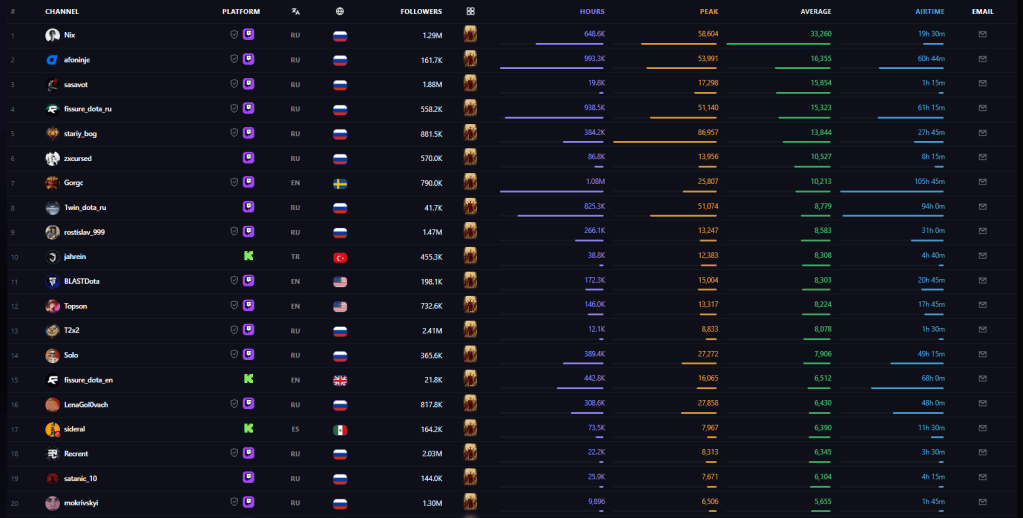
The Covid pandemic has served as the final nail to the coffin towards consecrating esports toward widespread interest as young people, already well-acquainted with using the internet as a big part of their lives, are starting to follow their games’ competitive scene en-masse. Dota 2 struggled to maximise it even with the International reaching record views. From 2017 to 2019, the game went from lagging behind Counter-Strike by 400K in terms of peak viewers to being ahead by 700K. From 2024 to 2026, Dota 2 went from being behind Counter-Strike by 300K to being behind by 950K. It didn’t explode as much as fans would have liked and a Cyberscore article on the game’s slow growth attributes it to Valve’s growing disinterest in managing the game alongside the meta being homogenised which disincentivised unique playstyle. All the while it remained under the shadows of League of Legends where its view counts tend to be double or even triple in comparison.
I tried to get back into the game over the past few months, playing with my older cousin and his friend group as we made an attempt to climb up the online matchmaking system. While the thrill of winning a match remains, almost everything else about the game comes off as lacking. The general game etiquette where you need to play the entirety of the match with the punishment of abandoning it, regardless of the game mode, makes for a miserably addictive mechanic where it feels more like an obligation than it does a hobby. The growing array of game mechanics to spice up the longevity also means that you’ll need to keep yourself invested in the game even if you have to relearn it as you need to keep in mind the reworks, additions, and even removals over the aspects. And this ignores the implications in power creeping or certain heroes being virtually unusable in all but the most niche of scenarios.
There are also ways in which the new events (which include a collaboration with Monster Hunter) have sought to entice people with the possibility of winning the rarest cosmetics called the Arcana. It’s a motivational aspect to get players to commit themselves to the game in order to fish out a few rewards. However, when you take into consideration the aforementioned mechanics that forced you to finish the game in its entirety on top of the demanding changes, the payoff comes off as faded. It’s the main reason why I reentered Dota 2 only to be reminded that to invest my efforts into the game again to get the rewards will only drain me. After all, I did spend thousands of hours into it and while it’s an undoubtedly fun experience, it is one that I find to have overstayed its welcome. I am getting old.
Aside from Dota 2, I spend a portion of my gaming time on other entries. I have a childhood favourite in Warcraft III that I periodically visited (and of which Dota’s very first incarnation was made from via its in-built World Editor). There is another game in Disco Elysium that I have written several posts here on as an example of a title with considerable artistic analysis. Aside from the wink-wink-nudge reference to Umamusume right at the beginning, I also played Genshin Impact and Honkai Star Rail as the other gacha games for a good while although I have moved on from them both along with my online friends. There’s also Minecraft for another mainstream title with its sandbox elements and iconic graphics. Among the other games I have played include System Shock 2, the Elder Scrolls V: Skyrim, Fallout: New Vegas, Team Fortress 2, and Democracy 4.
So why did Dota 2 stick out from the rest in particular? It’s the game that I have both sunk a lot of time into even if it’s between playing bot games on my own and raging at imperfect moves in online matches that remind me of my mediocrity. It’s the game that got me interested in competitive gaming and led me to become hooked on its esports scene up to this day even if it recently became more periodical. It’s the game that made me realise that there’s an art in multiplayer games that makes for a frustrating, toxic, beautiful, and awesome experience. Now, it’s the game that got me to acknowledge that interests that last a lifetime can exist only in a handful between individuals. And it’s the game that I bear witness to seeing its weathering to be niche outside of the post-Soviet countries.
There is a documentary last year which tackles the winner of the International in Team Falcons which was produced by the esports organisation’s media team. The roster’s mixture of young talents in Stanislav “Malr1ne” Potorak and Ammar “ATF” Al-Assaf meshed well with the veterans in Oliver “skiter” Lepko, Andreas “Cr1t-” Nielsen, and Jingjun “Sneyking” Wu to being recognised as one of the favourites. Valve’s own production in True Sight, centering around the grand final of the International, had been discontinued in 2021 following Team Spirit’s win which leaves the game’s top teams to host their own vlogs to record their journeys throughout a successful tournament run. There is a big shadow looming over the qualities of the films especially given that the 2018 True Sight iteration is beloved for its storyline on the ragtag gang context surrounding the winner in OG whose roster was made in response to a dramatic change.
If you watch Team Falcon’s documentary, there aren’t many details surrounding the subtext over the players’ backstory and the significance of the tournament to them. There’s the insight into their communications, the choices made, and the pre-game preparations for sure. However, you rarely get to see the individual rationales for what makes the game especially important to their lives and the tribulations taken to win the International. You don’t get to hear about Cr1t-’s opinion as an experienced player who has yet to win the cornerstone tournament despite playing at the top for over a decade at the time. And you wouldn’t know of ATF’s and Malr1ne’s investments in the game from the video unless you watch the other contents featuring them.
Perhaps the most daunting feeling however lies not in the winning organisation’s documentary; they are incentivised to portray the difficulty of their journey to make their victory look more well-earned after all. It lies in those who play professionally at the top for a long time only to find the fabled glory slip almost every time. One of the 2025 runner-up Xtreme Gaming’s players, Wang “Ame” Chunyu, has been active since 2015 with the epithet of the “Uncrowned King” for his numerous runner-up placements in the International over the course of his career. His home country of China was once at the top of the scene back in the 2010s with three wins over the seminal tournament along with being a leader in making innovative strategies.
Yet, China’s scene is plagued with an especially older playerbase with the high average age of 27 years old in a big qualifier for the upcoming DreamLeague tournament. It also suffers from rampant match-fixing with several players banned following an investigation as recently as 2025. There’s a lot of symbolic weight on Xtreme Gaming’s shoulders to win the International to put Dota 2 back into national spotlight even if it’s just for a brief moment over Ame finally being able to claim glory on the biggest stage. The failure to do so, combined with how this year saw all Chinese teams be eliminated before the main event, leaves the country’s future bleak over whether it’s able to even remain as its own categorised region due to its less competitive state. Chances are high that Ame will retire without the win as his country fades along with much of the game’s future appeal. And that’s what struck me.
For every We Got It from Here… Thank You 4 Your Service from A Tribe Called Quest, you get an Infinite from Mobb Deep. For every emphatic win for closure from the likes of Toni Kroos, you get the likes of Stan Collymore whose talents never culminated to a glorious climax. Even established names, my example being renowned jazz singer Nina Simone, would have had their perfect career ending with the 1976 cover of ‘Stars’ only to carry on with a forgettable second half of their discography. Much as we dreamed of our heroes and idols’ denouement to be respectful to their legacy, the chances of it actually happening is infinitesimally small.
And for a game like Dota 2 and a player like Ame, it reflects back at me that one of the most integral parts of my life will close not in a bang, but with a whimper. I would like to imagine a kind of closure with the game that feels like I can move on before it quietens down to an end-of-service maintenance mode. That would be a Chinese team winning the International once again or a new face from other regions like Southeast Asia or South America finally snagging the win. I would love an event to arise that hones in on attracting newcomers so that there are at least fresh names from around the world who would play competitively in the next few years. I wish that there’s a one-off comic that acknowledges that the game is past its prime as a thank-you letter to its most loyal players much in the same way that Team Fortress 2 had shown with its final comic. But that’s the kind of thinking that exists in a fantasy. I could only move on from the game sooner or later. The same goes with the many who played it over the past 15 years.


Leave a Reply