
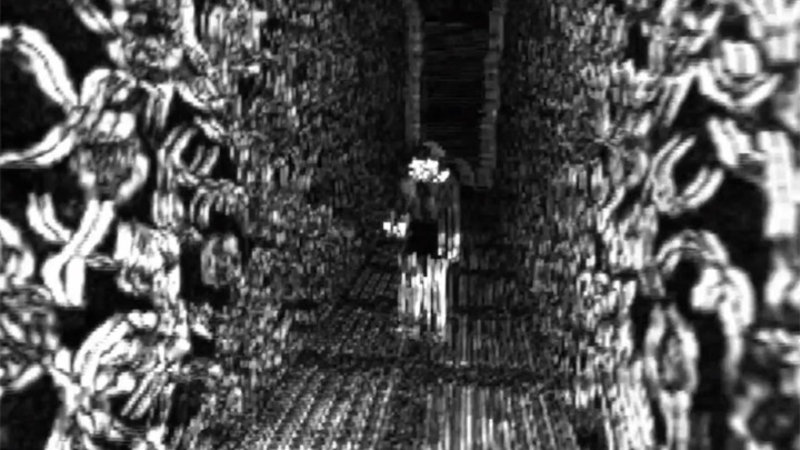
There are many web horror games that deal with grim subject matters, objectionable images, and eerie ambience. What’s the deal with them?
CONTENT WARNING: THIS POST DEALS WITH THEMES OF CHILD ABUSE (ESPECIALLY SEXUAL), PAEDOPHILIA, RAPE, AND GRAPHIC VIOLENCE. PLEASE READ WITH CAUTION WITH THIS IN MIND.
In 2015, an obscure game was made known from the deep corners of the web titled Sad Satan thanks to a purported playthrough of it by the YouTube channel called Obscure Horror Corner. It’s seemingly made by the anonymous user “ZK” with a minimalistic gameplay that involves walking through corridors and empty rooms. Meanwhile, surreal, distorted samples play in combination with photos of serial killers and child abusers as you progress through the game until you eventually die when a child-like character comes in contact with you. Rumours surrounding the original build was nothing short of scandalous due to its graphic images and even child sexual abuse materials coming in circulation. Thank goodness I have never played the game nor do I ever intend tol.
Sad Satan seems to have the appeal in that its grim topics and obscurated origins make for an enticing inspiration for edgy clones. For one example, you have murd311 which seems to be about helping a person who was obsessed with making flesh puppets. Much like Sad Satan, it has a minimalistic gameplay which functions more like a point-and-click adventure that lasts under 10 minutes along with traumatic “autopsies” (read: graphic jumpscares) that could only be found in the most wretched abscesses of a Torr search result. In its disturbed premise however comes a dull execution with how dependent it is on shock value in addition to the viruses you would have downloaded if your morbid curiosity compels you to get the game. I would not recommend it at all.
Another example is praise.se which similarly deals with helping another child from their abusive aunt as well as their mother although in this case, the twist is that you need to find said child’s body. The gameplay there is more like Sad Satan with a broad plotline and a utilisation of metanarrative progression where you need to open the game multiple times to proceed through it. It frequently closes whenever you reach a key section of the game’s story which pushes you to re-open it in its short playtime of roughly 10 minutes. This in turn makes for a slightly engaging instance of the medium as an art form as you find yourself more involved with the game even if it is lacking in the mechanics department.
I would very much like to credit the YouTube channel NostalgiaWind for uploading the videos of their playthrough of the two games. You would (and ideally should) hope that they take the precautions of ensuring that their computer isn’t filled with malware to say the least on top of being aware of the ethical and legal implications of what they willingly and knowingly downloaded. What I do need to preface, and this is not to disparage the channel, is that the games are ultimately made in reaction to Sad Satan. I do not mean that in the sense that they’re inspired by the original game, but more so in the sense that they try to capitalise on the mythology that surrounds it.
There is a subreddit dedicated to Sad Satan that tries to document what users know of the game both with disgust and fascination at its abstract premise outside of a broad theme of child abuse. Anecdotes, screenshots, and images are taken to this day of their attempts to experience the game with comments from others and even pinned posts by the mod team to dissuade actually finding it for themselves. Because the history surrounding it rests strongly in how unknown it is, it invites speculation. You might at least have both the conscience and the self-control to not seek the game out, but the fact that it’s so fucked up in its nature means that you will always be drawn to whether there’s a deeper meaning to it.
And that’s the appeal that murd311 and praise.se are both going for. The three games are dependent on explicitly graphic pictures of real-life violence that culminates in dismemberment to get you to feel as though your guts could retch at any moment. They gravitate around samples originating from said violence or associated acts to disturb or unnerve the player. And yet they all share the same themes that push into taboo territories which is an un-innocuous interest in children and the many ways in which they could be abused. The sensitivity of tackling child abuse at its plainest and most banal gives the original game and its copycats the appeal that is hard to ignore the same way that book readers would feel enticed by the controversial nature of Vladimir Nabokov’s Lolita. You can condemn the glorification of criminals in most Grand Theft Auto entries, but it’s hard to not feel the thrill of running over pedestrians and getting into gunfights with anything that moves.
The shock value thus demands that there is more to the games owing to their audacity, that there should be a deeper meaning behind the horrific sighting. Its hollow background however, due to its exclusive access via internet as well as with its inability to hint at why its images were picked out, leaves little room for any good-faith interpretation outside of edginess or worse. There are no texts or materials from “ZK” that sought to describe Sad Satan’s thematic intent. murd311 didn’t elaborate on the protagonist’s obsession with flesh puppets nor is it curious enough to wonder why they’re into it or even what at interest suggests on a psychological basis. And praise.se shows no interest in exploring what would have been a fascinating insight into the relationship between authoritarianism and child abuse especially in the abuser is well-regarded in their community.
The games thus are best described as having no meaning at least on the basis of authorial intent. The “Death of the Author” arguments to substantiate the artistic implications aren’t so much an individualist option as they are a necessity to guarantee their texts’ cultural longevity. And those who did write, record, or commentate on their experiences are otherwise disappointed at how shallow the games are (one example being a Sad Satan review). The following that they have managed to grow are more intent on mythologising or analysing them beyond the established bit of information we know of about them. You can only do so much to evaluate the games that are devoid of context even in the realm of how they’re distributed if we do not know of the creator and any broad backgrounds surrounding them. Otherwise, you might as well try and decrypt the message even if it’s all just shit in the end.
There are many other controversial games that deal with taboo subject matters from different decades. There are some like 1986’s 177 where you play as a Japanese man trying to rape a young woman walking home from an outing are subjected not only to cult followings for its overt exploration of illegal acts, but also enjoyed analysis over its background and its implications regarding its setting. I recommend reading a piece by Joey Wawzonek from the Stacks which examines the game’s role in shining a light on Japan’s crisis with its cultural views around sex and its lack of interest in tackling systemic misogyny that’s enforced by sexual violence. It does come off as being offtopic at first in relation to the three games that I am talking about, but the crucial point is that there’s substance to be drawn once you are aware of the background surrounding the texts.
Thus, there is little to talk about Sad Satan and its copycats as it functions to its best only in relation to its first impression. You walk through the corridors or some abstract space, reach what seems to be the destination, and then you get a big jumpscare with some of the most disturbing images you’ve ever seen. You then try to progress through it only for it to either be finished sooner than you realised or you end up dying in the process. You try to connect the dots around it, but there is no manual or text that you can go to in order to decipher the themes in a way that is coherent. All you have are the nausea at the sight of the images along with the guilt that one or two of such are illegal sightings for a good reason.
So why are we drawn to the games if they don’t have any meaning or intent? I guess the answer for the most part lies in that they are disgusting the same way that seeing an iconic Vietnam War photo of an execution is disgusting. It’s an invitation for us to express our disapproval even though our curiosity has led us into seeing the debacle. There’s a self-destructive loop in revolting at the sight of the spectacle almost to the point where the act seems enjoyable. There’s a relevant recent paper by Reginald Adams Jr., Brian Xu, and Katharine Adams which tackles the seeming correlation between our negative feelings and our pleasure from it. The ways in which it highlights our tendency to have cognitive dissonance and the implication that we turn to black comedy to relieve ourselves from the grim implications of the subject matter (see p.4) illuminates Sad Satan’s role within niche online culture. We’re drawn to it not necessarily because of some reductionist assumption that we have a depraved essence within us, but because it’s an innate survival mechanism that now subsides to thrill-seeking.
The manifestation of our morbid curiosity and subsequent entertainment was utilised and is still used to this day to push forward messages regarding issues that the creators want to flag up on. For audio albums which relates to one of my main interests in music, there’s a 1992 documentary Buyer’s Market by Peter Sotos which deals with victims of sexual abuse with many having experienced such since they were at a young age. Its transgressive themes which are typical of its artist (who was charged for possessing CSAM in 1985 due to his zine works) mirror the bubbling interest in true crime since the 1980s. Non-horror video games like Spec Ops: The Line flips the conventions of a first-person shooter narrative in its head to convey a metatextual critique of American expansionism and the trending popularity of militarism as a broad theme upon its release in 2009.
Sad Satan’s discovery in 2015 in conjunction with its clones following its provocations soon after fuels the temptation that it has meaning in relation to its context. After all, the year marked the point when Donald Trump announced his run for presidency in the United States while a handful of publications started to shine a light on his relationship with sex offender Jeffrey Epstein. Online forums that took pride in its anonymity like 4Chan and Kiwi Farms made and popularised memes like Pedobear, shared CSAM with virtually no consequences, and otherwise harassed people they perceive as “lolcows”. 4Chan especially was the site that Sad Satan was purported to be first found.
That the game was published during what many would describe as the tail end of the “Wild West” era of the internet with the political rise of Trump led credence to its speculated evaluation on child abuse. The game could have been about the exploitation of children and the systemic methods that allow it to flourish for way too long. After all, among the less graphic images include notorious sex offender Jimmy Savile with British Prime Minister Margaret Thatcher during the early 1980s as well as a 1989 mugshot of serial killer Tsutomu Miyazaki who targeted prepubescent young girls. There are also images of religious movements as well which could allude to how religious authorities can use their position to prey on children.
Of course, the vagueness and lack of clarification around the game’s intent leaves no room for confirming or making a compelling case that it’s supposed to condemn child abuse under a provocative manner. All we have instead are just speculations. I can’t simply repeat the fact that the game is at best just an edgy experiment meant to lure people in to revile at its subject matters, but the senselessness of its content gives credence to theory-making as a core component of it as entertainment. There are Reddit posts after all which try to look into “ZK”, the player character in the game, and the significance behind the name itself which is periodically published up to this day.
Sad Satan thrives on controversy to appeal to the deepest of our primacies. It tries to make itself stand above other horror games for its portrayals of evils especially over child abuse. And it seeks to shield itself from both legal persecution and critical scrutiny by relying entirely on its access being from the deep web while its creator remains anonymous. However, it is within its ambiguity that leaves only the first point as the integral part of its appeal. murd311 and praise.se too followed through on that where their contexts are abstract to the point of discouraging serious analysis aside from the time of when it’s been published. There are only nightmares there for us to chase after, but it only exists as long as we give value to it.


Leave a Reply