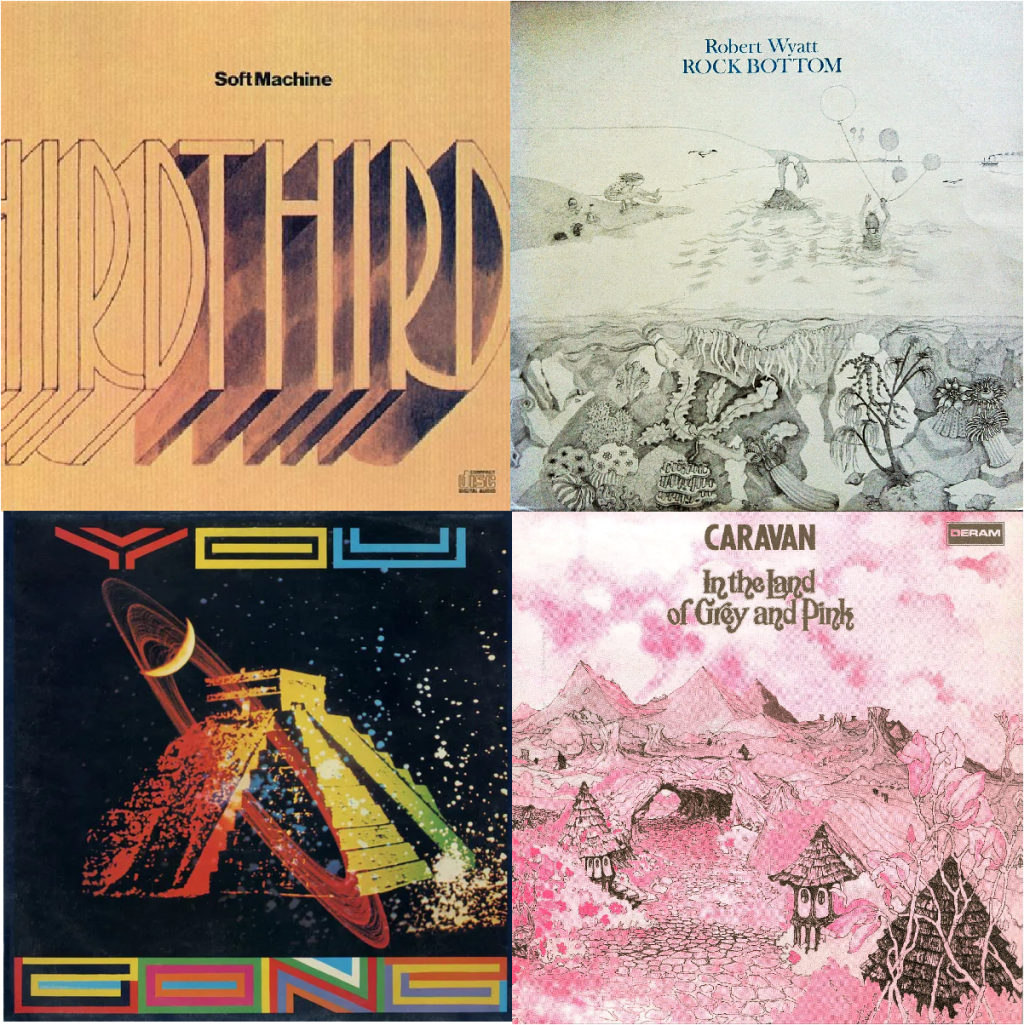
- Rock Bottom – Robert Wyatt (1974) (PERHAPS THE MOST NOTABLE CANTERBURY MUSIC ALBUM FOR ITS LITERARE LYRICISM & IDENTIFIABLE EXPERIMENTATION WITH SYNTHS)
- You – Gong (1974)
- In the Land of Grey and Pink – Caravan (1971) (EXEMPLIFIES THE PSYCHEDELIC SIDE OF THE CANTERBURY SCENE WHICH GRANTS THE BAND CONSIDERABLE ACCLAIM)
- Space Shanty – Khan (1972)
- Of Queues and Cures – National Health (1978)
- Hopper Tunity Box – Hugh Hopper (1977)
- Third – Soft Machine (1970) (MARKS THE MILESTONE FOR THE SCENE TO BECOME A NOTABLE PROG-ROCK SUBGENRE WITH ITS LARGELY IMPROVISATIONAL INSTRUMENTATION)
- Whatsevershebringswesing – Kevin Ayers (1971)
- The Rotters’ Club – Hatfield and the North (1975)
Canterbury is a quiet city in the UK, but it’s one that always find itself be tied in to history. As the namesake pilgrimage spot in Geoffrey Chaucer’s Canterbury Tales around 1400, the cathedral city see a lot of tourists coming in to take a look at the landmarks & experience the local culture. What seems to be overlooked by the wider audience is that the city is once the melting pot for ambitious musicians to work together & push progressive rock to its core – by implementing a lot of jazz & a lot of psychedelic fanciness. In the mid-60s to the late-70s, the city is home to some of the most well-balanced mix between jazz-like instrumentals & futuristic effects. That is, if the artists feel like the name is suitable that is.
While you would often hear of other names around different acts like National Health or Hatfield and the North, there tends to be one prominent act that embodies the subgenre especially in the 60s-70s. The Wilde Flowers is the first ever band to be associated with the Canterbury scene & is made up largely of artists who dabble in psychedelic rock & rhythm & blues. Although they haven’t released any studio album in their three-year run, the former members would move on to establish their own group with their own traits. One band is called Caravan that follows the psychedelic craze in the US & the UK while the other is Soft Machine, having initially followed the same path as their contemporary before embarking on a vastly different path that is more in tune with the zaniness of jazz.
This leads to a small, yet fundamental, string of releases in the early 1970s when Caravan’s In the Land of Grey and Pink and the Soft Machine’s Third is released in 1971 and 1970 respectively. Pushing the two key aspects in the Canterbury scene’s characteristics in psychedelia and jazz to its most prevalent, the impact around the 2 records have left a big impression. Many prog-rock bands starting to include more jazz-like compositions & a more ethereal studio production to try & replicate the similar level of effect that the two records have offered. Needless to say, most of the records struggle to live up to the reputation nor the attention that Caravan & the Soft Machine had earned on their own merits. Maybe the answer to do with how fun it is. According to websites like udiscovermusic, critics have noted that despite the vast scope that the records tend to have, it’s otherwise still obedient to the pop sensibility & by extension, it doesn’t take itself too seriously.
Although the 2 albums does succeed in putting the subgenre into the hemisphere of prog-rock, the Soft Machine does end up chipping away with the former members going on to leave their mark. Prior to Third, bassist Kevin Ayers left the group after their self-titled debut was made in 1968 & by 1972, drummer & occasional lead singer Robert Wyatt left the band as well to embark on a solo career after being left disabled from a window incident. Ayers have enjoyed some acclaim for his works & in his obituary in the Guardian, he’s even hailed as being among the most important figures in British pop music alongside Syd Barrett. Robert Wyatt, on the other hand, ends up carving up a lot of recognition for himself as an artist within the scene with Rock Bottom, his first album post-Soft Machine in 1974, becoming a cornerstone of the subgenre. With Pitchfork placing the record amongst the top 100 in the 70s in 2004, Robert Wyatt had all but cemented himself as being among the finest singer-songwriter in Britain thanks to both his accessibly witty lyricism & his willingness to branch out into new territories. Meanwhile, acts like Gong have been founded outside of the UK even, but their sound is so similar to that of Canterbury’s due to a principal member (Daevid Allen) being a part of Soft Machine that they’re thrown into the pack as well.
As the 60s is marked by a lot of interest in bringing fantasy & science fiction to the wider audience, you always hear about the likes of Doctor Who or Star Trek exploding in popularity. Tolkien’s innovative take on mystical worlds & creatures had left an impression on mainstream entertainment that many artists would often try to create fictional universes in their songwriting to mimic the otherworldly sensation. Mix that with the uneasiness that comes with the Cold War & it’s not far-fetched to assume that the Canterbury scene does serve as an underground escapist route to take a listen to. Thus, space rock ends up becoming an influence in the scene & bands like Khan have made use of it in their music which leads to a niche following being carved out. They might not be the biggest name in the world, but they’re definitely among the most unique in a sense that their sound is more out of a sci-fi concept than it is rooted in the sense of mythology.
Like a lot of scenes that tend to revolve around close-knitted communities like no-wave in New York, the Canterbury scene finds its idiosyncratic identity be toned down as the progressive hype died down. Following a few more strings of notable albums from the likes of ex-Soft Machine member Hugh Hopper, the scene ends up quieting down to a whimper ever since the 80s strung along. Maybe it’s to do with how the bands there had not receive any attention from the city (ironically enough according to Calyx) since Canterbury isn’t as regarded for its music scene as Liverpool or Cardiff. Members like Wyatt finds the label to be misleading as he’s born elsewhere & had started his career elsewhere before finding success with the Wilde Flowers or for Hugh Hopper, it’s just journalist jargon that means nothing when asked about its definition.
Perhaps, like many scenes at the time, it eventually mellow out into a subtle influence of bigger trends like Britpop in the 90s. In hindsight, it’s hard to listen to the wittiness of Pulp in their hey-day, the eloquence of Belle & Sebastian, or the majesty of the Divine Comedy without thinking about the Canterbury scene. The attempt to balance out the eccentricity of psychedelia & jazz with genuinely pleasurable tunes to listen to is easier said than done for the most part, but the bands, for the most part, had succeeded in that.
Will we see another scene like that of Canterbury’s? The Windmill in Brixton had garnered attention since the 2010s for being the go-to venue for experimental post-punk bands, yet their sounds tend to not be catchy enough for others to enjoy. You do have the post-punk revival a decade early, but it’s been dismissed as a landfill of Arctic Monkeys knock-off with only a 1-hit wonder in their belt. Now? We might see a small trend of bands who opt to go post-rock with varying takes on what to make of the textures, the timbres, or the atmosphere. Nevertheless, they might have struggled a bit in capturing the certain magic that’s comparable to what had happened in Canterbury back in the 1970s.
 GutterPutter
Leave a reply to ‘I Just Want to Sell Out My Funeral’: How the Wonder Years Resonate With the Lost Generation – GutterPutter Cancel reply