
CONTENT WARNING: CONTAINS A SMALL REFERENCE TO SELF-HARM, CHILD ABUSE, & SUBSTANCE ABUSE. PLEASE PROCEED WITH CAUTION.
This will be the last chapter in this rather big project that I’ve been doing ever since back in April. The genre of Emo, if you’re interested in the details surrounding its history & its development as a part of popular music, is available at its entirety within this very blog. I will provide the links to it by the end of the introduction, but this is effectively a huge milestone as I tend to do a lot of research in & while it may not have been the most notable in terms with views, it’s one that I take a lot of pride in. This part will prove to be no exception as I will continue with a lot of research on the numerous subgenres, there will be a list of albums that could be of worthwhile interest to anyone who wanted to take a listen to any of them, & I will also try to do a historicist argument on why the genre resonates to many people. It might be a stretch, but it’s one that could prove itself to be fun when you think about it.
So, what is there to talk about in the 2010s? Emo might not reign as being one of the biggest trends in popular music, but that doesn’t mean to say that there’s no room for it to thrive. By letting go of the commercial focus that paves the way towards its derivative-based downfall, the genre can find new areas around its surrounding to make its course. Split in two ways between rock’s decline in popularity with hip hop & electro-pop taking the lead in the first half & the divisiveness of the genre’s originating country of the U.S in the second half, there lies a whole lot of opportunity for emo to take its course. The 2010s in general is identified by some of the most vocal calls for social changes for the sake of the collective with movements like #MeToo being used to put the need for security for the oppressed. Suffice to say, the genre can easily be affected by the movements from there on both ends with some bands enjoying a wreath of acclaim for their consciousness while others end up going on hiatuses or have even disbanded over the accusations.
The adolescent/young adult demographic that emo sees its most voracious fans in sees a newfound desire for diversity not only regarding genre experimentation, but more broadly with representation from non-Caucasian ethnicities to sexual/gender identities. Suddenly, the inner-geek drive that is so often chained with the stereotypical nerd in the 1980s-2000s now forms the common humanity in everyone. Finally, the ascension of the internet into not just being the necessity of everyday living but being essentially a door to a double life for many of the younger generations have poured in more details surrounding one’s private life – often to a grossly deep level.
& what are the results that stem from all of them together? A seed for emo to not so much restart from its dwindling popularity in the 2000s as it is a chance for it to reach new sonic horizons & branch out into new territories. Rapping proves itself to be as invaluable a medium to project one’s turmoil as a guitar does & through the likes of the Brave Little Abacus, there lies a need to put as much weight over the musical content as one does in the sincerity of their lyrics. That doesn’t mean to eschew the post-hardcore/alternative rock roots entirely as we’ll see later in the article; there’ll be plenty of examples that find its roots in American Football, Brand New, &c. However, expect several parts of this article to dedicate itself to emo rap & how the weight placed on emotional turmoil sets in within other genres.
Part 1 for emo – https://gutterputter.wordpress.com/2021/04/06/under-the-label-emo-part-1-beginnings/
Part 2 for emo – https://gutterputter.wordpress.com/2021/08/11/under-the-label-emo-part-2-mainstream-breakthrough-underground-flourishings/
Part 1: Taking Shots on Your Own – The Rise of Emo Rap.
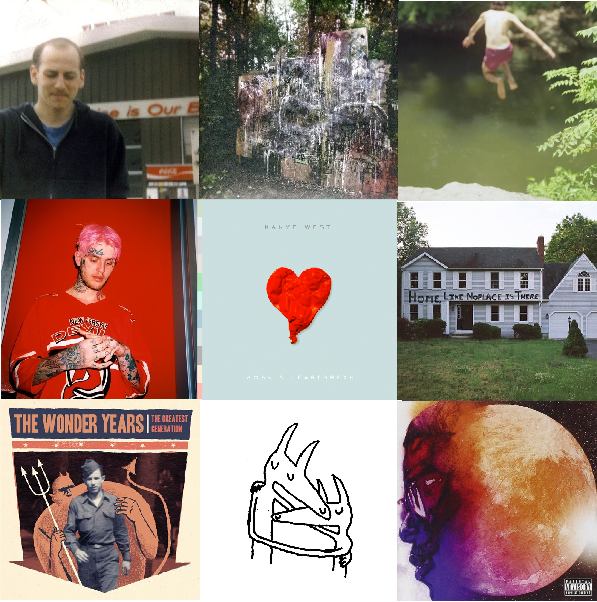
- 808s & Heartbreak – Kanye West (2008) (FOUND MIXED REACTIONS ON RELEASE, BUT RECEIVES ACCLAIM NOW FOR BEING THE BLUEPRINT OF EMO RAP)
- Man on the Moon: The End of Days – Kid Cudi (2009) (SIMILAR TO KANYE, SEES ITS REPUTATION CLIMB UP OVER THE NEXT DECADE TO HELP ESTABLISH THE GROUNDWORK OF EMO RAP)
- Scumbag – Bones (2013)
- Shuv These Colors Up Your Anus – Syringe (2015)
- Hellboy – Lil Peep (2016) (CONSIDERED TO BE THE KILLER RELEASE OF THE GENRE & IS NOW HAILED BY FANS AS BEING THE STAR RECORD)
- Crybaby – Lil Peep (2016)
- Eversince – Bladee (2016)
- ? – XXXtentaction (2018)
- Goodbye & Good Riddance – Juice Wrld (2018)
Rock always finds its way to cross over with hip hop ever since the 1980s with the Beastie Boys sampling the classic rock hits for the driving instrumentation of their songs. While such attempt at its use tend to yield varying results, there are sightings of emo being used as one of the examples of the rap rock hybrid. Until the early 2010s, samples & covers of it is used without any questions as to wherever emo can be fully incorporated into hip hop to the point of being acknowledged as a distinct subgenre on its own. You can see some remixes done to emo pop or pop punk bands like Fall Out Boys, but that doesn’t mean to imply that it’s emo rap. It’s just a palette of urban beats being mixed into rock songs regardless of how others would react to it.
There are however certain key aspects of emo rap that would find its footing in the late 2000s. Kanye West released 808s & Heartbreak in 2008 which, rather than being into rapping like his last LP before, sees a more melodic approach where he would focus more on singing with autotune. The beats is also more inspired by R&B & electropop to the point where one might well categorise the whole album as being such rather than hip hop. Most importantly however, many of the album sees Kanye dive into his most honest & vulnerable moments lyrically as the album is inspired both by his mother’s passing & his breakup with his fiance then. The left turn is so abrupt that many react to it with reservations on its release with only a positive 75 on Metacritic then.
Meanwhile, producer of the album Kid Cudi released Man on the Moon: The End of Days on 2009, just a year after Kanye’s. While the critical reception to it is simply positive, it shares many of the same traits as 808s through its introspective, personal lyrics that describe feelings of self-loathing & trauma from past events over a more melodic direction from its chorus. In addition, its aversion to the benefits of fame & its synth within the beats would help to predate the typical trap layout for many of the records afterwards. With hit songs like ‘Day ‘N’ Nite’, Man on the Moon would follow its mentor’s footstep in providing a way for a new type of hip hop to rise without the egocentrism or its materialist desires… which might take a while before it does hit the mainstream in all its weight on it.
Of course, sightings of emo rap at its fullest can be first found around 2012 when cloud rap & trap is on the rise to shift hip hop towards a clearer electronic direction than ever with rappers like Elmo ‘Bones’ Kennedy O’Connor releasing mixtapes like Scumbag with little attention. One can see that upon listening to it for the first time, there’s a lot of characteristics that derived from Kanye’s release like the electronic beats, more emphasis placed on singing, a confessional outlook on life, & a sense of introversion compared to many of its contemporaries.
However, many of the prototypical work blends in as being just a sample piece within underground rap until 2016 when a tsunami starts to hit hard. You have rappers like XXXtentaction, Bladee, & Juice Wrld who finds their fame & fortune to rocket shoot to astronomical lengths. A special shoutout can be given to Lil Peep whose rapid climb to prominence comes down to a streak of successful mixtapes with Hellboy being the straw that broke the camel’s back with its trap-based beats & his lyrics being around his struggle with his drug addiction & depression. Reactions around his work is enthusiastic as while it’s hard to execute confessional songwriting with a more modern touch of hip hop, his works does so at ease without the drive to re-define what emo is. Pitchfork would go as far as to proclaim him as being ‘the Future of Emo’ in the beginning of 2017 with an interview which puts into context how he got to where he was now.
Commercially speaking, emo rap is a big success with ? by XXXtentaction reaching 1 on the US Billboard 100 while Juice Wrld sees his studio debut reaching 3x platinum in the US alongside a 2x platinum in Denmark & New Zealand. However, it doesn’t mean to say that it’s lacking in controversy. Many would lambaste the genre as being too self-indulgent with lacklustre lyrics & generic beats while there’s an awareness of both deceased figures & abuses taken place. Lil Peep died from a drug overdose in November just shortly after his interview with Pitchfork while Juice Wrld suffer from the same fate only 2 years after. XXXtentaction would get into many controversies over his abusive relationships which leads to Lil Peep was said to reject any possibility of collaboration with him. Whatever your thoughts around the genre are, it seems like that it will find its place in youth culture as long as hip hop continues to remain on top of mainstream prevalence.
Part 2: Waiting for the Day to End – The Underground Revival of Emo Pop & the Midwest
- I Could Do Whatever If I Wanted If I Wanted – Snowing (2010)
- Attack on Memory – Cloud Nothings (2012)
- Summer Death – Marietta (2013)
- The Greatest Generation – The Wonder Years (2013) (LEADS THE ‘DEFEND POP PUNK’ MOVEMENT IN ITS AWARENESS FOR MENTAL HEALTH & CLOSE TIES WITH EMO POP)
- Whenever, If Ever – The World is a Beautiful Place… (2013) (IS SECOND ONLY TO THE HOTELIERS IN DEFINING THE RESURGENT INTEREST IN EMO VIA MINERAL-LIKE FOCUS ON TEXTURES OVER RIFFS)
- Home, Like Noplace is There – The Hoteliers (2014) (DEFINES THE REVIVAL WITH ITS ROCK FOCUS & ESPECIALLY FOR ITS POIGNANT & POETIC LYRICISM)
- Chinese Football – Chinese Football (2015)
- Greatest Hits – Remo Drive (2018)
- Somewhere City – Origami Angel (2019)
If you’ve been listening to emo for a long time, it’s very hard to not have heard of American Football. Everyone’s aware of their unusual tunings, their twinkling arpeggios of a guitar riff, their youthfully untrained vocals to the point of being whiny, etc. While their debut received little recognition in its initial release in 1999, a gradual expansion in the album & its contemporary’s following in the years that followed grow bigger & bigger as more fans aspire to replicate its melodies & vulnerability. Then, just as the mainstream music industry decided to cast emo out of the spotlight amid growing mockery, a grass-grown underground scene is quietly made that’s defined by its relationship with the genre. Taking many cues from their idols in the 1990s-2000s’ without a commercial intent, expect a lot of arpeggiated riffs, strained singing, & a whole lot of diversity in focus. Although there has been disputes over wherever it’s right to title the underground popularity as a revival, many were grateful that the genre finally has a chance to extend once more when it’s out of the spotlight.
There’s a lot of bands that could be cited as being pivotal to the revival scene. While the greater emphasis placed on independent labels & self-management means that such bands won’t meet the same heights as their predecessors, they’re otherwise free to explore any stylistic to their likings. Ironically enough, it’s through this great expanse of freedom which ends up leading to a lot of similarities with the likes of none other than American Football. Such examples of such tend to include Camping in Alaska, Midwest Pen Pals, & perhaps most notably Snowing. Don’t let the cookie-cutter implication make you think that it’s a mere falsehood as if anything, many of the bands mentioned are well-liked for their technicality & sense of fun overall.
Nevertheless, these similarities can extend to the point where a lot of math rock albums end up adopting the same artistic tropes as its Midwest Emo contemporaries with a particular love for arpeggiated riffs or beats spread over an unusual time signature. However, that doesn’t mean to say that some of the most beloved albums in the underground movement follow the same musicianship. Perhaps the most notable of such would be from Whenever, If Ever by The World is a Beautiful Place & I am No Longer Afraid to Die (or The World is a Beautiful Place for short) with its focus on the overall execution of the textures & composition rather than adhering to the structure. Drawing some inspirations from the more orchestral approach that’s popularised by post-rock bands like Godspeed You! Black Emperor or Explosions in the Sky, Whenever, If Ever helps to provide new depth for the Midwest Emo revival instead of adhering to the same zany principles of American Football.
Even excluding the boundaries set by The World is a Beautiful Place…, several classics have owed itself more to the alternative rock direction of the 90s rather than on the twinkly riff basis. There’s the Hotelier with Home, Like Noplace is There which not only contain a mix of typical rock elements like with post-hardcore, but it sticks out for its socially conscious & literate lyricism. Highlights from the album like ‘Your Deep Rest’, which deals with the guilt over an implied passing of a friend via suicide; ‘Housebroken’, a song about toxic codependency with an extended metaphor of an abused pet dog; & ‘The Scope of All This Building’, another codependency track which is more parasitic & with the metaphor of birth. While bands like Cloud Nothings have also embraced a more typical route before the Hotelier, they have never been able to quite show a standard as well as Home, Like Noplace is There & to this day, many still strive to meet up to such heights with only a handful being able to draw a favourable comparison.
Amid the explosion of bands & acts who wished to follow the stylistics of American Football, pop punk is also enjoying a gradual climb in credibility through adopting themes of mental illness & existential angst. From independent labels like Hopeless Records, the trend would evolve into something of an outlier for a genre that’s been derided as having diluted the primal energy of its parent. Nearly anyone who’s attracted to pop punk might see the 2010s as being the best era for it – even a handful of staunch traditionalists can’t deny the weight of the movement. Especially with The Greatest Generation by the Wonder Years after years of growing acclaim over their poignant lyricism & fluctuating structure of their music, the lines between pop punk & emo had blurred once more to draw back comments around emo pop. Suddenly, there’s no denying the size of the underground scene for emo. It might have lost its favour to the mainstream eyes, but with that comes a triumphantly artistic return to the independent scene.
Even now, the revival scene is going rather strong as recent years have overseen beloved hits come out with upcoming names like Remo Drive or Origami Angels. While some focuses on the traditional styles alike to alternative rock, other bands opt to perfect the template from American Football with one of the most famous examples being the Wuhan-based band in Chinese Football with its self-titled release. With a bit of recognition from all around the world, the genre’s future stays surprisingly bright & it’s possible for it to one day come right back into the public spotlight should rock ever appear back into the centre of attraction in the music industry.
Part 3: … & We Slip Back into Dreaming – Unorthodox Strains
- Just Got Back from the Discomfort – We’re Alright – The Brave Little Abacus (2010) (LIKE MASKED DANCERS, IS LOVED FOR SHOWING THE IMPORTANCE OF CREATIVE MUSICIANSHIP)
- Wildlife – La Dispute (2011) (ESCHEWS CONVENTIONAL SONGWRITING IN FAVOUR OF OVERT LITERARY STORYTELLING WHICH GARNERS A CULT FOLLOWING IN THE YEARS FOLLOWING ITS RELEASE)
- Twin Fantasy (Mirror to Mirror) – Car Seat Headrest (2011) (BUILDS A CULT FOLLOWING FOR ITS LGBT+ THEME & WOULD EVENTUALLY GET A CRITICALLY ACCLAIMED REMAKE 6 YEARS LATER)
- World Wide Wonderful World – Bronbaba (2012)
- The Albatross – Foxing (2013)
- Solitude – Lord Snow (2013)
- Science Fiction – Brand New (2017)
- Come In – Weatherday (2019)
- the first glass beach album – glass beach (2019)
Every now & then, there’s always going to be a certain group who wants to re-define the boundaries of their genre & emo is no exception of course. As the definition around the genre is mostly flexible, the focus placed on strong emotional performance & songwriting to the point of being confessional tends to be a go-to starting point on wherever the album can be classified as one. Such exploration is marked by the return of bands like American Football or Brand New – with all their members now at their late 30s to early 40s at the time of reunion which could lead to a conflict around which direction to take. The former band’s second LP received relatively mixed reactions from the fanbase for not having the same signature sound as their debut, but there were some appreciations for the matured lyrics to appeal to their now-older fans.. Especially for the latter with Science Fiction which takes the band’s post-hardcore roots in a direction that’s more alike to art rock, the pressure is clear for reuniting bands to change their sounds to compete with their younger rivals.
It’s impossible for one to fully get into the emo revival scene of the 2010s without coming across the Brave Little Abacus whose constant experimentation through including both baroque composition & electronic sampling left a solid legacy. Just Got Back from the Discomfort is their sophomore & last album released in 2010 which is a conventional breakup album thematically. However, any strains of its ordinariness are offset mostly through an abundance of synths, organs, samples from acclaimed sitcom Malcom in the Middle, & many more. Being even more well-known than its preceding record, many would turn to Just Got Back from the Discomfort as a starting point for when to expand on the horizon of their album’s composition & some fan-made compilation would even include samples from films or shows to add some aesthetic to the angst of the songs.
In turn, this led to a handful of avalanches in development around what direction to take with emo. This is especially pronounced in only a few years after the Brave Little Abacus’s release where the likes of Bronbaba would release records that takes more cue from shoegaze or noise rock than with pop punk. Meanwhile, notable bands from the revival scene like Foxing adopts chamber pop to add a more cinematic impression to their artistry in a bid to earn more renown. There’re even the likes of glass beach whose debut album in 2019 earn a lot of notability for its vast influx of influences which cumulate in a respectable 7 from Anthony Fantano. Through the kaleidoscopic array of inspirations to help many came to appreciate the eccentricity of emo records when compared to the mainstream ones in the 2000s.
However, that doesn’t mean to say that many of the unusual emo records need to go avant-garde as many of the bands wish to either go all literate (even more so than with Brand New!) or use lo-fi recordings to convey some authenticity. This is most notable in La Dispute & Car Seat Headrest respectively as while they might not be connected very much so with emo as a whole, their albums each carries a unique trait that would eventually help to influence later albums from the likes of Weatherday. La Dispute’s Wildlife takes on a very mythic portrayal of mental illness & despair through extensive storytelling which is inspired by progressive rock. Meanwhile, Twin Fantasy (Mirror to Mirror) use low-quality audio recording to create a concept album inspired by Car Seat Headrest’s lead singer Will Toledo’s breakup with his boyfriend.
Both of the albums have received critical acclaim from the underground demographic with Twin Fantasy especially getting recognition from 4chan as being one of its standout favourites. It would eventually be remade into the cleaner Twin Fantasy (Face to Face) in 2018 with considerate acclaim for its band as well although its emo aspects get toned down even more. La Dispute on the other hand would have to wait for its album to flourish in the next couple of years following their release, but its following is among the most loyal thanks to Wildlife’s literary songwriting. There’s no denying around the decline of emo’s mainstream popularity, but the aftershock sees its introspective pessimism reach into many niche subgenres for the next decade. Some would go as far as to argue that indie rock now wouldn’t be in a form that it was in without the emo revival scene.
Emo in the Present
Suffice to say, emo is now at a very solid spot for a genre that’s for so long been mocked & derided for its melodrama. Every now & then, you may find some videos on YouTube that have a compilation with songs from most Midwest Emo revival bands with the most popular one having around a million views. Sites like RateYourMusic, SputnikMusic, Pitchfork, &c. continue to give praise to the many bands for their honesty around their feelings alongside some riveting instrumental performance. You would hear around bands or acts like Parranoul from South Korea who released a couple of highlighted songs & a praised LP in To See the Next Part of the Dream in February at the time of this article’s writing.
One might go as far as to say that emo is en-route to making a comeback into the mainstream. Through the dark songwriting from pop superstars like Billie Elish & the tendency for unknown songs to get popular through the likes of TikTok, it’s close to inevitable for emo to eventually appear into popular culture once more. This is all the more notable with My Chemical Romance’s reunion which sees a chance for a breakthrough connection with their younger fanbase who might’ve gotten into the band since their breakup back in 2013. Emo rap continues to find popularity despite its divisiveness, more bands were formed in respect to American Football, pop punk bands start to delve into self-reflection. There’s no denying that emo could eventually re-emerge as one of the most notable genres in alternative music in the next few years.
So what will this mean to popular music? Will it be overused to the point of being the object of mockery like the 2000s? Maybe it’ll stick around for longer with more respect from the mainstream. Perhaps we’ll see it evolve even further thanks to the prevalence of hyperpop that had taken some cues from emo rap to add onto its unique palette. It’s nearly impossible to tell for certain where emo will go later on from there, but we can say that it has reclaimed back its renown in the underground.
 GutterPutter
Leave a reply to ‘I Just Want to Sell Out My Funeral’: How the Wonder Years Resonate With the Lost Generation – GutterPutter Cancel reply