
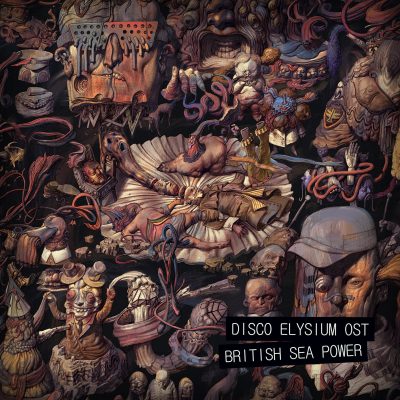
Every great game gets backed with a soundtrack that fits its environment. The acclaimed isometric RPG has a standout track that defines its theme.
Note: This blog post will cover the spoiler of Disco Elysium with its ending. If you have never played the game before, you could either watch a playthrough or play it before should you want to keep the surprise.
Be it the Georgian choirs in Halo, Minecraft’s ambience, or an unexpected swing of Shibuya-Kei for Katamari Damacy, a good way to identify the quality of the video game is its soundtrack. It’s one thing to appreciate one for its graphics and its artstyle, but it’s another for just one song to make you completely remember all of your experiences playing a classic and the ways that it engineers how you feel about whatever is happening. They all help to add to the transcendent atmosphere.
Disco Elysium sticks out as one recent example for how a great soundtrack elevates the overall experience of playing the game. Composed by Sea Power who were once one of the leading post-punk revival bands in Britain back in the 2000s, it sticks out on two angles. The first is that compared to contemporaries at the time of its release in 2019, it’s predominantly shaped by post-rock in the same vein as Explosions in the Sky or Sigur Rós. The second is from the perspective of the band as their indie rock roots rarely touch on more instrumental-driven directions. There are hints of it in previous classic songs like ‘Cleaning Out the Room’ and there is one instance where they compose a previous soundtrack for the 2009 DVD release of 1934 ethnofiction film Man of Aran which is more minimal in vocals. There isn’t a moment where they focus completely on using their instruments outside of the typical rock formula.
Among one of Disco Elysium’s most affecting tracks is ‘La Revacholiere’; the song which plays in the climax when you finally complete your main goal. It is a brooding track at first with its siren-like horns and rattles that makes you tense up. It however subsides with the presence of vibrato violins and a simple guitar riff which soothes the engendered anxiety. This euphoria only gets amplified with a layer of piano melody that appears to follow the Major Seventh interval to further alleviate the tension before it fades back into the same droning at the start.
The song works as an integral part of the game because of the specific context that it’s been used in. That being when you encounter the mythic Insullidian Plasmid after apprehending the communist assassin. Up until now, playing as Harry Dubois, you would confront a wide variety of events that largely remind you of your failures and your loathsome previous attitude prior to the game’s main event. Be it your inability to move on from your ex-something or your otherwise eccentric or idiotic blunders that ruin someone’s life, the game likes to force you to confront your past to try and be better. However, it’s also one that shows that even in the bid to become a kind-hearted individual who is willing to remedy his wrongs, you can’t fix everything. Such an example includes the Tribunal where civilian casualties will happen even if you get the best rolls you could ask for . It’s these aspects that ensure that the game remains grounded despite its more speculative setting.
However, to encounter the Insullidian Plasmid makes for a dramatic break from the relatively low-fantasy direction of the game’s worldbuilding. It’s a key part of the game even though it’s a side quest that you could optionally get into. In it, you help a cryptozoologist named Morell and his wife Lena in finding one. Lena especially has a vested interest in the topic due to her childhood memory of seemingly finding one in the suburbs and as the first character to treat you kindly, you have the emotional incentive to help her and her husband with their project. The side quest ends initially as a downer where, after so much time has been spent on setting up the traps and tools for nothing to show of it, she even doubts as to whether her experience is real or if it’s just a part of her imagination.
The discovery of the Plasmid retroactively affirms the lifelong search as not being for nought. Its existence validates the goal of Lena and Morell even though it’s implied that their pseudoscientific interests are what made them isolated from others. Although completing the side quest would remove the couple from the game, you could optionally ask Lena about her address in case you do find it just before then. Right until the end, the game hints that the quest is cuckoo in its goal and that it works at best as a testament to the newfound personality you adopt as Harry Dubois. There is no hint aside from Lena’s testimony that the Plasmid truly did exist and to find it highlights the unexpected hope in all the disappointment. In other words, it is a miracle amidst all the havoc one could experience in their life.
‘La Revacholiere’ replicates this kind of contrast. The droning ambience in the beginning and the end represents the industrial monotony that feels “factual”, “mechanical”, and otherwise hollow. It’s the persistent presence that lingers even if it fades well into the background to serve as a reminder of harsh reality. The violins, the guitar, and the pianos, by being in the major musical keys, all act as the optimism that everything will work out in the end. That even for just a few minutes that there is something that makes life valuable or even just making it worth living. By having that occupy the middle section of the song, it neuters the impact of the ambience in the end as it dampens the typical association of its dulled sound with cynicism. Instead, it marks the return to reality with all the fears being pushed aside even if it’s just for a moment.
As a final aside, there’s a companion piece to ‘La Revacholiere’ that plays when you reach the island for the first time. That is ‘The Cryptozoologists’. It’s functionally the same with the key difference being that the ambience is missing. This leaves instead the middle section to be played in its entirety which represents the unfiltered hope that is to be experienced without anyone or anything to interfere with it. It’s very much the symbol of the cryptozoology couple’s passion as a way to get by in their lives. Unfiltered in its binary opposition between hope and despair, ‘La Revacholiere’ encapsulates one of the core themes of Disco Elysium.
 GutterPutter
Leave a comment