
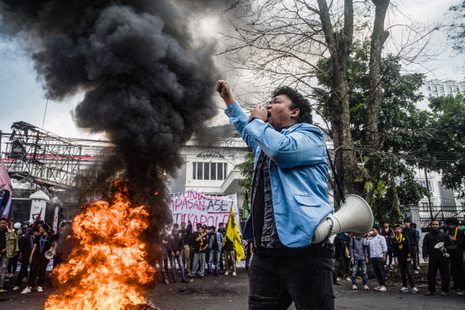
The country’s history with politically conscious music rings strong from the current government protests – one that could echo in Southeast Asia.
On the 20th of February of this year, a music duo from the Indonesian district of Purbalingga called Sukatani took their song down under allegations that it was done out of duress. They made it clear with a social media announcement where they have no mask on for their anonymity while adding an apology to the chief of the police force. The two had before not revealed their identity, but the post had led to one member being fired from their day job as an elementary school teacher. ‘Bayar Bayar Bayar’, from their debut Gelap Gempita, was making rounds within the country, known for being among the most corrupt and the most oppressive in free speech, for its anti-authoritarian lyrics which target cops who abuse their authority.
The timing was perfect in an ironic way. The social media post was dropped during a nationwide protest where labour unions, student-led movements, and even anarchists came out against national security over economic problems, democratic backsliding, erosion in free speech, and police brutality. In other words, it’s like when a popular opposition newspaper was forced to close down during the revolution. Sukatani was essentially martyred at that moment with ‘Bayar Bayar Bayar’ becoming one of the theme songs for the protestors. As the protests develop throughout 2025 which culminates in the creation of the 17+8 Demands, the band’s song continues to remain all the more relevant. Yet, noteworthy as it is to recognise what could grow into a revolution in Indonesia, ‘Bayar Bayar Bayar’ is one of many songs that add to the country’s musical history of social commentary on corruption and abuse of power.
Since the 1970s, bands in the country have long used popular music to rouse public anger against the government, especially the head of state, over their corruption and abuse of power. In 1980, the folk band from Yogyakarta called Kelompok Kampungan released their only album Mencari Tuhan (Indonesian for Looking for God). While the band is not “punk” in their sound, their songwriting reveals the depth and pride of their local heritage in contrast to the dissatisfaction felt from the New Order regime by then-dictator President Suharto. According to the Indonesian music publication Pophariini, Kelompok Kampungan uses the theme of religion in order to incite empathy and compassion between people in Indonesia. They see it more as a tool to improve the country for the better instead of just spiritual mediation. The band, despite their short-lived status thanks to their outspoken views, saw their legacy unexamined at least in the wider web compared to their contemporary Guruh Sukarnoputra’s Guruh Gipsy based on the Jakarta Post’s article. It’s worth noting however that Guruh was the son of the country’s first president Sukarno who was overthrown in 1965.
In the next following decades, through the underground scene, Indonesia continued to see many of its cult-following bands defy authority in favour of liberty and equality. Musicologists from Australia’s Victoria University Kiernan Box and Greg Aronson covered the late-1980s and 1990s in comparing the country’s protest songs to that of Australia. Highlighting especially Indonesia’s emphasis on its traditional music culture to fend off neocolonial influence from West-imported songs, the lyrics are more grounded in relatable narratives about escalating costs of living and negligence on key sector occupations. Iwan Fals is quite possibly one of the country’s most famous singer-songwriters whose rebellious attitude often sparked public unrest whether he tried to tour throughout the decade. When the protests in 1998 saw Suharto crumble, it was Fals who was frequently credited for his commentaries that inspired many to eventually call for the regime’s end.
The 2000s saw the internet boom into everyday use. With that comes the emergence of several bands who, even as Indonesia moved on from Suharto’s authority to the Reformasi period of democratisation, saw little change in their freedom and material conditions. One notable star was Efek Rumah Kaca whose first two albums won acclaim for their biting, socially conscious satire. They sing of the problems with materialism, the overabundance of love songs, and even once said that they’re willing to die if it helps to revolutionise Indonesia for the better. Their fandom would have pushed them near the top of the country’s music scene, but the band members voiced in 2009 that they would rather disband if they hit their creative limit rather than trend on the same grounds. While they are still making music now, it was at their own pace as all of the members have their day jobs to tend to with their most recent, Rimpang, having come out in 2023. It’s released eight years after their third record Sinetesia which saw acclaim for its ambitious concept and more philosophical approach to social commentary.
Among some of the other names in Indonesia whose albums allude to the political climate in the country include: ippo.tsk, a member of the Vocaloid scene whose songs occasionally critiques the dehumanising process of exploitation; Morgue Vanguard, a rapper once part of the collective called Homicide whose solo career drew regional attention for his charged song ‘Check Your People’ featuring Doyz; and Kelompok Penerbang Roket, whose punk rock style tackles the seedy underworld of Jakarta with constant violence and corruption. Indonesia has a longstanding history of dealing with a string of corrupt authorities who rule over the country either like a dictatorship or as a dictatorship. It’s interesting to note how diverse the underground music scene is in terms of genre even if they write songs that challenge Indonesian politics and society. It brings to reality the fact that while it isn’t a mainstream staple, it is a normalised and even mandatorised part of the music culture since it shows the desire for self-expression.
Indonesia isn’t the only country in Asia that had a rough history with authoritarianism and colonialism with its influence remaining to this day. Let alone one that relies on music as a strong avenue for political discontent and even change. Many Asian countries undergo the same experience like the Philippines with the political dynasties such as the Dutertes and the Marcos, Thailand with the military and the constitutional court, and China with the one-party system. Free speech feels limited from the trauma of generations’ worth of restriction and oppression, but it is culture that always reminds us that having it is an experience that is second to none. Music is one medium that exemplifies the expression the best.
I hope that something good might come out of Indonesia that inspires many in the South East Asian countries to aspire for better democracy and more empowered social rights. It’s needed for the sake of hope. If it takes one song or a hundred albums, then it’s worth waiting for that future to happen. If you want to help out for the cause, there is a non-profit organisation called Manushya Foundation which is focused on human rights. Feel free to give them a bit of donation if you like.
 GutterPutter
Leave a comment