
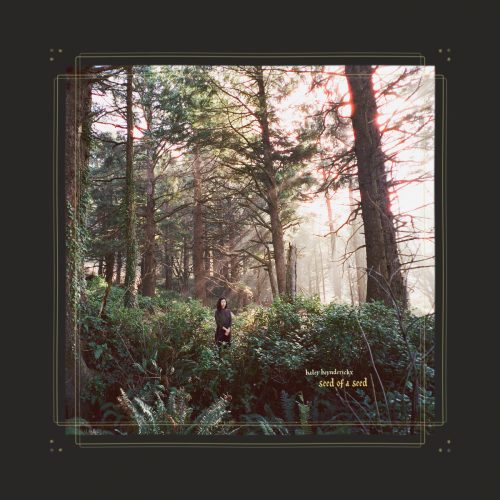
After six years have passed by, something pretty has just happened with the Oregon-based singer-songwriter’s sophomore album.
It has been six years since Haley Heydnerickx sprouted out with her debut, I Need to Start a Garden, by the time Seed of a Seed is finally released. She is a Filipino-American with an initial aspiration for shredding the guitar like a rockstar although that flipped on its head to be more akin to Joni Mitchell during her more rock-like Hejira period. Similar in some respect to her more famous contemporary Phoebe Bridgers, her indie folk style yields an astonishing level of introspection that’s peppered with a love for rural life. I can’t help but think more of Chris Brain’s Hold Steady even as soon as the title comes through – Seed of a Seed. Growth for growth.
The album’s main influences outside of its pastoral use of acoustic guitar is its chamber backings; think of the likes of Sufjan Stevens or Joanna Newsom with a bit more restraint in their ambitions. The chordophones particularly help to dictate its feelings. From the very first track ‘Gemini’, the cello comes on from the deep end as Heydnerickx sings about her depersonalisation, being face to face with her former trait “just out of context”. The way that it swings in all its vibrato adds a lot of surreal weight, thanks in part to its deeper tone that conflicts with its elegant sound which adds to the uneasiness of the song. The title track embraces its Mitchell-esque inflections, yet the violins add dignity to the pursuit of simple living. On ‘Jerry’s Song’, the backing instruments sound as if they’re sighing at the potential of the figure who never quite matched himself up to them. The chorus especially is sentimental in the elongated vocals from Heynderickx.
Accompanying much of Seed of a Seed is its outreach towards Americana to give a lot more spice to much of the music. ‘Mouth of a Flower’ shines through with the violin whether the guitar notes are plucked in a melodic lick; its electric variant helps to add a slight modern kick to the lullaby-like lyrics that would remind some of Vashti Bunyan’s fantastical odes to Mother Nature as a next-door neighbour. Then there’s the horn in ‘Spit in the Sink’ that rings the alarm to the decaying expectations on the relationship especially with domesticity and marriage. The fingerstyle for the guitar enables its melody to be played at a relatively quick pace to heighten the tension surrounding the crumbling resignation of love. There’s the percussion of ‘Foxglove’ that thuds along with the riff like the prelude to the Western shootout. The energy feels apparent in its direct confrontation to the city/urban life that could end our fantasies – “daydreams die slow”.
Much as there are slight episodes of unconventionality in the backing instruments, Heynderickx depends on her guitar proficiency to keep our attention. The way she hums along on a different rhythm to her notes in ‘Redwood (Anxious God)’ or how she can make the pauses between her twangy playing feel abrupt on ‘Sorry Fahrey’ add personality. It’s not as if she’s advocating for a hippie-like lifestyle where we are in tune with our natural surroundings. Instead, there is a nonchalant acceptance in everyday experiences be it as a struggling young adult, an aspiring employee, or as a partner who might be falling out of love that such moments are more or less normal. That it’s these moments that make us human in spite of how off we feel from our home environment. This gets more pronounced in ‘Ayan’s Song’ which depends solely on its guitar to describe the feeling of tranquillity in being alone or in ‘Swoop’ where, through the layered harmonies of the chorus, there is the drive to keep on living through our art.
Haley Heynderickx, through her more articulate guitar playing, has made quite a tune on Seed of a Seed. Where so many of her contemporaries either come off as if they must sing of their interpersonal lives or the sanctity of nature and life, she instead turns to make them intertwine. Granted, this kind of decision means that the album’s more low-key nature would not have been as emotionally hard-hitting as Stevens’ Javelin nor does it feel as all-encompassing as Newsom’s Ys. Instead, it relies on sounding pretty to do the trick and while its prettiness might not be the most unique in the world, the album’s artistry and craft makes it a worthwhile listen to fans of indie folk and its more glamorous variants.


Leave a comment