
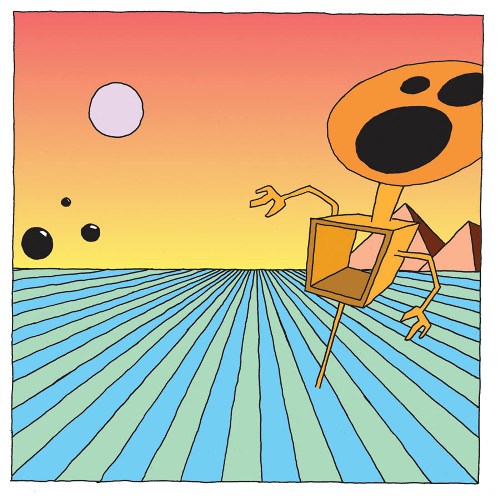
Twenty-five years ago, the D.C. rock band concocted what might well be one of the most indie records of all time, rife with everyday youth problems.
Picture this: you are a college student or graduate in your early-to-mid twenties. You got your degree to land on whatever job you want (regardless of its practical value), you have your friend group to hang out with (read: lecture acquaintances), you have your ambitions ahead of you (that is, just a metre to the exit). You are prepped up for the many unpredictabilities that might ensue like love or the changing landscape that is home. You are roughly a quarter into the transcendental experience that is life. Carpe diem!
As a matter of fact, being a young adult isn’t as grand as many would like to hype it up as. Capitalism demands that you make a dime every time to keep yourself over the poverty line and that’s no guarantee. Urban life is going to hit you like a truck; you are not all that ready for bonding opportunities to be rare. You might stumble upon someone who might be the love of your life, but they have plans for their future where you might be a footnote at best if you aren’t willing to commit. Partying isn’t a bona-fide rite of passage, planning for your life feels like predicting which raindrop will land on your iris in one moment, not even a dream job is all that you’d hoped that it would be. To put it this way – life’s a bitch and then you die.
The theme of young adult disillusionment and anxieties is what drives the Dismemberment Plan’s third album and masterpiece, 1999’s Emergency and I. It was released with rave reviews which include the sheer adoration of Pitchfork which granted it a 9.6 for defying virtually all conventions of indie rock in favour of its eclectic, unique style that relies little on following any style like grunge or post-hardcore in particular. Even twenty-five years later, while the likes of Neutral Milk Hotel is devouring up all of the attention from music fans, Emergency and I had built itself a small fandom for its quirkiness. There was no other album like it and even now, it doesn’t feel like there are any records that emits the kind of impression that it’s from a universe where artists are made into stars if they make the most out-there projects.
Uncommon time signatures, Byrne-esque vocal delivery, and a nerdy touch in its lyricism rounds up much of the album’s charm with all its zany little unpredictabilities. ‘A Life of Possibilities’ sees the drum pattern go in fives underneath the elongated vibrato of bass notes with existential panic in bound about alienation – “You’re just earth in all directions / It’s endless, it’s mapless, no compass, no North Star”. ‘Gyroscope’ tempts its guitar riff in fours only to have the last note be cut off while the rest of the song goes in an abrupt kind of eighth, the zany pacing complimenting the theme of facades, love, and joy. And then you have the likes of ‘Memory Machine’ with its noisy feedbacks and quirky synths which befits the Huxley-esque temptation of escapism at the cost of our humanity. Oh, how the bullshit that is life often goes along with.
Frontman Travis Morrison frequently comments on how in writing the materials for Emergency and I, he doesn’t want to follow the lyrical self-obsession of emo and punk. Based on the article from defunct website Rocket Fuel, he opted to flip it around with talks of community and togetherness as inspired by soul and country music. This adds a distinctly humane attitude towards much of the subject matters of the album. ‘What Do You Want Me To Say?’ turns to the conventions of sci-fi to portray the distance between a failing relationship, the post-punk power chords blending well with the budding frustration. Meanwhile, ‘The Jitters’ owe its euphemistic reference to the cyclical deepening of depression from losing your friend group. There is a kind of spaciness between the instrumentation to stress out both the hollow feeling that pervades alongside the distance felt as you go out of touch with your closest relationships. ‘Back and Forth’ has the frantic beats accompanying the change from nihilistic self-indulgence to a brief moment of care, a suitable ending with the twee synth melody serving as a nice breather.
All that is said, there are moments of switcheroos, changes that are meant to highlight the dynamism of the whole album which abides to no genre whatsoever outside of indie rock. ‘You Are Invited’ spends the first half as a minimalistic indietronic piece that assures socially anxious people that they are always welcome to be a part of a greater whole. It is as soon as the third instance of the chorus comes that the cathartic cacophony of rock comes along. You are well and truly invited to do whatever you want to do with your friends. In ‘Spider in the Snow’, the monotonic synths last for what seems forever which evoke krautrock’s love for tenuto-length, psychedelic-feeling notes. Yet, the way the bassline bounces along is reminiscent of funk which contrasts with the feeling of derealisation that time is moving on without you. Then you have ‘Girl O’Clock’, a sassy yet unpredictably danceable track with abrupt changes between sections like Zolo that feels like a half-way point between satire on inceldom well before its time and a mental breakdown over sexual frustration.
Between the falsettos that gives ‘I Love A Magician’ its identity and the half-done riveting of the guitar in the ironically-titled ‘8 1/2 Minutes’ lies the fan favourite – ‘The City’. Whatever bits of quirkiness the Dismemberment Plan shows in Emergency and I before then blows over in comparison to the tale of worn-out love and Modernist urbanity. It has a bit of everything that you could reasonably label as characteristic of the band like creative use of the synth, nerdy-ah singing and lyrics with unexpected high notes and cryptic imagery, and unconventionally catchy guitar riffs. Twenty-five years after the release of the album, the song still works like complete and utter magic especially in its acceptance that the addressee is better off without their original love interest. It was thus in the last quarter of the song that the final verse relieves us of the prospect of moving on with Morrison’s everyman vocals.
Emergency and I stands tall even as it might not have enjoyed the sheer number of recognition that other contemporary albums might receive in the same broad genre. Its fandom, quiet as they are, feel attached to the allure that there aren’t any other records quite like it. For one, it might as well be the most accessible for math rock fans to the point where for those who want to promote “math pop” as a notable sub-subgenre, the Dismemberment Plan might be the first of their kind for implementing different time signatures within a recognisable song structure. Emo fans would feel attached to intersectionality between self-loathing and the need for communal support which is further bolstered by . Post-hardcore fans love the slight roughness in the instrumentation and the ways that they are played with little regard for what one would consider “proper” performance. Even electronica enjoyers would see in standouts like ‘You Are Invited’ the same pursuit for self-affirmation the way they would otherwise see in the likes of Porter Robinson. Granted, this does not mean that the album’s legacy is truly far-reaching. It’s just that there are a lot more to note down with how underrated the album feels in its kaleidoscopic array of influences and styles.
In an interview with the Fiddlestick in 2011, Morrison admits that he finds that a lot of the lyrics have aged badly with some songs from Emergency and I having been singled out. You can admit that there are insensitive comments to be found in the record, be it the Injuns on ‘What Do You Want Me To Say’ or the entitlement for sex in ‘Girl O’Clock’. Yet, controversial as they are, it is these instances that only heighten the album’s appeal to young adults. One decade, you’ll find it to be representative of every feeling you have that is bottled inside of you. Another, a whiny cringefest that contains comments that would have you be called out for. Yet, add in an extra decade and you realise that there aren’t really a lot of albums that encapsulate the pains of being in your twenties, both broadly and in depth, as much as Emergency and I. That even Morrison accepts to be grounded in facts one way or the other.


Leave a Reply