Marc Gartman takes himself to dance rock with Low’s Alan Sparhawk, leading to some decent bits of storytelling.
3.5/5
Marc Gartman is a veteran in Duluth, Minnesota’s music scene ever since moving there from New York around 2001. While he might not be the most recognisable name in the world, he stood in as a banjo player for a handful of bands and projects since 2000 although he said that he’s been trying to make music since his early teens. His passion for music makes him not only prolific with how many records he writes with four rough copies being done every year, but it enables him to experiment with folk, electronica, and slowcore. Now, dance rock is completed as his next venture in his expanding array of genres being played through his new band DAMIEN.
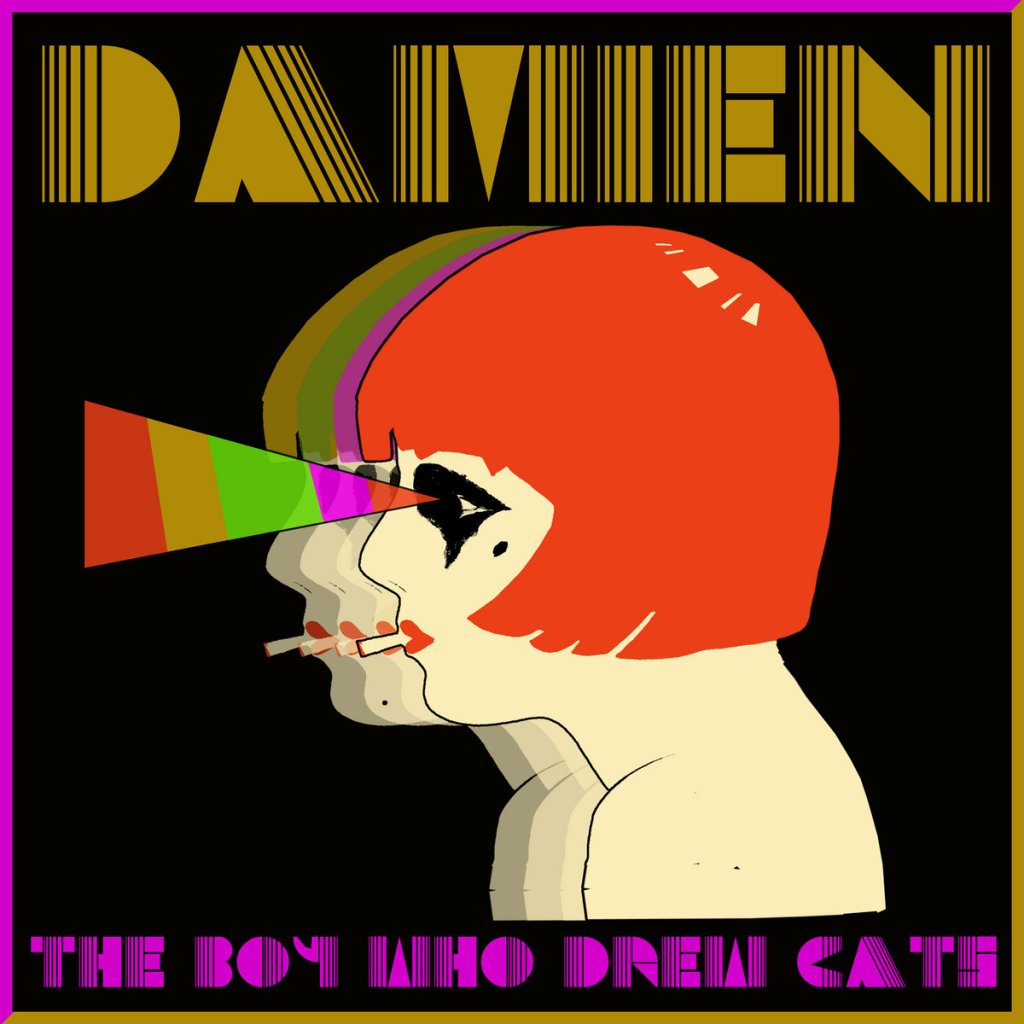
With that in mind, Gartman’s not the frontman that many people would turn over to listen to when they want to check the new release which is titled The Boy Who Drew Cats. While the subtext behind the album is inspired by a Japanese fairy tale of the same name that his father would read to him in his childhood, most would focus on one member. That just so happens to be guitarist, backing vocalist, and one half of slowcore legend Low’s Alan Sparhawk and his son had joined him as the bassist.
The last time he appeared as an indie mainstay is from his old band’s latest album HEY WHAT. Unlike his past endeavours, it’s a part of his post-industrial experiments from the late 2010s which caps both his and his wife’s legacy not only as seminal slowcore artists, but as forward-thinking creators long after what should’ve been their peak. Since his wife Mini Parker’s unfortunate passing, Sparhawk maintains some presence online to update on his situation. He is wrestling for ownership against Universal Music Group over his most notable band’s master recordings according to Stereogum. DAMIEN is likely one of his side projects given that he’s looking to have moved on to performing under Derecho.
Yet, The Boy Who Drew Cats not only feels like a natural musical evolution for Sparhawk, but the quality of the album could easily leave a tingly sense of a breakthrough for Gartman. As mentioned previously, it’s a dance rock record with machine-like percussion and groovy bassline. The kind of sound that takes you back to LCD Soundsystem or some funky post-punk revival acts. As an aside, the album also happens to be conceptual with all of its tracks being related to the one story that we’ll learn more of later on.
Starting off with ‘Avoid Large Places’, Gartman’s knack of storytelling shines through in his anxiety-filled anecdote of his dad scaring him off. It’s largely instrumental-led after three minutes in. But the progression afterwards that lends itself into a crescendo with gradually louder mixing gives you a good peek into the band’s technicality which is by no means laughable at all. The swirling guitar strums, horn-like keyboard, and slightly chaotic drum rhythm gives off a sense of suspense that keeps you tugged in with the tale for a good while. Of course, it might have overstayed its welcome as the lyricism could be expanded a bit more.
The similar theme happens on the title track which adapts the first two-thirds of the same fairy tale that Gartman once listened to. To hear the priest character’s “Avoid large places / keep to the small” be used as a chorus sends chills down your spine as if it’s a phantasmal leftover. Admittedly, the instrumental build-up feels lacklustre compared to the previous track, but the cliffhanger ending with the boy moving towards the temple that the rat resides will hook you into the narrative. Too bad that the next two tracks happened to take the album’s potential down a bit.
The two tracks, named ‘Light on the Hill’ and ‘Stay Hidden’, were a tad bit uninteresting. The former, with its downtempo beats and sentimentally slow guitars, is tolerable mostly thanks to the gorgeous backing vocals from Sparhawk himself and the psychedelic guitar solo. Otherwise, Gartman’s singing feels too limited in trying to convey either a sense of hope or draw in the naivety of ever finding peace. DAMIEN’s dance direction gets sidetracked with soft rock on ‘Stay Hidden’ which feels more like a d-side Eagles throwaway. The theatrical attempt in the chorus feels too exaggerated compared to the rest of the song and the guitar riff feels both uninspired and repetitive. It’s a combo that makes you feel tempted to just skip the two tracks although you might risk missing out on some part of the story.
‘The Goblin Rat’ sees DAMIEN kick back into motion with its militaristic drum pattern, ethereal synths, and ghastly chorus which feels like a PSA on encountering the rat. The staccato keyboards that sound faded in the background gives off the impression of the rat moving about and it tugs into the immersion to which I especially like. The production further adds to the surrealness of the track thanks to the wavy vocals from Gartman in the end, suggesting that the magic of the drawn cats that the boy had drawn will come to life to attack the rat.
This leads to the final track and it’s among one of my least favourite, ‘The Morning After’. It’s supposed to give off a sense of finality as the boy is now revered as the saviour with its triumphant synths being used as horns. The overall instrumentation however feels too melancholic and without any implication regarding what happens afterward, it feels as if a moral betrayal had been committed on the rat’s death. The original fairy tale suggests that the boy had either moved on to work as an abbot or as an acclaimed artist. Another big sense of nagging to me is the final interpolation of the priests’ reprise back in the title track. Gartman’s delivery feels too hammed up to be worth taking seriously which makes it feel like a big emotional dissonance from the whole album.
The Boy Who Drew Cats is, first and foremost, a nice little addition for those who like to listen to the more creative side of dance music. This can be electronic-based inspirations such as LCD Soundsystem as mentioned after the beginning or the minimal side of New Order’s catalogue. In practice, the instrumentation works nicely most of the time with a nice complimentary narrative to go along with it. Unfortunately, there are a lot of notable hiccups that could distract you from the whole listening process. Don’t go in expecting Sparhawk to take complete charge. Instead, take a listen as if you’re checking out one of the diamonds among the dirt, no matter how dully cut it might feel at times.


Leave a Reply