
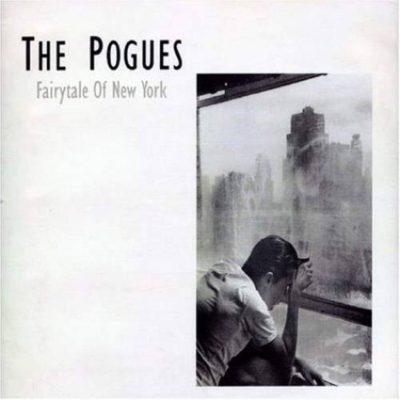
‘Fairytale of New York’ is a Christmas song that doesn’t need any introduction. However, for those who do want to know its impact, it’s regarded by virtually everyone in the United Kingdom as one of the greatest tunes for the season. Recorded by British-Irish Celtic Rock band the Pogues in which lead singer-songwriter Shane MacGowan shares vocals with Surrey-born music artist Kirsty MacColl, it’s a tale of bitterness. One that resides in regretful couples and fallible dreams over alcohols and fornications that just so happened to take place during “the most wonderful time of the year.” It is a celebration of the holidays with its warts and all in frank display.
What makes the song interesting is that while it’s quintessentially British, the tropes and imagery used to illustrate the story signify one idea that is placed well outside of it. The main couple are implied to be immigrants who moved to New York City with Kirsty’s sung portion being “promised that Broadway was waiting for [her]”. Their aspirations are tarnished to which they implicitly coped with by cheating on each other and becoming addicts. Their story ends in a painfully humane acknowledgement that they are at least committed to each other through their dreams that were gone for good. This feels reminiscent of the American Dream – a concept which idealises the United States as the land where opportunities are found and made to help you make your social mobility upward. And ‘Fairytale of New York’ sought to tear it down.
The criticism of the American Dream as being fundamentally fantastical to reality’s unpredictability has long stood as the theme. In acclaimed literary works like F. Scott Fitzgerald’s The Great Gatsby or Richard Yates’s Revolutionary Road, romance tropes are utilised illustrate its impossibility especially if it leaves the love interest either dead or abandoned. Films like Once Upon a Time in America which was directed by Sergio Leone and video games such as Grand Theft Auto IV thematically look into the American Dream as being achieved only through amoral criminality and even that is no guarantee.
As for songs in particular, the American Dream was satirised previously prior to the Pogues’ entry although at the time of ‘Fairytale of New York’’s release, it’s swamped by poppy new wave tunes. In 1984, Bruce Springsteen’s ‘Born in the U.S.A.’ was released as one key example. It initially brings into mind the prospect of rising above your humble milieu to become someone who’s great only to be met with condemnation surrounding the treatments of military veterans. Being a soldier was regarded as that one career which gets especially populated with the hopeful notion of social mobility itself from several tours. This however is more implicit in the sense that while the American Dream can be analysed should you be curious about the representation of the song, it is secondary to its critique of how veterans are neglected and left without support.
‘Fairytale of New York’ thus stands as being peculiar in how overt its critiques of the American Dream is despite its background. The Pogues and Kirsty MacColl spent much of their lives in Britain and the former had only toured in New York when the song was starting to be made. Their music even enjoyed some bits of commercial success soon after – the Pogues’ If I Should Fall from God peaked at number 3 in the UK’s Official Albums Chart in 1988 and Kirsty MacColl almost topped the US Billboard Modern Rock Tracks with ‘Walking Down Maddison’ in 1991. So, what is it about the song that makes itself so poignant in how it examines the American Dream?
It’s likely that while it’s not explicitly known to be the key cause of the song, ‘Fairytale of New York’ was released in the decade which saw the rise of neoliberalism. The ideology has first seen its growth in the UK and the US with its incitement of individualism and self-priority over directly intervening with the abundant array of impoverished lives. Leaders like Margaret Thatcher and Ronald Reagan aimed to align personal success with job promotions and earnings over compassion while reminiscing about the past in the early 20th Century as the prime of society with many prioritising themselves over others. This might come off as getting off the track, but it is through this thinking which helps to add a lot of significance to the song.
In examining the meaning of neoliberalism as one that promotes individualism over community and self-success over altruism, it clarifies the American Dream. ‘Fairytale of New York’ was released in the time when many coal mines were shut with former workers having been left without an alternative job to go to while families broke down over the extent of their poverty. Rather than provide escapism, it instead shows Christmas as it really is: a messy affair where its intended bid to cheer many lives up was conflicted with brewing personal problems that will reach across many lives. The couple’s shared miseries throughout the holidays resonate with many listeners not only for its realism, but also because it subversively represents Christmas as the sobering window to reality where dreams more often than not die alone.
As mentioned in the beginning, the main couple escaped their old lives in pursuit of success only to be met with disillusion as they bunker down in their vices to escape from reality. One visited the drunk tank to sober up from his alcoholism while another realised her codependence on him for her happiness (“Well, so could anyone / You took my dreams from me when I first found you”). It follows the similar template as had happened with the American Dream as the main theme.
However, the seeming hopelessness was subverted with the last two lines before the final chorus: “I kept them with me, babe, I put them with my own / Can’t make it all alone, I built my dreams around you”. Here the crushed dreams of working in Broadway were recontextualised instead towards having each other. The fleeting self-serving ambitions smolter to make way for another chance to rebuild a new kind of community that accepts the reality of the situation.
Is it perfect by any chance? Not at all of course. The couple still needs to deal with their addictions. Yet, they offer themselves a chance to reconcile with one another and make amends with their dreams that were too good to be true. The tragedy lies in the naivete of pursuing the American Dream when it’s an entirely individualistic mindset in the first place. However, it opens a path to a new dream that becomes true when you’re together. It rejects Christmas as the idealistic wishing well and instead sees it as a rebirth of the commune just as it does reject neoliberalism in its love for individualism. ‘Fairytale of New York’ thrives because it sought to replace the fantasies of the American Dream
 GutterPutter
Leave a comment