
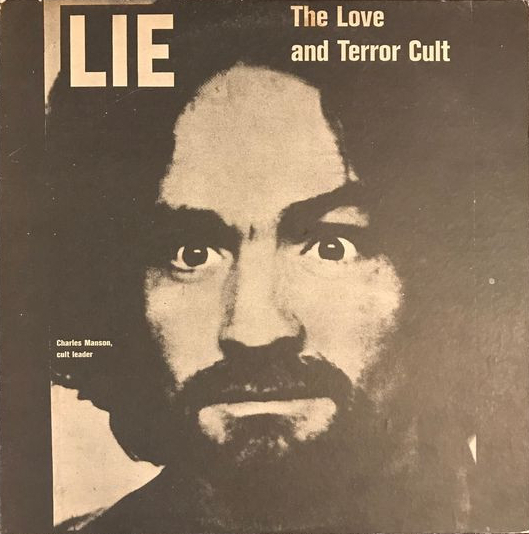
Charles Manson is one of the most notorious figures in pop culture history. His avant-psych style folk debut album is utter feces.
This isn’t going to be a long retrospective album review that I would occasionally do with something like the Dismemberment Plan or Okkervil River. This is going to be more of a smaller thinkpiece that’s related to Halloween. In a more grim sort of way. This is a piece that will look into the sole studio album by one of the most infamous names in the history of the United States – Charles Manson. In addition to his murder of then-upcomer Sharon Tate and her associates, Manson had an interest in making music. In the lead-up to the murder and his subsequent imprisonment, he developed connections with several figures in California’s entertainment industry including Beach Boys member Dennis Wilson and producer Phil Kaufman. The latter helped him to record his music between 1967 and 1968 and would soon visit him several times during his early years in prison.
The result is what could be described as an omnishamble once it was out in 1970. Lie: The Love and Terror Cult feels like an avant-garde demo that one would hand in for an audition for Frank Zappa or Captain Beefheart’s band. With a largely rudimentary type of guitar playing, Manson sought to exude a sense of profound wisdom that in practice is no less different from a Scientologist. In ‘Garbage Dump’, he philosophises on what a garbage dump is although it resembles more like a Flanderization of Bob Dylan, Leonard Cohen, any of the other singer-songwriters in the ‘60s who actually proved that songs can be carved out from literate poetry. Otherwise, he would like to chat up about hippie tropes of freedom and community in tracks such as ‘Your Home is Where You’re Happy’, and ‘I’ll Say Never to Always’.
What is especially interesting in a way with the album is that the lyrics in and of itself are complete shit. The subtext regarding Manson and his “family” made much of the songs’ representation of the aforementioned themes feel less authentic and more like a Jonestown exercise. In ‘People Say I’m No Good’, Manson portrayed himself as a martyr in hindsight whose knowledge is ignored in a world of ignorance, the world of fools. It however lacks the framing device that Dylan had utilised on ‘The Times They Are A-Changin’’ which puts said knowledge in the hands of the younger generations to push the contemporary climate in a better direction. There’s no symbolism to allude or draw comparison to a crisis as is the case in ‘Blowin’ in the Wind’. It’s all vaguely progressive peace-slop that lacks character. Good luck finding any worthwhile quotes in ‘Sick City’, ‘Don’t Do Anything’, or ‘I Once Knew a Man’.
Scratchy, rashy, and wacky. Lie: The Love and Terror Cult reveals not an aspiring singer-songwriter who has a knack with words but a cult leader who manipulates people around him to do his bidding. Or else. The only aspects around the album that is complimentary to Manson is that it’s “avant-indie”. Its’ demo-like production allows the instrumentation to stand out as being more normal rather than fancy even if its amateurish playing might add little to the textures. The vocal is more befitting of an everyman that was the members of the Greenwich Village Scene than a tour-de-force like Frank Sinatra, but it collapses when everything around it comes off as a far-fetched pursuit of a grand vision. At worst, it provides an insight into how he cultivated a following from his seeming seductions in tracks like the intro ‘Look at Your Game, Girl’.
Why separate the artist from the art when you realise, in abject horror, that this might be the best that Manson could have ever come up with? While some might find themselves drawn by the perceived qualities of the album, it feels as if it’s only because of the constant mystique that is built up around Manson. Of how “special” he might come across despite his horrific complicity in leading his ragtag gangs to murder people. There is something profoundly shocking and sickening in particular that Kaufman would capitalise on trying to sell this from the ensuing media coverage in the same year where Vashti Bunyan debuted with Just Another Diamond Day. The one artist whose music was so overlooked that it took more than 30 years until she finally made a comeback once she learned that people genuinely love her singing and her songwriting. Meanwhile, even the commercial flop is enough for Lie: The Love and Terror Cult to be included among Manson’s many infamies.
There’s no doubt why Manson didn’t take off as a musician. People would murmur about how he might fit with Zappa’s clique as mentioned just after the beginning. However, Zappa was known for his strict auteur-like management of songwriting and his satirical itch abhors what he deemed to be the phonies in the broad counterculture movement. Look no further than We’re Only in It for the Money in 1968 which parodies psychedelic music and its pioneers like the Beatles. If Zappa ever got a whiff at Manson and a good grasp at his skills, he might legitimately give him a beating regardless of whether it’ll make him safe or not. Maybe then would that prevent the tragedy of Sharon Tate then and it would prevent the tragedy of an overhyped garbage dump like Lie: The Love and Terror Cult from taking off now.
 GutterPutter
Leave a comment