
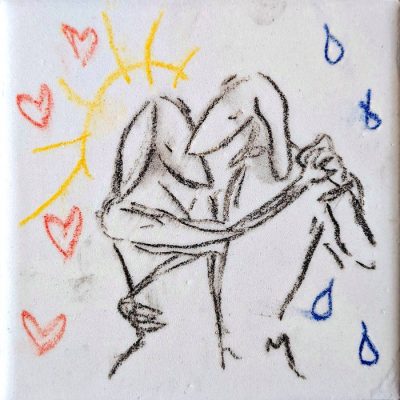
In a big subversion to post-industrial artistry, the Ontarian flips everything we know about love to convey his rawest feelings. And it is stunning.
August, Yours Truly is the main project of an anonymous post-industrial Canadian music artist who lives in Toronto, Ontario. At least back when he first started his Bandcamp account back in 2020, he released three albums alongside several singles and EPs at the time of writing. They are all conceptual with the debut being based on gender performativity and the second based on their distancing away from the religion he once grew up to believe in. At first, his style, broadly speaking, isn’t much different from your share in Xiu Xiu or Coil as the general theme he explores lean more towards the provocative side of the topics covered.
That is, until Devotion To A Higher Power, another concept album. This time, it’s one that situates itself around love and all its facets with featured help done from MattUU, Grace Scheele, and halfdecentheart. August, Yours Truly draws inspiration from his intense feeling in a relationship that, while it is fulfilling and even netted an engagement, it doesn’t help to calm down his anxieties. In his own words, “I struggled a lot with isolation and worrying I wasn’t enough for the girl I wanted to give everything to.” He imagines it first and foremost as being based on a kind of binary opposition between the heartfelt romance between the couple and the deluge of fears and doubt compounding in the psyche. To further bolster his artistry for the process, he cited Mitski, Perfume Genius, and Bjork alongside others as his other musical influences for a slightly different approach to structuring the songs.
Indeed, the intro of ‘Happily Ever After’ is recorded in a more lo-fi manner with clear instances of breathing and slow piano chords for a sentimental ballad. Immediately, while the post-industrial droning comes into full effect just after the song, the delivery reminds me of the last of Low’s output before Mimi Parker’s unfortunate passing. There’s a tenderness in wanting to dedicate one’s entire life to their partner and while such phrasings would have come off as cliche, how it works in practice has a depressive subtext. The voice seeks in their partner a being that needs to be revered to make up for all their flaws. In short, ‘Happily Ever After’ sets up the feeling of being in love in a way that highlights both its highest passion and its most obsessive fall, setting up a near-perfect start to showcase the themes and motifs.
First comes the contrast in presentation between the lo-fi piano ballads and the post-industrial textures. Whether the former comes, the lyricism comes off as being clear, yet ambiguous in the ultimate expression. ‘…Softer Than The Sun’ for instance lacks the colourful language that sets Badly Drawn Boy or Jordaan Mason apart from others in conveying relationships. However, the song explicitly sets out to establish the voice as being nothing without devoting themself to their love interest. This obsessiveness punctuates through the feeling of nothingness, exemplified best by the inability to decide on whether to be “your man” or “your girl”. For another example, ‘…Like You’ attempts to mark a break from the seeming co-dependency through hoping to be “warm / and nurturing” like their partner although the ending sample implies that it is fuelled by a Freudian struggle in childhood.
In ‘Devotion’, the music shifts to a minimalist droplet of metallic sparse drum and elegiac synths in response to the declaration of wanting to begin again. Here, the self-loathing begins to become more apparent which is punctuated by the very production and instrumentation surrounding it. This culminates in the last line that wishes to go “where the beautiful people are” which insinuates a profound consciousness around physical looks. ‘Inhale’ continues to pick up on the instrumentation with a more glitchy addition and a more drill-and-bass clicking all the while shifting focus to idealisation. This segues into the more scatterbrained bricolage of varying notes and percussion, all seemingly done in random time signatures, within ‘Ordinary Seraphim’. Much of the songs fixate on the contrast between the voice and their partner; the vices that seemingly swallow them and the virtues that they aspire to treasure at all time.
This leads to the second aspect that is physicality. By that, I largely mean the body which, as exemplified by ‘Let Love Destroy Me’, serves as a “prison” that demands to be set free only by love. This in turn would lead into other nuances surrounding the complication of being in a romantic relationship like gender dysphoria or religion. The slowcore folk in ‘In The City, A Beautiful Woman’ imagines the nuclear family-like daydream of “[coming] home / To a beautiful woman”. Yet, the sheer whiplash between the dream itself compared to the yearning of childlike irresponsibility and the last verse with “[wanting] to be all your everything” infers the desire of wanting to be a woman as the instrumentals begin to swell. ‘Inheriting Niagara’ makes a casual mention of being formerly religious back as a teenager, but it’s sandwiched between the focus of the alcoholism problem. This leads to one enquiry – does the belief in God truly help set one for a good life or a solid relationship? Or does it set unrealistic expectations on the believer and their partner especially at the prospect of leaving it?
Some of the most beautiful highlights to have come out of Devotion To A Higher Power is when the confessional reaches the personal in the final fourth. No longer does August, Yours Truly appear to keep a thin distance between himself and the presupposed voice in much of the music. Instead, he begins to reveal details about his partner, tearing down the doubts that bestowed him be it his gender identity or his religion. After the glitchy mess (not meant to be entirely negative with artistic intent) that is ‘Worthless’, ‘Her Name is Emily’ finally revealed the name of the love interest. Note the lo-fi production that was only found in the previous piano ballads or, the horn-like synths, or the faded singing that is hauntological. All the electronic beats have been cast to the minimum in favour of one final declaration until death comes to part. ‘A Higher Power’, with its droning and its conclusory harp and piano, serves as the final closure to the artist’s anguish.
As ‘…And Only Love Remains’ serve to close out the album at last, Devotion To The Higher Power rises up as a more unique post-industrial record. There’s nothing grotesque or apocalyptic about it that is typical of industrial music as a whole. There is no dramatic dissonance, no screaming nor relapse into madness. Instead, desperation comes to haunt the artist in his desire to settle down. There is no poetry, no grandeur nor even a whisper that had previously made Spiritualized’s ‘Ladies and Gentlemen We Are Floating in Space’ a masterpiece. It is colloquial, it is sparse, and it is from the heart.
Be it for better or for worse, August, Yours Truly have made a gem. While Devotion To A Higher Power isn’t going to make serious waves in revolutionising how we envision industrial music, the genre proves successful in showing the extent one would express their feelings without shock value. This means that those who are in it for the graphic details will find this to be wholly short of its potential. Yet, if you give it time to sink in with its experimental directions, this album feels more sincere and convincing than a million love songs envisioned by Take That or many boy bands alike. This is the real deal and if your partner makes a song that is upfront like this, they’re a keeper.
 GutterPutter
Leave a comment