
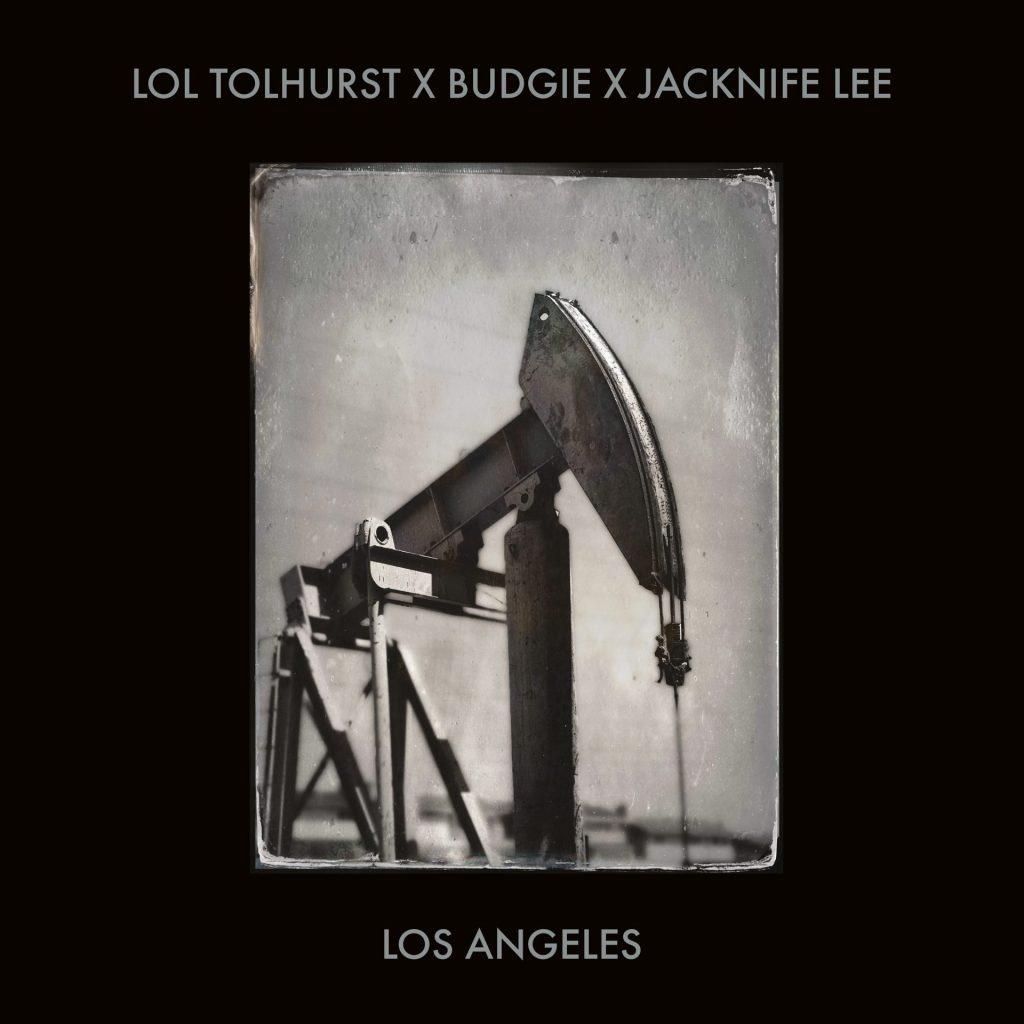
The combination of dub influences and bubbly production makes for a subversive bop of the stacked collaboration even if it’s slightly bloated.
This is one of those collaborations that you might not have expected with the final result you might not even have thought of at all. Lol Tolhurst and Budgie, for a start, are both English musicians who broke through in the 1980s by respectively playing for the Cure and Siouxsie and the Banshees on the drum. When the peak of their career starts to wind down, the two work together mainly through their podcast since 2020. Jacknife Lee, by relative contrast, is a respected producer whose skills on guitar is overshadowed by his works with big names like U2 or Snow Patrol since the late 1990s.
How the three got together is not some grand friendship arc for sure. From an interview with the Guardian, Tolhurst and Budgie are supposed to play with Bauhaus’s Kevin Haskins for their fresh new ideas before turning to Lee who is the former’s neighbour in Los Angeles. The whole album, built around the combination of rhythmic drumming and experimental production, was based around the city’s feedback loop of toxicity and community as confirmed in an interview with NME. To try and express this, there’s a lot of guest artists who tend to do the lead vocals such as Bobbie Gillespie of Primal Scream, James Murphy of LCD Soundsystem, and Modest Mouse’s Isaac Brock for a start. Out of 13 tracks, only two are void of any features through ‘Everything and Nothing’ and ‘The Past (Being Eaten)’. Being instrumental-driven with a respective touch of ambience and krautrock, caution should be exercised if you decide to listen only for the features.
On the one hand, you have ‘Bodies’ with Lonnie Holley and Mary Lattimore where the altered vocals and Caribbean drum beats make you pay attention to the racial themes of death and suffering. On a more general level, these elements can also be found on ‘Uh Oh’, ‘This Is What It Is (To Be Free)’ and ‘Country Of The Blind’ when it comes to layered productions and sociopolitical commentary on American life. Given Tolhurst and Budgie’s background as drummers, it’s worth giving props to Lee for putting careful attention to giving the rhythm more depth. The way that the bassline would weave through with the clashing of the snares and the toms allows much of the record to keep itself on the ground even if it goes too far in the musical diversity.
On the other, the likes of ‘Ghosted at Home’, ‘Train With No Station’, and ‘We Got To Move’ feels as if they meander onward with the rattling percussion, ghastly reverbs that doesn’t make you feel airless, and lyrics that feel too vague to say anything about the city it’s mythologising. A major aspect of what I don’t like about the album is its attempt to be flexible in the kinds of songs the three can create does lead to moments where it doesn’t feel as cohesive as it could have been. One minute, you are listening to the spoken-word murmurs of Pan Amsterdam in the post-industrial ‘Travel Channel’, the next you are checking out the funky new wave of ‘Noche Oscura’. It’s not necessarily convoluted, but the patchwork pattern of the album leaves you with less thought on the city after a few spins.
It is worth giving praise to James Murphy for his yelping in two of the tracks I find to be big standouts – the self-titled track and ‘Skins’. The former finds him singing of decadent generations and urban failings like a madman who warns that the city “eats its children” to the bouncy xylophone and bouncy bassline a la Battles’ ‘Atlas’. On ‘Skins’, the drumming feels more reminiscent of afrobeat where, with anxiety and desperation, Murphy’s seeming lack of composure feels like David Byrne’s classic mania on Talking Heads. If there’s someone you can trust for any post-modern twist on dance-punk, Murphy might as well steal the show from Tolhurst, Budgie, and Lee.
Los Angeles, at its most negative, might give off a certain similarity to DJ Khaled’s studio albums which feels more like a hodgepodge of a collab rather than even a sum of its thematic parts. There’s a lot of singers who don’t occupy more than a quarter of the record, the genres at best could be described as messy art rock, and you might not feel the two main artists’ presence as much as you would have liked. Nonetheless, it’s an expansive piece that, at best, looks at its titular setting through both love and hate with great drumming and lively production. If you like post-punk especially from the 1980s, it’s for the best to keep an open mind when checking this one out. What it lacks in strict formality, you can bet that there’s a bit more originality that the three can offer to the scene.
 GutterPutter
Leave a comment