
- Anti-Scrunti Faction – Damsels in Distress (1985) (IS ONE OF, IF NOT, THE FIRST PUNK ALBUM THAT DIRECTLY DEALS WITH LGBT+ THEMES WITH HOMOSEXUALITY BEING ONE EXAMPLE)
- God Is My Co-Pilot – I Am Not This Body (1992)
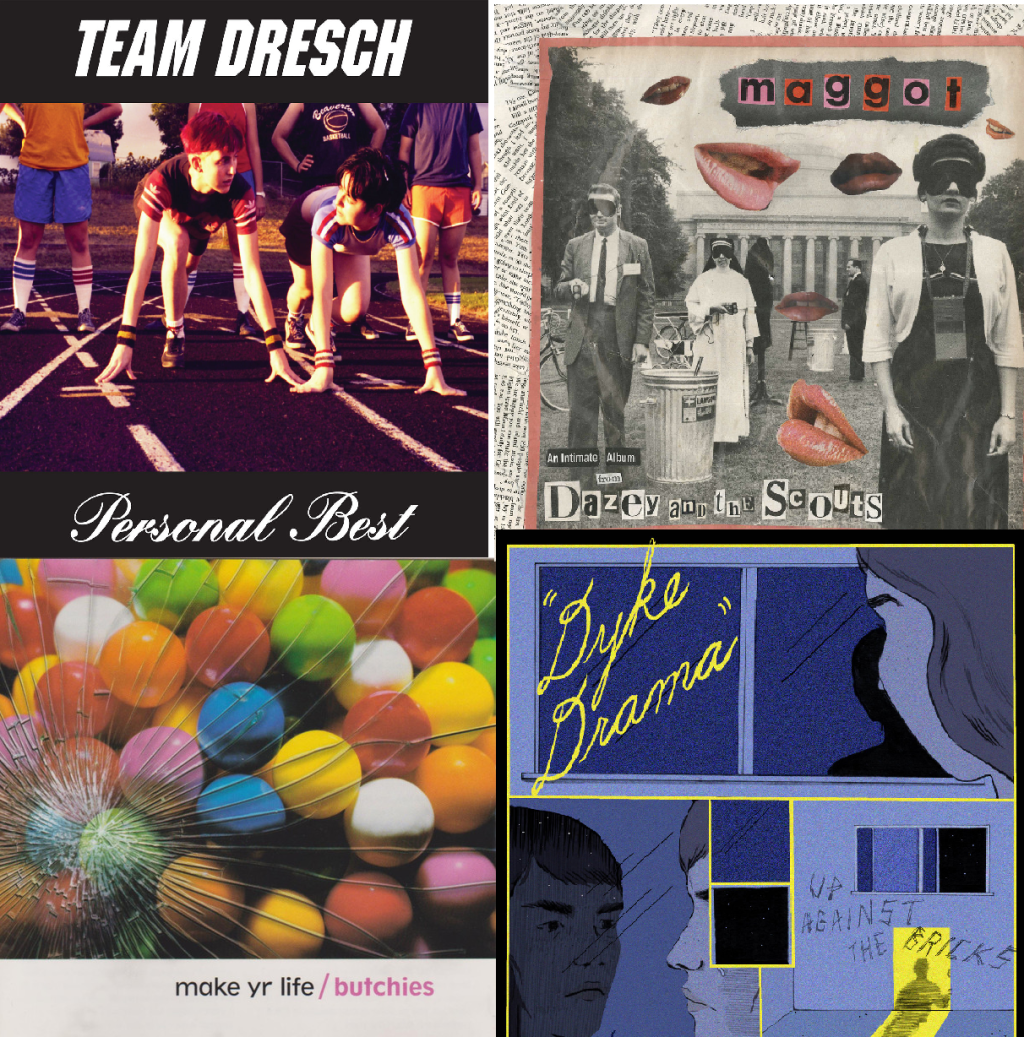
- Team Dresch – Personal Best (1995) (DEFINES THE SUBGENRE WITH ITS EXPLORATION OF ANGST, SOCIAL COMMENTARY, AND RELATIONSHIPS THROUGH THE PERSPECTIVE OF A LESBIAN)
- Longstocking – Once Upon a Time Called Now (1997)
- Limp Wrist – Limp Wrist (2002)
- The Butchies – Make Yr Life (2004)
- Against Me – Transgender Dysphoria Blues (2014) (IS SEEN AS ONE OF THE BAND’S MOST NOTABLE ALBUM THANKS TO ITS THEME OF TRANSGENDERISM IN LIGHT OF THEIR FRONTMAN’S TRANSITION)
- Dyke Drama – Up Against the Bricks (2016)
- Dazey and the Scouts – Maggot (2017)
Punk rock, above all else, is one big middle finger against the establishment. Thanks to the Sex Pistols’ seminal Never Mind the Bollocks, Here’s the Sex Pistols (1977) and the Clash’s London Calling (1979), more people have opted to listen to simple yet socially/politically conscious records. Provocative statements relating to sex ends up being on the rise as well as part of the anti-status quo sentiment against the conservative mindset which prefers chastity and devotion. Pushing into the 1980s, the rampant assault on traditions continue to pile up as subgenres like hardcore punk took off with a lot of success. The decade could well be best seen as a turning point where independent music is starting to turn into its own part of the industry. There is nothing for punk rock to abide from to find its market – its music alone could search for its audience.
However, coinciding with the rise of punk rock and its prototypical founders is that of the LGBT+ movement. Since the Stonewall riots in 1969 and the gay liberation movement which goes all the way to the 1980s, there’s a growing yet small number of representation of same-sex relationships in both the media and in popular culture. Especially helping with the rise is the feminist sex wars in the mid-80s which divide the until-then unified movement about the sexual representation of women. Some argue that explicit signs may only serve to objectify women as subordinate to men. Others argue that it’s a strong sign of liberation and that most women should use sex as the ultimate symbol of their freedom from centuries of living under repression. One of the topics of discussion for the conflict is that of lesbianism – how should its sexual conduct be played out? The prevalence of the male gaze makes balancing between growing civil campaigning and male-favoured gratification difficult.
From these factors, it’s no wonder why fans have long argued queercore to be integral to punk culture’s resistance to traditions. However, the name of the subgenre would struggle to find its footing in the 1980s. In 1985, the Colorado-based Anti-Scrunti Faction released what is deemed by many to be the first punk album to tackle same-sex relationships with Damsels in Distress. Although it doesn’t see any crazy success in the underground scene when compared to contemporaries like Rites of Spring, it does gain some attention from fanzines like Flipside which makes the band at least memorable among the niche audience. In the meantime, hardcore punk bands like Dicks have members who are openly gay, but they didn’t label their music as being explicitly about same-sex relations. Xtra once mentioned that because of the bubbling LGBT+ following and interest in the punk scene, fanzines are thinking about naming the movement ‘homocore’.
Needless to say, the transition of queercore to be its distinct subgenre came at full swing in the 90s when third-wave feminism start to challenge not only the degree that women should earn her rights, but also on what it means to be a woman. Especially helping with the growth in popularity is the popularity of academics like Judith Butler whose works like Gender Trouble analogises the ways that gender identity could change over time to that of a performance. With the riot grrrl movement that explodes out of Washington as one of the main representations of the decade’s feminism movement, queercore finally finds the space to make for itself known to the wider alternative scene. While bands like God Is My Co-Pilot have sought to tackle themes of gender identity with no wave influences, others like Team Dresch embraced the riot grrrl influence & push towards a sound that’s more complex in its structure. In 1995, Personal Best is released to strong acclaim for its portrayal of homosexuality through both the passion and the pitfalls that the voice might have to endure.
Considered by many to be influential to both the genre and the riot grrrl movement, Personal Best would eventually take root in making queercore diversify away from being purely punk-based in favour of indie/alternative rock. Pitchfork mentions in a retrospective review that the album, even to this day, remains relevant for its shameless comment of lesbianism against the backdrop of mainstream euphemism and sanitisation. Indeed, contemporaries like Longstocking or the Butchies have found an audience to entertain throughout the late 1990s through the early 2000s. It’s also from there where male-fronted bands like Limp Wrist would also earn some renown for standing out within the largely female-led movement. With the amount of noise that’s coming out about same-sex relationships, there aren’t a lot of attention given to transgenderism or non-binary exploration.
Fast forward to now, the genre continues to find ways to capture the attention of the LGBT+ community in one way or the other – including those who either identify as the opposite sex and those who feel that they don’t really fit in either gender. With the 2010s rolling through with the internet’s popularity, fourth-wave feminism delves deeper into the nature of intersectionality. With transgenderism once again playing a big role in the movement, queercore music doubles down more on its exploration of gender dysphoria and non-binary feelings. You still have more ‘traditional’ bands like Hunx and his Punx which carries on the long-explored themes of same-sex relationships, but those who struggle to fit in with identifying at their assigned sex would much rather find a band that they could relate to.
It’s from there when acts like Against Me! start to emerge as pivotal representations for the transgender community. 2014’s Transgender Dysphoria Blues is inspired by lead singer/guitarist Laura Jane Grace’s transition from male to female after a lifelong sense of dysphoria with the original intent being to write a concept album around a transsexual prostitute. The confessional details of being confused about who you are helps the band reach a level of acclaim that is rarely sought after since their debut in 2001’s Against Me! Is Reinventing Axl Rose. To this day, Grace remains one of the mainstay of alternative music’s transgender representation with two albums that is separate from Against Me!’s usual style.
This showing of transgenderism could be what makes talking about it more significant to the queercore community through the later half of the 2010s. Since then, acts like Dazey and the Scouts or Dyke Drama have released songs that tackle the theme of gender dysphoria, non-binary feelings, or plays considerably with the notion of gender identity in itself. Some might follow the same path as many punk bands and disband just shortly after releasing their first LP, but the fact remains that when interest in a non-heteronormative representation of sexuality is at full swing, it’s a storm that can’t be easily stopped. While it still remains small in size, many artists who opt to help spread LGBT+ representation are more than welcome to do so with queercore. And with that comes the following that, while small, is devoted to its very core.
 GutterPutter
Leave a comment