CONTENT WARNING: AS A CAUTIONARY MEASURE, THE ARTICLE WILL DEAL WITH TOPICS THAT RELATES TO SEXUAL ASSAULT, SUICIDE & DOMESTIC ABUSE. IF ANY OF THE LABELS HAD PROVED ITSELF TO BE UNSETTLING BEFORE, IT’S FOR THE BEST TO STAY AWAY FROM IT.
It’s been a few months since I’ve started writing around the genre of emo & its origins as an artistic offshoot of the post-hardcore scene back in Washington D.C. Having left it just as we are about to enter the decade where it’s been seen as one of the distinct branches of alternative rock (or pop punk/power pop to be more exact), this era is interesting mainly as it’s a point where the representation of your typical American youth culture is at its peak since the 1980s. The success of shows like Degrassi: The Next Generation, Dawson’s Cheek &The O.C alongside the phenomenon that is the reactions around films like Mean Girls, Donnie Darko or Scream helps to establish the cliques that we now have come to familiarise ourselves more with. Wherever it’s the prep girls, the jocks or the nerds, the stereotypes have always been prevalent within any media that’s based around high school life is rife with them for the sake of bare semblance to real life. There is however one more grouping that had exploded in popularity & that is the emos – depicted mainly as being either melodramatic with the constraints of their lives, overindulgent in their feelings or at worst, are prone to causing self-harm which can cause concerns among others. It’s largely thanks to the explosion in popularity from the emo genre that ensures that the group is found commonly among the archetypes of the theme.
Through the adolescent lament on lost love, the fear of growing up & distancing away from loved ones & the tracts of mental illness, emo is highly befitting of the topic’s epoch. The codifying of the intercontinental understanding through the popularisation of the internet, the US’s jeered-at war in Afghanistan & against terrorism alongside the ennui from then-president George W. Bush makes for much of the older millenials coming off as being demotivated. On top of the historic precedents, the rise of figures like Sam Harris who argues against the need of religion or literary works like Battle Royal by Koushun Takami helps to add to the skepticism of the younger generation. There might not be a spike that ensures that the millenial populace are bound to be more academically smart or even wise in regards to the happenings in their lives, but there is an uptick in how the emo genre can carry out its themes to them. One of the topics that I wanted to tackle around it is on the amount of subgenres that cover subject matters that can come off as being philosophical or literate for much of the audience in mind.
Expect the relative era of emo’s development to bear an overlap to the ones from the last article. The amount of underground music acts & the volatile state of the scene makes it difficult to pinpoint the exact moment when it’s agreed on by many to be the definitive point for the genre to be respected by many. In addition, the popularity of the genre can also lead to a lot of confusion regarding which band or record can be classified as being ‘emo’ due to the simple definition of the genre – that being that it’s focused especially around confessional or honest emotive expression. This article will slightly narrow down the definition of the genre on the basis that it must be largely rooted in rock music & was characterised primarily by its high-energy performance.
Part 1: A Sudden Anthem to the Poor – Pop-Punk & Power Pop’s Dominance
Highlights
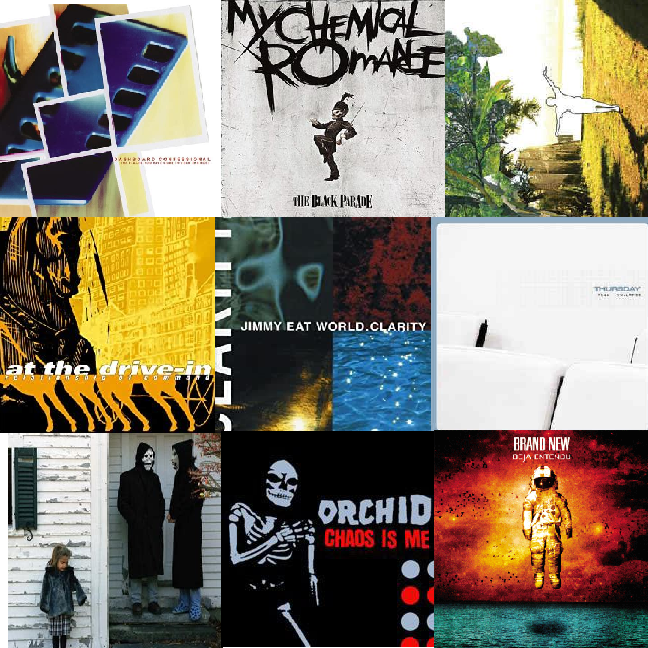
- Clarity – Jimmy Eat World (1999, WAS INITIALLY OVERLOOKED LIKE WEEZER, BUT IS NOW REGARDED AS THE BAND’S BEST WORK & A NAIL TO THE COFFIN FOR EMO’S INCORPORATION OF POWER POP)
- Bleed American – Jimmy Eat World (2001, MARKS THE BAND’S BIGGEST COMMERCIAL SUCCESS & MADE EMO A TREND WITHIN THE ALT-ROCK SCENE)
- Something to Write Home About – The Get Up Kids (1999)
- Tell All Your Friends – Taking Back Sunday (2002)
- Three Cheers for Sweet Revenge – My Chemical Romance (2004)
- The Black Parade – My Chemical Romance (2006, ROCKETS THE BAND TO SUPERSTARDOM, CONSIDERED TO BE THE PEAK OF EMO’S POPULARITY & IS NOW HAILED AS ONE OF THE 2000S’ BEST ALBUMS)
- From Under the Cork Tree – Fall Out Boys (2005)
- Riot! – Paramore (2007)
- … Is a Real Boy – Say Anything (2004, Earns acclaim for its satirical tone over its subject matters rather than remaining fixated on its despondency)
- Crimson – Alkaline Trio (2005)
- The Places You Have Come to Fear the Most – Dashboard Confessional (2001)
There is no doubt that the emo scene in the 2000s is known especially through one certain connection – that of its ties with pop-punk & power pop. Most would deem the crossover between emo & the two mentioned genres as emo-pop & given the difficulty in trying to categorise the albums based on certain characteristics such as sincere feelings, I wouldn’t blame them for the struggle. It’s known that the genre has flourished well in the first half of the 2000s thanks to the likes of Jimmy Eat World whose initial post-hardcore roots have since Static Prevails been mellowed out in favour of the more melodic sentimentalities of Midwest emo. Their major label debut Clarity was released with warm reviews from the critics; many have praised the record for its adventurous dynamic instrumentation & ambitious vision to the point where some had even wondered why the album wasn’t bigger than in reality. There are however some reservation where certain critics have seen it as being too full of childish dramatising & overproduced. One writer in Pitchfork initially said on the album (through an imaginative interrogation) that:
“… I think not. They’re trying to rock and be aggressive, but it’s too polished, too produced. Whatever edge Jimmy Eat World might have live is sanded down to a waxy, smooth linoleum surface. And the harmonies are still everywhere. It’s almost as if they don’t know how to sing any other way outside of this ‘tender and yearning’ mode.
“[…] There’s no edge, no barb, no emotion. Sure, they may have come from the ‘emo’ scene, but the feelings here are so adolescent and stale that it’s hard to be moved. This band could be the next Goo Goo Dolls.”
(Source: DiCrescenzo, Brent. (1999). ‘Clarity’. Pitchfork https://web.archive.org/web/20080603120738/http://www.pitchforkmedia.com/article/record_review/18878-clarity)
Nevertheless, the acclaim that has been garnered from the press has helped to establish a cult following for the band even if the commercial underperformance had cost them their spot in Capitol Records. The variety of smaller genres that can be identified within the album & most especially, its pop-punk direction & shiny production has led to many smaller bands taking an interest in whatever idea that Jimmy Eat World had in mind & therefore start to write angst-driven alternative rock songs. Tracks like ‘Lucky Denver Mint’ are seen as diamonds under the rough for its power pop infectiousness so there is also a general drive for bands to try & make hits that are catchy as well as being solemn in tone. The praise that was given to the song could well foreshadow the band’s flirtation with more explicit power pop charm in their next album Bleed American which is released under Dreamworks. The direction has been hinted at from Dallas Observer where Matt Schild wrote:
“Though Jimmy Eat World will enjoy an even higher degree of freedom when it ventures into the studio [Capitol] than it did in in the hands-off Clarity sessions, that doesn’t mean it’ll let things slide creatively. On its latest songs, Adkins says, the act backs off the intricate noodling that marked its early explorations through the world of post-hardcore. The stylistic change makes its newest batch of songs sit closer to cheery pop than anything that preceded them—but their simplicity shouldn’t be mistaken for a lack of effort: the band’s move towards stripped-down numbers was just as demanding as its jaunt through complex arrangements”
(Source: Schild, M. (2000) ‘Seller’s Market’, Dallas’ Observer. https://www.dallasobserver.com/music/sellers-market-6393327)
When Bleed American was released in 2001, the commercial success blows Clarity out of the water. With a platinum from the RIAA & in Canada & a hit single in ‘The Middle’ that placed 2nd in the US Adult Top 40, the result was that many acts such as the Get-Up Kids are starting to gain attention for their work as well thanks to the credibility that had been established. While much of the bands are active shortly before Jimmy Eat World’s third album was released, the potential to expand their fanbase more was discovered through them & it’s until Bleed American had come around when it does feel like success is right on the tips of their fingers. Bands like Dashboard Confessional & Taking Back Sunday are starting to gain both a reputation as being respectable over their musician craftsmanship on top of rapidly gaining popularity within the younger crowd. Fuelled by the political disillusion from G.W Bush’s presidency & the widespread knowledge of teen culture, these factors have enabled emo to be a popular trend within the alternative scene with the main demographic being rancorous teenagers. A rave review from former staff writer in SputnikMusic, Knott-, wrote around Say Anything’s …Is a Real Boy with an inference where truthfulness is required for emo to succeed, stating that:
‘Honesty and the absence of artifice are qualities admired by music fans and critics alike, but the impact they have and the level on which they operate is hugely variable. In law, a distinction is drawn between the whole truth and nothing but the truth, and such an application of truth and honesty is equally valid in the musical area. […] But the layers of honesty pile up; how much darkness is honest, and how far can you reveal yourself before the act itself of baring your thoughts becomes forced and fake? It’s a line that can only be really drawn in one place – that onf impulse and instinct. As soon as you try to be honest in an outward manner, it’s inherently dishonest; the only way to stay perfectly pure is never thinking about what’s acceptable.
‘[…] Despite the obvious irony in [lead singer] Bemis’s lovable, low-pitched whine, there’s something unbelievably raw and human about the way he approaches the subject of being too honest. This is the foundation of which Say Anything build a masterpiece – the gulf between what people thing and the way they act. […] …Is A Real Boy [sic] is a record of contradictions, paradoxes, and hypocrisy, with enough wits and twists to leave you completely lost, but enough of a message to make complete sense.’
(Source: ‘Knott-’. (2009) ‘…Is a Real Boy’. SputnikMusic. https://www.sputnikmusic.com/review/32916/Say-Anything-…Is-a-Real-Boy/)
While the success of the aforementioned bands was undeniable, the biggest example of a band that had benefitted from the exposure was none other than My Chemical Romance. Although lead singer Gerard Way had dismissed the categorisation as being ‘a pile of sh*t’, the label had nonetheless persevere through the band’s lifespan, often to the point where one can consider them to be the face of the genre’s peak popularity in the 2000s. Their sophomore Three Cheers to Sweet Revenge, written with the concept being around the protagonist being tasked to kill many evil men to be with his lover in the afterlife, was released to generally positive reception, the performance on the chart is impressive. The album reached a peak position of 28 in the US Billboard 200, all four of the singles have managed to land a spot in the UK Singles Charts (the highest being 19 with ‘I’m Not Okay (I Promise)’) & a 3x Platinum certification & a platinum certification in the US & the UK respectively.
The success only continues to grow further with the release of The Black Parade 2 years after Sweet Revenge, being another concept album (one that’s more focused than the previous) that’s around a cancer patient revisiting his past experiences with an introspective view. Just as rock-oriented as ever, the commercial success of the album is gigantic with the peak position of 2 in the US Billboard 200 & in the UK Official Albums Chart, all 4 of its tracks securing top 15 of the UK Singles Chart (including a peak position of 1 in ‘Welcome to the Black Parade’), 7 platinums being awarded from several countries (including a 3x variation from the US & the UK) & a year-end position of being 12 in the US Top Rock Albums. Showering as well was the critical respectability for the band’s drive. One example of that is a capsule quip from Robert Christgau who states ‘In prog, a good sense of humour means so much’ – a slightly more flattering comment than a negative dud from Three Cheers. Another piece is the 4.5 star out of 5 praise from AllMusic’s Stephen Thomas Erlewine who said that despite the lack of deviation to help leave a sonic impression:
‘[…] MCR does their signature blend of Sturm und Drang better than ever. “Dead!” rushes along on a series of escalating hooks, “This Is How I Disappear” surges with purpose – and when they’re paired with tunes that do break the mold, like the wonderfully pompous little track “Welcome to the Black Parade” or “Teenagers,” a tremendous reworking of the “Bang a Gong”/”Cactus” riff that is the simplest and best song they’ve ever written, it makes for a record that’s their strongest, most cohesive yet even if it isn’t quite as weird or compelling as it should be given the group’s lofty ambitions’.
(Source: Stephen Thomas Erlewine. (2006). ‘The Black Parade’. AllMusic. https://www.allmusic.com/album/the-black-parade-mw0000563300)
The sizable success of the emo-pop trend is vast & it can be found in many media texts at the time with shows like Clone High usually making use of some of the tracks to add to the satirical take on teen drama. It’s virtually impossible to escape from it during the 2000s especially if you’re a teenager who lives in the US. Alternative radios would frequently play whatever song is popular in a bid to appeal to the younger fanbase with the representation of the adolescents having helped to contribute to the fuel. The melodrama of the topic matters may have lead to the genre being slammed into mockery by the end of the decade, but it had nonetheless become a comfort for many disenfranchised youths.
Part 2: Erudites for the Generation – Lyrical Sophistications & Artsy Exploration
Highlights
- Deja Entendu – Brand New (2003)
- The Devil & God are Raging Inside Me – Brand New (2006, CONSIDERED TO BE THE EXEMPLARY PIECE OF SONGWRITING FOR THE GENRE)
- Fevers and Mirrors – Bright Eyes (2000, The band would later on depart from the sound in favour of a more diverse range of topics as shown in Lifted or I’m Wide Awake, It’s Morning)
- Sing the Sorrow – AFI (2003)
- Full Collapse – Thursday (2001, EARNS FAVOURABLE RESPONSES ON RELEASE & HAD SINCE THEN BEEN CITED AS HAVING LAID THE FOUNDATION FOR MANY POST-HARDCORE EMO ALBUMS OF THE 2000s)
- The Second Stage Turbine Blade – Coheed and Cambria (2002)
- Domestica – Cursive (2000, PREDATES CONCEPT ALBUMS LIKE THE BLACK PARADE IN ITS NARRATIVE AROUND AN UNSTABLE RELATIONSHIP)
- We Have the Facts & We’re Voting Yes – Death Cab for Cuties (2000, the band would later on make a considerably larger impact on the indie scene with Transatlanticism)
- At Home with Owen – Owen (2006, serves as the musical project for Mike Kinsella after American Football broke up)
The inherently confessional nature of the genre, owing to its emphasis on emotional sincerity, had paved a way for many bands to try & add a literate flair to their lyrics, leading to a more enchanting & heart-rending piece of poetry. It’s already common enough for one to go into details about a heartbreak or their mental anguish; virtually everyone had heard of them before in one way or the other. However, it’s a whole new level of impact for another to describe it in a manner that is explicitly reminiscent of the confessional poems that might well sparked emocore into motion back in the mid-80s. Controversial topics such as suicide, dysfunctional relationships or mental illness are then allowed to be elaborated in a delicate, sophisticated manner rather than be said in a plaintive style that would be mocked or offend. It’s from the possibility of the genre’s themes where what one would regard now as a gateway entry to the indie scene were able to experience a breakthrough as a worthwhile artist. The likes of Bright Eyes with Connor Oberst & Death Cab for Cuties with Ben Gibbard have first made a name for themselves as being an emo act through their lyrical flair before they would move on to create their identifiable opuses.
Of course, that doesn’t mean to exclude other bands who bear a closer connection to the singer-songwriter label. One of such acts was none other than Cursive, consisted of the remains of a bygone name that is Slowdown Virginia whose breakout album Domestica was released in 2000. Being a largely independent record, the commercial performance isn’t anything to write home about. Instead, what makes the record resonate well with so many others is on its singular topic which is about a domestically abusive relationship between a couple whom many believed were inspired by lead singer-songwriter Tim Kasher’s divorce. To opt for a record that explored the numerous angles of a doomed romance in just over 30 minutes in a story was seldom heard of (let alone explored quite like Weezer) & while it’s not often named as being one of the greats, it’s the record that I consider to be seminal to the lyrical components of emo. Bands are now reminded to be honest to a fault around the fractures of the everyday tragedies & to be blunt in their reactions – even if it may end up shocking others. One blog wrote about the impact that Kasher’s life had on the album on how ‘Rarely in rock has the modern screwed-up relationship been presented in such forthright, gritty, honest terms.’ (McMahan, T. (2000). ‘Domestica’. www.timmccmahan.com. http://www.timmcmahan.com/cursive2.htm)
Another band who helped to influence the songwriting direction of emo is Thursday – a post-hardcore band from New Jersey who earns some recognition off the back of Full Collapse back in 2001. The album was recognised for having screaming vocals that would eventually become a common backing vocal element & for its more conscious charge with the themes being around identity crises, LGBT+ discrimination & genocides. Although the mainstream press had given the album only average reviews, the smaller e-magazines are considerably more positive to it with many enjoying the fervent performance from the band & in a more subtle manner, its small spot of eloquent lyricism. A contributor from the now non-existent publication Wondering Sounds had noted that the ‘strikingly literary musings were packed with so much imagery and iconography that teens all over the country instantly latched onto these post-hardcore anthems’ (2011, https://web.archive.org/web/20160110170347/http://www.wonderingsound.com/review/thursday-full-collapse-2/).
This help to establish much of the retrospective acclaim of the band where many had made comparisons between the album’s content to Morrissey’s snide lyricism in the Smiths. With how many post-hardcore band would try to get their hands on trying to adopt the traits into their own work shortly after Full Collapse had been released, it should come as no surprise that nearly every band that would eventually have success would find themselves indebted to Thursday. A retrospective article with a commentary from vocalist Geoff Rickly summarises it thus:
‘Full Collapse is a defining record in Thursday’s life as a band. It was a moment we figured out exactly what we wanted to be as a band and it helped me heal from a lot of the young trauma in my life. After it caught on, nearly a year after it’s [sic] release. It redefined the genre and every band had a “sounds like Thursday” stick on their CD Cover. Every record that followed was a response to Full Collapse.’
(Source: Mohler, J. (2016). ‘Retrospective: Thursday – Full Collapse’. Kill the Music. https://killthemusic.net/blog/15-years-thursday-full-collapse)
Lastly, there are no bands, not even Thursday for all the gratitude that’s been sent to their direction, that would receive as much citation for their songwriting influences as that of Brand New. Although the sexual misconduct accusations years ago had caused a debate regarding the whole separation between the artist & the art, the band’s legacy is too intrinsic to emo for it to be wiped out with ease. Their debut Your Favorite Weapon was released just shortly after Thursday did in 2001, but the reviews are positive even as it’s not to the point of worship. It’s with Deja Entendu 2 years afterwards which marks the leap in fame from being a respectable pop-punk band like all the others to being a legend in the emo scene. While it doesn’t have a concept in mind, many did take notes around how the sophomore record managed to subvert tropes that are related to rock into poignant scenes of depravity. One example is ‘Sic Transit Gloria… Glory Fades’ which takes the rite-of-passage of losing your virginity into a grim account of sexual abuse (to the point of irony):
‘You don’t recover from a night like like this
A victim, still lying in bed, completely motionless
A hand moves in the dark to a zipper
Hear a boy bracing tight against sheets
Barely whisper, “This is so messed up.”’
The ties between the classic conventions found in most rock songs & the taboos that it can cause as a consequence enables the band’s songwriting to carry a heavier weight into its impact. Tracks such as ‘Me vs. Maradona vs. Elvis’ ponders around the prospect of vulnerability that comes with being past your prime. Meanwhile, other tracks like ‘The Boy Who Blocked His Own Shot’ subverts the tragic ballad to reveal the guilt of being the abuser of the dead relationship. These lyrical topics have helped to allow Brand New to garner a devoted fanbase & become an underground favourite. Websites like SputnikMusic & IGN had well given the record praise for its mix of pop-punk & post-hardcore, but the real gem that they’ve pointed out is the lyricism. Remember the emphasis on honesty that I’ve mentioned from …Is a Real Boy? No bands had ever seemed to put themselves in a spot of confessionalism as exposed as frontman Jesse Lacey did.
The positive reception that was given would only be further eclipsed by The Devil and God are Raging Inside Me (or The Devil and God for short) where the band starts to enter philosophical territory. Topics like religion, death, existentialism & morality takes the forefront instead of romance or simple personal woes as tracks like ‘Limousine’ were inspired by real-life tragedies. If being regarded by many as being one of the top poets in the whole scene isn’t enough, then The Devil and God cements Brand New as the sole titan in the genre. Being the band’s most critically acclaimed record then with a 78 average on Metacritic, more prestigious magazines like Pitchfork, Alternative Press & the Boston Phoenix have taken note of the poetic languages & contemplative themes. The rave reviews have helped the band’s reputation to grow continuously, ensured that the record reached a peak position of 31 in the US’s Billboard 200 & finally, mark the decisive point it’s possible for a musician to make emo songs as an artistic statement rather than just for appeal.
Long after the release of The Devil and God, the debates around its influence on not just the genre, but the music as a whole, still prevailed to this day. Just when the jeers around emo starts to accumulate into being insurmountable, Brand New was generally spared as being among the handful examples of those that doesn’t tread into cliches. A retrospective article from Medium notes that the magnitude of the album’s impact, especially from the depth of its spiritual admittances, makes it more comparable to The Joshua Tree by U2 or Slow Train Coming by Bob Dylan than to its contemporaries. (Tolander, M. (2016). ‘The Law and Gospel are Raging Inside Me’. Medium) Many artists like Halsey, Andy Hull from Manchester Orchestra & many others have made either remarks over the impressive songwriting that Lacey possesses in writing the lyrics or have noted its importance to both themselves as the artist & the scene as a whole. However unfortunate the news is that Jesse Lacey did indeed commit sexual misconduct shortly after the band’s dissolution in 2017, The Devil and God will continue to be seen by many as being one of the most important albums in the 2000s.
Part 3: Waiting on the Other Side – Alternative Re-inventions
Highlights
- Catch for Us the Foxes – mewithoutYou (2004)
- Tell Me About the Long Dark Path Home – The Newfound Interest in Connecticut (2005)
- Relationship of Command – At the Drive-In (2000, KNOWN AS BEING ONE OF THE MOST IMPORTANT POST-HARDCORE RECORDS OF THE 2000s)
- Some Kind of Cadwallader – Algernon Cadwallader (2008)
- A Fever You Can’t Sweat – Panic! at the Disco (2005, Divisive reactions for its use of baroque & electronic elements when compared to other bands at the time)
- Chaos is Me – Orchid (1999, IS AGREED ON BY MANY TO HAVE KICKSTART SCREAMO & EMOVIOLENCE INTO BEING A CULT-LOVED SUBGENRE)
- In This World – Susquatch (2009)
- Masked Dancers: Concern in So Many Things You Forgot Where You Are – The Brave Little Abacus (2009, LEFT IN OBSCURITY LIKE AMERICAN FOOTBALL, BUT IS NOW HAILED AS BEING THE MOST INVENTIVE RECORD OF THE WHOLE GENRE)
At last, there are many bands who are associated with the genre of emo, but was known for their musical experimentations to the point where it can be difficult to even argue that it’s a part of the genre. While some bands have pushed the subject matters like suicide into mythological territory like mewithoutYou, others opt for post-rock directions like The Newfound Interest in Connecticut. Some, like Panic! at the Disco would go as far as to use electronics & baroque pop into their music much to the divisiveness of the critics. Much of the innovations that was attempted then was around utilising math-rock characteristics much like American Football despite not having the unorthodox tuning as well. Acts like Algernon Cadwallader are known for their use of such which leads to them gaining a cult following even long after their disbandment.
One peculiar example for a band that is known to have helped expand the boundary of what emo can do is At the Drive-In; comprised initially of teenagers & young adults from Texas who rose to fame through word of mouth. Their final record Relationship of Command combines the visceral force of post-hardcore with largely cryptic lyrics, harsh production & mixing (much to lead singer Omar Rodriguez-Lopez’s frustration). Distinct from the band are some awing technical performance for a band whose genre is mostly in the realm of the DIY-driven punk rock from which many had taken note of. A retrospective review from the BBC had hailed it as ‘a statement of grand intent that could never be followed,’ the milestone of which every albums that followed it will continue to measure in terms with its unadultered energy. (Driver, M. (2010). ‘Relationship of Command’. BBC) Meanwhile, Spin ranks it at 177 in their list of the 300 best albums between 1985 & 2014 to which writer Chris Martins described it as being ‘brutal magic.’ ((2015). ‘The 300 Best Albums of the Past 30 Years (1985-2014)’. Spin) Finally, The Guardian placed the album at 42 in their list of the 100 best albums of the century in 2019.
Meanwhile, there are also other bands whose focus, rather than being just sung for around 4 minutes as per expected, was more around literal screaming on top of the cacophonous crashing of instruments. Such is called ‘screamo’ or for a more extreme variant of it, ‘emoviolence’ & while it’s not at all digestible to most listeners (me including), that doesn’t mean to exclude the fact that many band have their share of loyal fans. Orchid is one of, if not, the most recognisable name of the subgenre thanks to their handful of albums. For an example, Chaos is Me is their debut album & although it received little attention in its release back in 1999, the album had nonetheless endured a beloved following simply because they embody everything the genre is around. All of the songs aside from ‘Epilogue of a Car Crash’ lasts 2 minutes at most, all of the vocal performances are screaming & the guitars are just as harmonised as they are on the verge of screeching it all out. Don’t expect the mainstream media to pick it up for commentary, but to the handful of those who did hear of Orchid, it might well be the embodiment of ‘Fury, emotion, intensity’. (Rogowski, J. (2005). ‘Totality’. Punknews.org. https://www.punknews.org/review/4842/orchid-totality)
Usually, most of the emo records tend to be similar to either pop-punk or post-hardcore. So far, all of the albums that I’ve mentioned in this part are either ones that pushed the latter related genre to its logical conclusion or are brutal extensions of it. Enter the Brave Little Abacus who may have the melodies of Midwest Emo, but they have the tendency to not so much push the genre to its logical as they would reinvent it in its entirety. They would add in an impressive array of psychedelic production, a wide variety of instrumentation unlike anything before & lyrics that would include in different languages from English (really!) & that would come all thanks to their debut album. Masked Dancers: Concern in So Many Things You Forgot Where You Are (or Masked Dancers for convenience’s sake) is a behemoth of avant-prog creativity blended in with the usual emo aesthetics. Meddled samples that might even be from video games are found there as does serene pianos, synths, layers after layers of multi-part song structures & even industrial noises can be found within it. The ingenuity might have blocked the band’s shot for instant mythologising, but the later reactions around it is what adds to the distinction of the album from so many others.
Now, Masked Dancers is one of the most highly rated albums for the genre with many having praised it for its authenticity despite all its eccentricities. The album received an average of 3.89 in RateYourMusic based on just under 5000 ratings while a 4.1 average (based on just under 150 ratings) in SputnikMusic with the selected review giving it a classic 4.8 stands as an indication of the retrospective acclaim. One review from Pitchfork around Pannanoul’s To See the Next Part of the Dream infers the influence that the album has in encouraging other artists to adopt more unusual crossovers between emo & the likes of shoegaze as an example for the artist’s focus. Other later acts like glass beach drew comparisons to the Brave Little Abacus for its avant-garde structuring of emo which acts as the seed of its following. No matter how obscure it may be, the Brave Little Abacus’s zaniness helps to assert itself as being among the greats & an integral piece for all artists to expand on the musical area just as much as they did lyrically or technically. They would later on create Just Got From the Discomfort – We’re Alright a year after which is relatively more popular than Masked Dancers before they broke up shortly after, but Masked Dancers sticks out to some fans as being the best representation for what the band can pull off.
Part 4: Oversaturation, decline & legacy
Just because emo was one of the biggest trends in alternative rock, it doesn’t mean to detract from the everlasting criticism that follows it like a spectre – that of its perceived immaturity. Many had seen the genre as being whiny, inauthentic with presenting its emotion (of which some would call ‘fashioncore’), prone to self-harm, overplayed & overhyped by the press that came around to enjoy them. Especially with the advent of the internet, the portrait of the subculture surrounding the fanbase of the genre had been moulded into a pastiche of every teenager’s worries of the decade. Anything from petty love affairs to materialistic plans going awry had been put into a pedestal of insult from many. Throw in the worship of more acclaimed acts like Brand New alongside the nostalgia for the emocore days back in the 80s’ & all of a sudden, there’s a fracture within the subculture over who’s the best & whose expression is the most truthful. M. Douglas Dashchuk (2010) had wrote around the prevalence of the divisive reactions around the fandom of the genre & how:
‘As “fashioncore’s” aesthetically and dispositionally unique bloc of fans became more numerous and conspicuous, a range of cultural products – most notably Steve Emond’s Emo Boy graphic novel series (2007, 2006) and the infamous 2005 Adam and Andrew song “Emo Kid” – began to correlate one’s affinity for emo style with emotional instability, bisexual desire, and suicidal thoughts.’
(Source: Dashchuk, M.D. (2010). ‘Messageboard Confessional: Online Discourse and the Production of the “Emo Kid”. Berkeley Journal of Sociology, 54(Knowledge, Production and Expertise). p. 98. https://www.jstor.org/stable/40999937)
Even the mainstream media that once accepted the looming presence of emo would later on came around to shun the subculture that rose up from it. Magazines like Seventeen would make articles & sections dedicated to satirising, mocking & dismiss both the youth culture & the genre as being pretentiously melodramatic & more into it for looks than genuineness. The attack on the genre further adds fuel to the tension to the point where an article from Punknews.org critiqued the oversimplification & underestimation on the cult following. However, the media weren’t wrong with the accussations of posing as bands like Hawthorne Heights, Simple Plan, Plain White T’s & many others were suspected for having a shallow subtextual resonance to their songs. Dashchuk continued on around the media’s relationship with the genre & the subculture, noting the significance of the diversion between the fanbase regarding the sincerity of their favourite band’s feelings.
‘[…] Lest it be perceived, however, that these reports [by the media] deliberately sought to construct an “emo kid” representation that would cast doubts on the mental health and morality of contemporary adolescent culture, I have instead located the genesis of this particular youth stereotype in a micro-mediated line of subcultural discourse. Motivated by the threat of their own subcultural capital’s depletion, and by collective anxieties that the symbolic economy long serving to structure the punk subcultural field was endangered, web-based punks effectively initiated a program of representational politics against a population of assumed capable of devaluing the sanctity of their subcultural space. In so doing, a body of knowledge on this burgeoning population of “others” was constructed – first through shared discussion forums primarily concerned with a mainstream initiatives to co-opt the punk subculture, and subsequently through the emergence of cultural products solely meant to subject the population in question to a program of insidious character degradation.’
(Source: Dashchuk, M.D. (2010). ‘Messageboard Confessional: Online Discourse and the Production of the “Emo Kid”. Berkeley Journal of Sociology, 54(Knowledge, Production and Expertise). p. 102-103. https://www.jstor.org/stable/40999937 )
For all the attacks around the genre that had led to its decline in popularity, the innate frankness did start off the drive of many artists in tangibly related genres to write works around their repressed psyches. Later influential albums such as Kanye West’s 808s & Heartbreak or more recently, Fiona Apple’sFetch the Bolt Cuttershad not only retained the everyday issues that was already popularised, but had started to adopt the string of confessionalism that enables listeners to resonate more with the content within it. Now, popstars like Billie Ellish gained recognition for their macabre interpretation on typical themes of pop music like relationship with her big hit in ‘bad guy’ which leads to a big following. For all the parodies that was thrown around the genre & the following especially in the 2000s, teenagers & young adults are now more open with what they can say around their personal feelings. This would often go to the point where they would ask if it’s normal for them to be in whatever predicament they find troubling. Emo may have faded out of the mainstream as a punching bag for overindulgent sadness, but the capacity for admittance is finally out in the open.
Lastly, some albums would be perceived as being not only important to the genre, but also to the whole music industry. In the latest edition of the Rolling Stone’s Top 500 greatest albums in 2020, The Black Parade manages to place 361 based on the selection of over 300 critics, musical industry professionals & artists which is indicative of My Chemical Romance’s fame. The Devil and God of course are usually hailed as being the prime example of how important lyricism is to making a solid record & by extension, made Brand New into alternative legends. So many albums have been given praise as cult classics in underground labels & even presses like Pitchfork would re-rate records like Clarity with a more positive score alongside a breakdown on how important they are to the development of the genre. It seems that more than ever, some songs can stick with you well into adulthood.
Afterwords
First of all, thank you for taking the time to read this gargantuan article. What I initially hope would be around 2000 words at the least had turned into an ambitious attempt at looking at how each strains of the genre helped to quietly form the music scene into the way it is now. I had done some extensive research around it, mainly through looking into Wikipedia’s citations although I did include in a scholarly source from JSTOR near the end, as to ensure that the details are as accurate as possible & to show the views around the genre & its evolution. The basis of which the information provide helps to drive me forward to add more into the article, eventually resulting in a bank of respected works for others to check out. However much I enjoy writing & doing research around the topic, it’s worth noting that some of the highlighted albums are not exactly to my liking. The example being Orchid as I have forewarned previously & that while I did view Cursive as being important to the poetic depths of the genre, Domestica isn’t exactly the most jaw-dropping work I have listened to compared to Brand New as per say. Regardless of my personal feelings, I can say with certainty that this might well be my best work & that in the next edition of the genre, I can’t wait to go even more in-depth with the revival as we close into the last decade.
 GutterPutter
Leave a reply to Under the Label: Slowcore – GutterPutter Cancel reply