Rapping have never been this addictive in the Virginia-based duo’s sophomore opus through the Neptune’s futuristic beats & a love for the drug trade.
Summary
Gangsta rap’s downfall is well documented as the rise of emcees like Kanye West, Lupe Fiasco, or Kid Cudi shows a growing interest towards personal, everyman problems over ghetto tales. There’s no arguing that when back in 2007, the hip hop megastar in 50 Cent’s Curtis loses out on both the sales battle & critical reception to Kanye’s Graduation, symbolising the collapse of the grim & harsh stories around gang wars & intrigues. Legends like Nas, Ice Cube, and Jay-Z have all but moved away from the grittiness in favour of exploring a more diverse range of topics like social consciousness or the risks of wealth. Some even would move on to pursue a career outside of rapping. The initial controversy surrounding the genre’s subject matters is all but eroded to the point of being meaningless shock value rather than damnation. It’s all but certain that gangsta rap is on the decline, not with a bang, but with a pathetic whimper that strays from its glory days…
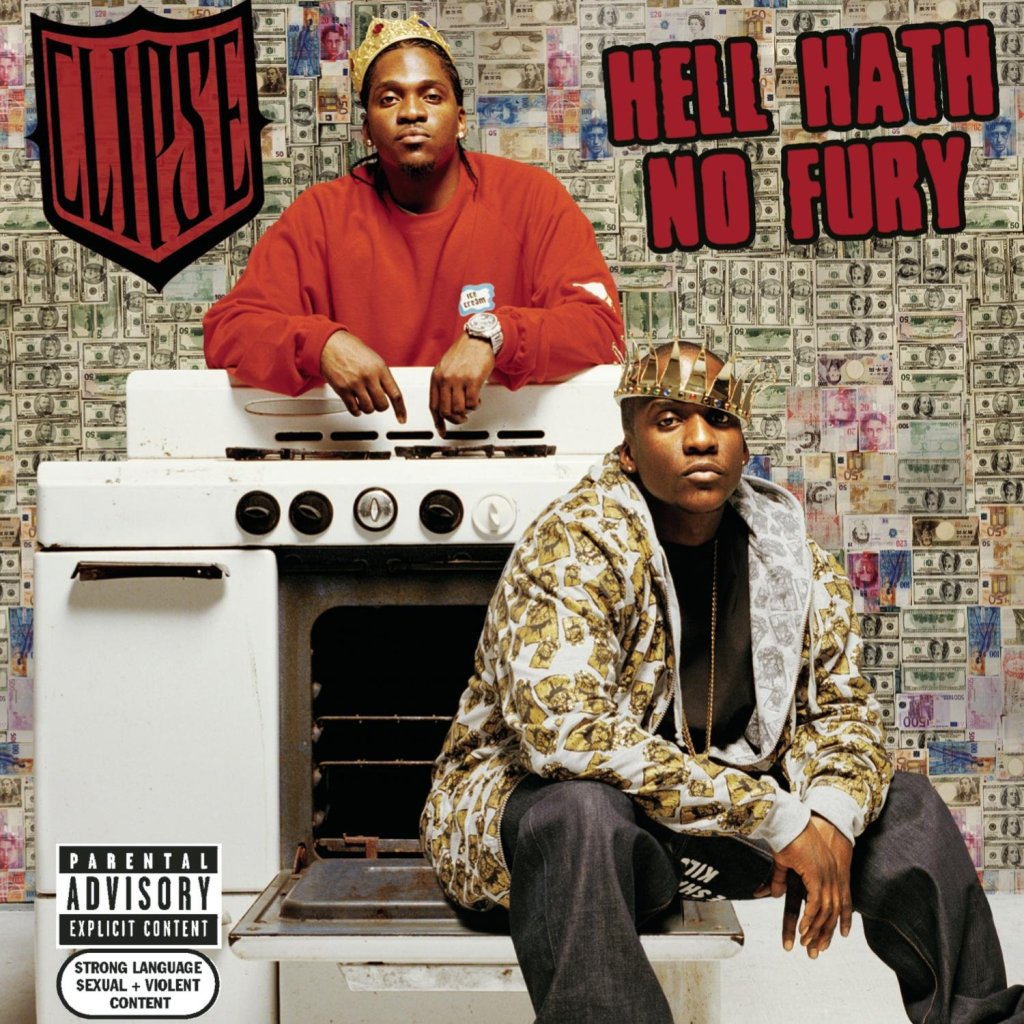
Or so does it seem like it on the surface layer. Let’s rewind a bit to get to what fans would consider to be the swan song of the ageing genre. In Virginia around 2006, a duo called Clipse, made up of Gene ‘Malice’ Thornton Jr. & his younger brother Terrence ‘Pusha T’, have finally gotten a position to release a special record. The album, named Hell Hath No Fury, follows up on the debut album Lord Willin’ 4 years prior which contains many of trademark characteristics of the duo. In spite of the glowing reception of the debut, the feud with their signed label Jive means that Hell Hath No Fury must be delayed many times in favour of pop acts between 2003-2006.There is one shelved project that dates back to the late 1990s called Exclusive Audio Footage which is said to take on a more cinematic approach to one of their most notable subject matter.
That is none other than their constant eye on drug dealing – expect play-on words & the likes to allude all the way back to the outlawed side of the U.S’s War on Drugs & they did so with next to no shame whatsoever. Apparently, Clipse’s obsession with the notion of drug trafficking dates back to the brothers’ childhood at the least where they get exposed to it many times. According to them, they even claim to deal drugs with Malice being kicked out of his parents’ house in his teenage years as a consequence. Thanks to the hit single in ‘Grindin’’, the two makes a big entrance into the competitive world of rapping although they might find themselves to still be lesser known to the wider audiences.
There are many ways to attribute the directions taken in hip hop to Hell Hath No Fury. Reviving gangsta rap is by no means one of them unfortunately as the sales proved to be only moderately nice. However, What Clipse does manage to achieve in their album is that the two manages to push their obsession with the nature of dealing drugs to the next level. Every single songs in the album never divert away from talking about cocaine in the slightest. ‘Mr. Me Too’ is one example as while a featured verse from close friend & producer Pharrell Williams (who’s one half of the Neptunes) is suave in his flexing, the expertise is made known through lines like Push’s “Pyrex stirs turned into Cavalli furs” or Malice’s “Ivory white, yeah that’s the same colour”. You also get ‘Keys Open Doors’ with its pun that’s around the many prospects of dealing cocaine, ‘Hello New World’ which favours the unity of hustlers for the best of the community, or the consequential aftermaths of succeeding in the game in ‘Nightmares’. Suffice to say, there is no boundaries to what the two will try to tell their stories with the aftermaths of cocaine smuggling being a particular mention.
With assistance to their close friends & go-to production act in the Neptunes, the textures around it is quite unlike anything before. The drum beats keeps on ticking, the sampled instruments like the horns or the harps gets warped to add a dystopian twist to the record, the electronica that usually surrounds the hip hop songs is at its most apparent without coming off as being robotic. If you were to listen to the tracks from there for the first time, you could think of them best as a subversive twist on Timberland’s love for forward-thinking stutters by processing it through darkwave inspirations & tribal savagery. The intro in ‘We Got It for Cheap’ takes on a Caribbean influence, yet the organ playing forebodes the well-earned arrogance throughout the album while the vocal hook adds a nice touch to the braggadocio that Clipse shows a fondness of. ‘Wamp Wamp (What It Do)’, ‘Dirty Money’, & ‘Trill’ sees the fullest extent of which the Neptunes show their experimental take through largely sparse yet sharp keyboards & bagpipes usage, explicit rock reminiscence, or visceral synths in the work. Pharrell would also step into many of the songs with the backup vocals & rapping (like with ‘Mr. Me Too’ as mentioned earlier) to the point of being almost alike to a third member of the act without detracting from the listenability.
It’s not only just the unrivalled mastery over painting a picture of the drug trade or the flexibility of the Neptunes’ production that helps rise the album up to the next level. There lies a diverse, yet cohesive listen in all of the songs which adds to to many fans of hip hop & with Clipse, an inclusion of wit makes for one entertaining listen. Take ‘Ride Around Shining’ which mixes the flaunting of success with the fast-paced lifestyle of the mafioso through the symbol of cars & a sinister glissando of the piano that is ripped out of a horrorcore classic. ‘Ain’t Cha’ is catchy for a track that’s made to shame failing or worse, fake drug dealers with a jittery surrounding to the drum beat. ‘Chinese New Years’ deals with the idea of home invasions & robbery with some of the most hypnotic synths in urban music as Push & Malice makes clear their prowess both as emcees & as actual criminals. Last but not least, ‘Momma I’m So Sorry’ takes on an infectious use of the accordion as Clipse somehow manages to connect their success in the drug trade with a philosophy bar around Socrates. You never expect whatever analogy the two will make with their illicit past, but it keeps on landing with no brakes whatsoever & that’s the one thing that keeps the fanbase addicted (no pun intended) to their work.
Honest yet shameless, Hell Hath No Fury might not have seen the commercial success that puts Clipse on the same footing as Jay-Z but that matters little compared to the impact that it has left on the hip hop community. The innovative production from the Neptunes leads to many aspiring producers wishing to replicate the spacey atmosphere while Pharrell Williams’ highlighted success leads him to see more fruitful respect as a popstar in the 2010s. Clipse does undergo a hiatus in the few years after the album with their last album in Till the Casket Drop receiving less love, yet their marks in the scene is all but clearly felt to this day. Pusha T continues to build on the growing success that he has by signing to Kanye’s GOOD Music label & going through a very successful solo career then with his 2018 record Daytona being hailed as being one of the best records of the year. Meanwhile, Malice does stray away from gangsta rap to focus on his bubbling interest in Christianity which cumulates in him sticking to the stage name of No Malice instead & made 2 albums to detail his life as a Christian.
If you’re interested about the fullest extent of how important Hell Hath No Fury is to the hip hop community, it’s that it does end up sowing the seeds for gangsta rap to pop up again in one way or the other. The modest commercial success might not be the saving grace for the wavering profitability of the genre, but the ways in which the album shows its interest in the aftershock of the drug trade is felt in the classic records of the 2010s. Kendrick Lamar’s Good Kid, M.A.A.D City is one example as one can trace a familiarity between the confessional willingness to be violent in order to thrive in the impoverished areas with no backup plans to save one’s life. Freddie Gibb’s Piñata shows the diversity in detailing the gangsta lifestyle in a manner which is similar to Push & Malice’s endless references to the drug trade. The genre of trap could well have owed the Neptunes one for the more explicit taking of electronica without veering into the R&B area of familiarity. In the decades that sees gangsta rap closing in to the end of its spotlight, Clipse proves that there can easily be more to the genre through wit, innovation, & imagination.


Leave a Reply