
Positech’s flagship political simulation series sought to capture the essence of electoral politics. Instead, it oversimplifies the decisions that led to change.
The days of strategy games as micromanaging individual units to decimate an enemy base are well behind us. Surpassing the likes of Warcraft and even subsuming the Total War franchise’s militant emphasis in trending popularity are the Crusader Kings and the Europa Universalises. Namely, grand strategy specialists like Paradox Interactive are sweeping through the market over the past decade with a grassroots community that helped to expand their favourite games through mods. Both the game like Crusader King III and the mods such as The New Order for Hearts of Iron IV put politicking in the centre with players being incentivised to win favours from leaders, build their economic base, and even plot ways to declare wars to expand territory.
Yet, electoral political systems in general are rarely depicted and should it be present, it tends to be shown in an oversimplified manner where the opposing party gets boiled down to background noise. Paradox Interactive especially is lacking in depicting electoral systems where even community-made mods like The New Order often struggle to portray the pressures that opposing media entities and political parties can place on the leading government to implement change. There’s a different company called Positech Games however which sought to represent electoralism in practice and that comes through in their flagship franchise – Democracy.
Democracy is a simulation game where you lead a government to change whichever country you decide to be the head of and to win an election. Consisting of several turns that represent three months up until an election, you use a numerical representation of political capital to implement or remove policies to win over public support such as adding a new type of tax, founding a national healthcare system, and sorting out the judiciary as well as the law enforcement. You additionally need to deal with situations based on the consequences of your policies and dilemmas where you need to make a decision that will affect your country all the while you win over voting blocs and alienate another at the same time.
I won’t comment any more on Paradox’s own representation because it’s ultimately there to establish the rarity of political simulations that doesn’t involve accruing land. There are others who already deal with that subject well enough. However, while you can at least get to know who your oppositions are and their potential motives in the likes of Crusader King III, Democracy finds itself floundering in its attempt to portray the struggles of maintaining power in a judicious way. Be it widespread criticism by the media due to ideological motive, prominent party members proactively pushing back against your agenda, or disadvantages set by constitutional layout, the game didn’t go far enough in its gameplay to warrant an engaging experience that highlights the inner workings of politics.
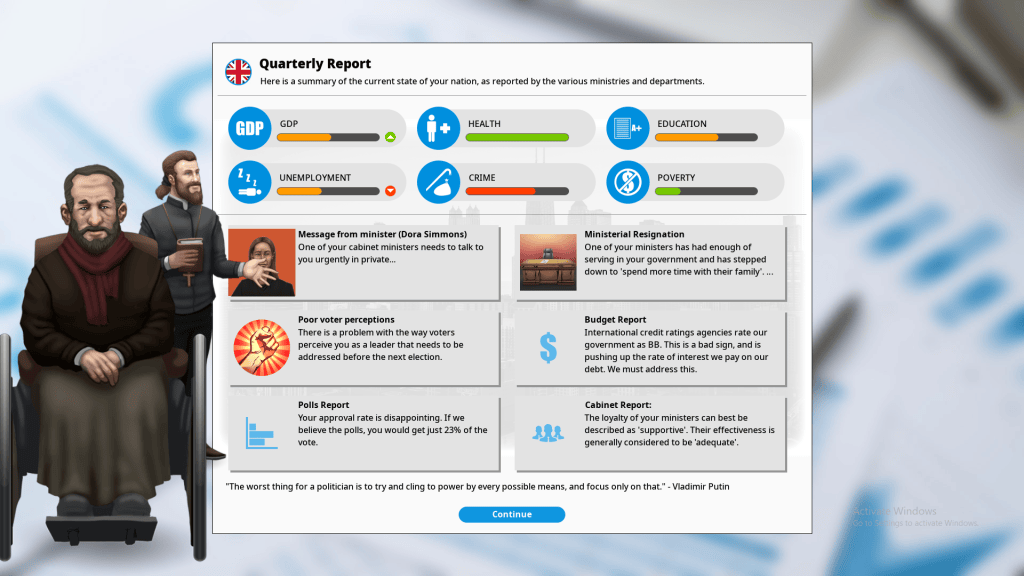
Democracy’s representation of opposing media or parties are shown through the page following a turn which shows an update on your economy, the index of education and health, and your popularity. You would get a news story about a citizen whose interests or acquaintance happened to be struggling due to your decisions. These are supposed to engender the negative consequences and how you’re hurting others. However, real life doesn’t simply just adjust itself according to the problems that have arisen. Many of the newspapers tend to have an agenda even if they like to proclaim their impartiality or objectivity.
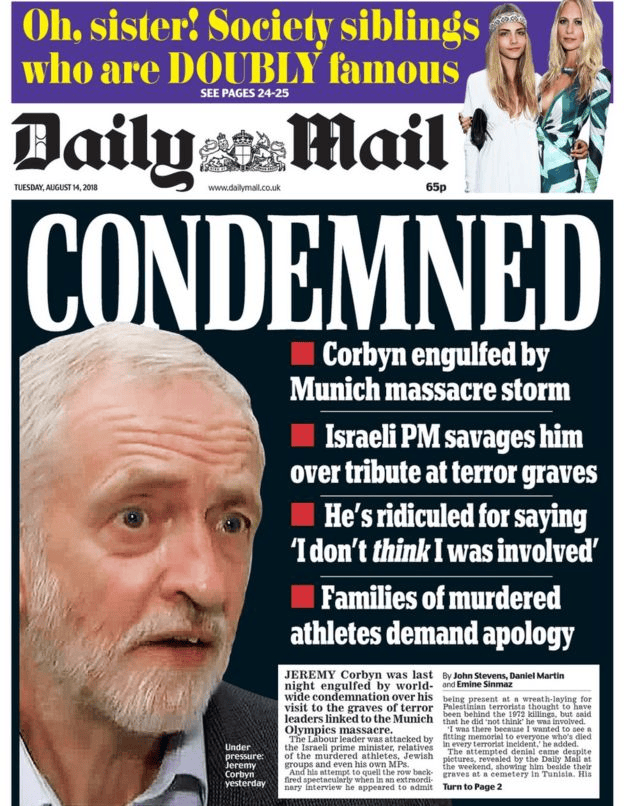
One of the most notable examples surrounding the viciousness of newspapers was the United Kingdom’s 2017 general election between the Conservative Party led by then-Prime Minister Theresa May and the Labour Party led by open democratic socialist Jeremy Corbyn. With the preceding election two years prior being driven by the vote for the country to leave the European Union dubbed as “Brexit” (which happened soon after following a referendum), this one served as an autopsy on the sentiments surrounding the departure. May’s government also came under pressure surrounding national security throughout the campaign due to terrorist attacks while other issues like student loans, taxation, and social care can add or take away support from key voting demographics.
Yet, much of the criticism was placed instead on Corbyn who had not held any political office under any circumstance outside of being a Member of Parliament. As early as in 2016 just after his ascension to party leadership, the London School of Economics and Political Science published a report to point out how the majority of the country’s leading newspapers like the Sun, the Daily Mirror, and even Labour-supportive names like the Guardian are critical at best of his views, stances, and manifesto. As recently as last year, scholars like Maximillan Guarini had noted the long-term effects of the slander by pointing out how both the visual imageries surrounding the coverage and the contextual fears around left-wing politics through “the red scare” can further shape the country’s reaction towards its ally the United States’ aggression against China.
The result in the 2017 general election was thus met with turnout that saw Corbyn’s party fall short of acquiring a parliamentary majority; May’s government was able to maintain just enough of it to remain in power. It was in 2019 when the intensifying attacks from the media – and the switch in leadership from May to pro-Brexit Boris Johnson – that pushed the Labour Party to having its lowest number of won seats in parliament since 1935. This was in spite of Brexit still remaining as a key issue with preliminary research coming out to suggest that it will pose a negative economic impact on the country as a whole. A major part of Democracy’s shortcomings, in a nutshell, is its failure to portray institutional discrimination against ideologies that are relatively not linked to the status quo.
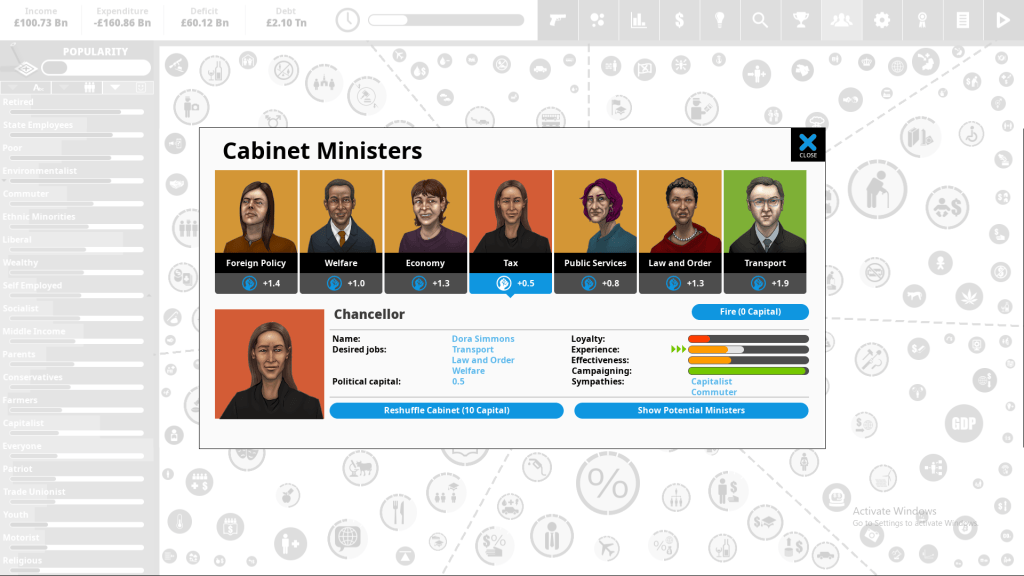
Democracy’s issues lie in the lack of representation surrounding opposition specifically from within the party. Within the game itself as we know it, you would often need to deal with cabinet members whose sympathies and expertise might not align with your goals and ideological priorities. At worst, you would receive notifications that warn you of their discontentment and their premature retirement should you not appease their interests. There’s at least a snapshot of how factions within the party can complicate major government programs if it doesn’t fit with their specific visions. What the game falls short of however is its exploration of entryism and the extent of which donors can drive division within the party.
Let’s look at the US for another example. In the country, you have three legislative branches in the White House with the lower political chamber being the House of Representatives. Being a de-facto bipartite country since its inception, the seats are split into the Democratic Party and the Republican Party with the two having their own factions. The past 15 years saw the more ideologically driven wings like the Republicans’ Tea Party Movement or the Democratic Socialists of America-aligned Democrats rise in prominence to take up federal or gubernatorial seats. The last two years since the presidential 2024 election especially saw figures like Zohran Mamdani win elections as mayor of megalopolises like New York City whose outspoken socialist views only add more widespread popularity. Meanwhile, federal backbenchers like Randy Fine proved impervious to what would have been career-ending scandals and controversies that stem entirely from their views.
Democracy lacks the gameplay mechanic to replicate members within your party who yield soft influence thanks to their convictions and their individual popularity. Similar to the donors whose fundings allow you to build on your progress towards winning the next election, those members, let’s dub them as “mavericks”, would pressure you into adopting policies that align with their stances with the extra bit of complexity being that they could also push public perception of them without needing a situation to arise. The option to boot them will be contingent on their own popularity where the more beloved they are, the bigger the hint you take from your support should you opt to kick them out of the party. If they fall out of favour, the cost will be minimal although they could join the opposing party to boost their popularity instead, thereby ensuring that they’ll remain a major threat especially if the public’s weary of you.
The final issue with Democracy and its limitation is that it fails to consider the constitution of which the government itself is dependent upon to both hold public mandate while ensuring that its country can remain stable no matter the leadership. On paper that is. A competent enough player can effectively game the entire playthrough by optimising their cabinet to share overlapping sympathies, push through policies without regard to public reaction or opposition to later praise, and comply entirely with a handful of set demographics to build support on. You never get a full glimpse of the system that you are supposed to be working in and the limitations you might have be it an uncooperative or partisan supreme court, a parliament that rarely sees an absolute majority in its dominant party, or even limitations on what policies you can enact based on the articles.
The value of the constitution and the governmental system along with the ways that they add to the gameplay couldn’t have found a better example than the Weimar Republic. The post-First World War state which largely took the borders of modern-day Germany was fraught with economic woes and political radicalisation. Its constitution in particular was argued up to this very day as having massive loopholes that could be utilised to enjoy absolute influence over the country which, under a dysfunctional enough parliament called the Reichstag, can lead to numerous constitutional crises. In particular, certain clauses like Article 48 or Article 25 can be used to immediately gain power to rule over the country. This happened in full in the 1933 Reichstag Fire which was seized by the National Socialist Party under the leadership of Adolf Hitler to seize full control of the parliament. Sweeping laws and legislations were enacted to allow for a totalitarian dictatorship that reigned until the end of the Second World War.
Democracy could have a similar (albeit oversimplified) set of constitution that’s different in each of the initial set of countries to rule over along with the system to dictate your political capital. Not only do you need to try and juggle rebelling party members whose support would be critical to adding in key policies that could help cover up debt or boost public support, you also need to work around the constitutional limitations that mandate or prevent certain laws from being enshrined. Clauses can be enacted depending on the situation which will reward you political capital at the cost of political polarisation or public apathy. With the votes you can gain from the election to approximate the amount of seats in the parliament or its equivalent you managed to win, you can even seek to replace or rework certain articles at the cost of increasing possibility of being assassinated or growing interparty discord.
Democracy has an interesting premise in that it doesn’t simply cover foreign policy as a central part in government simulation but rather as a piece in an interconnecting web of complex relationships that could be exacerbated or fixed by certain policies. It’s not a grand strategy compared to Paradox’s games where you feel incentivised to take over territories nor does it have a more niche focus on dictatorships and hybrid regimes like Tropico. It feels too barebone however in its general gameplay mechanics and it fails to capture the full array of complexities that comes with actual governance where the media can be more biased towards the establishment and political opponents are much less forgiving should you make a blunder. I would very much love it if these ideas were to be added in in the future. That would make for a more dynamic experience that, even if it falls just short of reality, would really make you feel like you have to appease every side of the aisle. No. Matter. What.
 GutterPutter
Leave a comment