
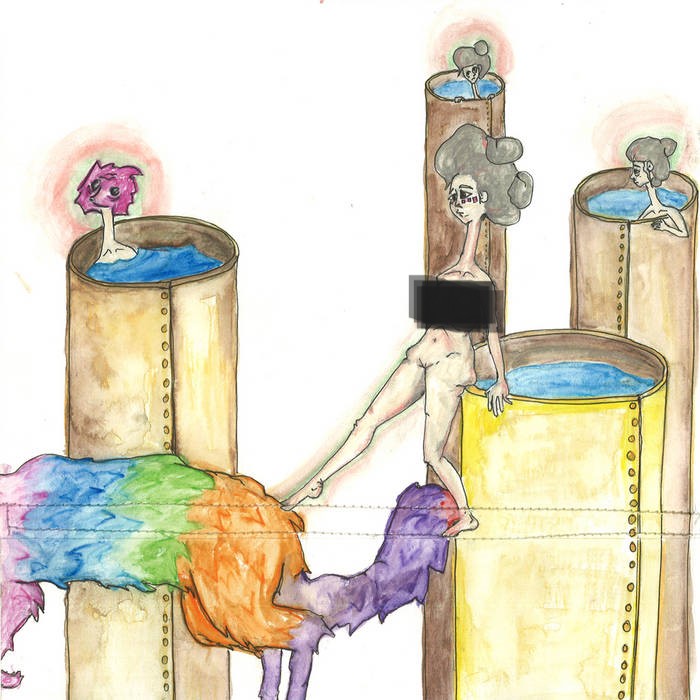
To say that a 2013 electropop gem is overlooked is an understatement in how it shows queer representation through chaotic production.
When I was doing my Under The Label entry on hyperpop, I stumbled upon an album while looking for examples of records that hold notable influences from the genre. It’s titled Bodysongs by Canadian singer-songwriter and avant-pop artist Cecil Frena (then known through his past stage name Born Gold). At the time of writing this article, the album has an average rating of 3.42 aggregated only from around 300 users (and the rating’s 3.30 when I first discovered it!) with a considerably small following. Many of these fans do wonder from time to time whether or not Bodysongs will one day receive considerable acclaim and reputation. One that puts it on similar levels to either that of Silver Apples or even Daft Punk’s at least with Discovery in comparing electronica-driven music.
On first hearing, I can definitely see what makes a record like this a precursor to the genre and indeed, I enjoy it very much. As mentioned previously on the hyperpop post, the singing and 8-bit production gives Bodysongs its own peculiar identity of being experimental without alienating its conventional pop structure. I did however listen to the album a lot more a few months afterwards which is when I began to take note of the different characteristics that made it not just special, but even eyebrow-raising in how overlooked it is. I would go as far as to argue, as the ‘thesis’ of this article, that Bodysongs is one of the most underrated albums of the 2010s at least.
From its examinations of bodies and how it manifests gender identity or mental health to its kaleidoscopic production, let’s break down what makes the album unique. Had it just been lucky enough to get the attention of Pitchfork at the times of its release, Frena would more likely be featured for a conversation about his style rather than 100 gecs (which says a lot given how good the duo are already). A far cry from my initial impressions, there is something about the album that clicks when you notice how one vocal note or erratic time signature can flip the whole meaning of the song in its head. It’s truly that much of a gem.
Context
The theme of gender ambiguity has been a staple point in pop music since the 1970s with David Bowie thanks to his androgynous aesthetic as Ziggy Stardust. Through his theatrics and avant-garde interests, many genres, artists, and movements opt to adopt his style as a key characteristic. The New Romantics have attempted to push the ethos of post-punk into mainstream attention through extravaganza and glamour. Meanwhile, queercore pushes LGBT+ perspectives into underground music with queer and trans identity being explored in greater details. As Canada is a member of the British Commonwealth, the effects of Britain’s cultural scene on Canada on top of sharing borders with an entertainment industry powerhouse will lead to a plethora of new perspectives on gender. The major national representation in Tegan and Sara helps queer representation stand out against what is perceived to be a largely capitalist system which discourages minority groups from performing.
Meanwhile, The sense of dancing between the lines of mainstream and alternative music, one that’s felt through playing around gender norms, that led Cecil Frena into making songs. In their Forbes interview, they said that their music career had started off from playing with hardcore punk hands before working on pop music. Specifically, they note that with Bodysongs, they see it as unique since “rather than aiming for some kind of comfortable universality, it’s pretty confrontational and abrasive in its immediacy.” This admittance that the album is supposed to stand out through its contrapuntal mix of chaotic left-field production with conventional pop accessibility helps to bind together its uniqueness. It lays the groundwork of what makes the whole of the album worth well more than the sum of its parts.
It’s not just the implicit queerness or avant-pop direction that makes Bodysongs a masterpiece in need of excavation. The album is released right at the point when independent music is looking to leave its mark on the mainstream. For example, Arcade Fire made history when their third album The Suburbs won a Grammy award despite their relative obscurity back in 2010. Meanwhile, online platforms for sharing music like Bandcamp or SoundCloud are gaining traction for their grassroot emphasis where small artists are allowed to publish and interact with fans at their own whim. This places further emphasis on how Bodysongs serves as the bridging point between underground and mainstream music.
“…We All Cut Close” – Glitchiness, Retro-Aesthetic, and Vibrancy
Glitch pop had long been a staple in underground electronica thanks to Sweet Trip’s 2003 magnum opus Velocity : Design : Comfort. Its deliberate use of clicks, erroneous repeats of the same vocal sample, and heavy reliance on ‘bad’ production gives the genre its unique charm. By splitting the immediate catchiness of pop music structures with a wonky, abrasive beat and editing, you find yourself in this ever-so-evolving stance of simplicity and complexity. This erraticity is what enables artists like Sweet Trip or later genres like hyperpop to earn recognition as being forward-thinking.
For Bodysongs, glitch pop sees itself be blurred with the more notable electropop which leads to a surprisingly unique indietronica record. From ‘Decimate Everything’ for example, we can feel the mixture of bitpop and chiptune influence in the beat feel as if it’s on the verge of collapsing through the clicks and irregular layers of programmed drum. Chuck in the subtly altered high note that Frena manages to hit and you always find yourself weaving between the vocal editing. This similar process happened to ‘Wombstone’ which constantly shifts between Frena’s radio-buffered singing and the chipmunk-tuned refrain amidst the stuttering edits using the same small cut.
There are extra small bits of influences within Bodysongs’ tracks that enable each one to stand out on their own terms. The most notable examples I could think of would be the relative dreamy drone effect on ‘Wrinklecarver’, ‘Alabaster Bodyworlds’ with the use of noise as an introduction, and the abrasive impression given to indie rock with ‘Lawn Knives’. By not fully abiding to the electropop conventions in favour of avant mixing, Frena is enabling each track to have their own nuanced identity. It’s through these differences that allow the album to be all the more exuberant in how the songs transition to one another; it’s the one key factor that is worth keeping in mind when exploring queer identity and dissonance.
“That’s not what your body said” – Gender Dysphoria, Euphoria, and Nonbinary Identity
Out of my initial impressions around Bodysongs, the one opinion I once had that aged the worst, would have to be my thoughts that there were no examinations of trans issues. At that time, I am thinking more so in the angle of social justice or discrimination compared to contemporaries like Jordaan Mason. As a sign of bad criticism on my behalf, I haven’t even thought much about the significance behind the interest with limbs and body parts. After all, the album is just a ridiculously overlooked prelude to hyperpop given the release date. Frena doesn’t appear to be too concerned with trans rights and it’s very likely that they intend Bodysongs to just be a fun zeitgeist of a project as Born Gold. As examined later on, there’s a lot more to say about the album’s potential intent outside of its artist.
EDIT: At the time of writing, I haven’t checked Frena’s recent social media updates to notice a clear preference in pronouns. Someone on Twitter had kindly reached out to me to say that Frena now goes by they/them. In response, this article will not only be updated to accurately reflect on the artist’s pronouns, but it further recontextualises the importance of non-binary/trans theme in Bodysongs. To say that this is a big revelation is an understatement in the context of the album as there’s a greater legitimacy that interpreting it through queer perspectives is not only plausible, but even obligatory.
By the time June comes around for Pride Month, I begin to think more about the motif of the body in the album. If we were to begin with the first track ‘Lawn Knives’, we’re first introduced with “We all cut close”. We do not assume much about the need to ‘cut close’ on a literal basis as we’re met with metaphors about being a woodland nymph and lying exposed on grass. This innocuous representation, reaching its peak with the outro “Let no one know”, gets flipped on its head in the end as Frena unexpectedly screams it out loud in rage and desperation. This is when trans/nonbinary representation really starts to come alive through the breakdown of a twee and energetic opener.
I’ve inferred in the first previous paragraph that the album doesn’t have much social commentary on trans rights. Not at least with regards to clear transphobia. While you can argue that the lyrics in ‘Lawn Knives’ are analogous to hiding your true gender with your biological sex, I think it’s more about the Eden-like value of dismantling gender roles. There’s really no explicit mention of clothes in the album. In fact, we can insinuate from the album cover that nudism is the key part of understanding our bodies for the better. To go along with how that point works, we need to picture clothes not as just something that you wear to keep yourself warm and comfy, but as mechanisms to uphold gender roles. This will therefore help us in uniting the rest of the album.
Much of the tracks would examine our bodies as a constant fight between your gender identity and your biological sex. ‘Eat Sun, Son’ is perhaps the most poetic when it comes to exploring the angles of how gender dysphoria is represented thanks to its Biblical allusions. Starting with an appreciative praise of the “womb [as] a mountaintop”, the fantastical innocence clashes with “the flames / Of gehenna licked” as “A demon and a god are now / Raging inside / Of your sacred fever”. There’s a certain density to be found as what seems to be a sign of euphoria, the ecstasy that you feel that your body is now in sync with your gender, gets a whiplash of anxiety and dread. How confident do you feel about being born in a body that you do not want? One that you try to change to fit your gender, only to feel distressed?
“…By the live you never wanted” – Complete Musical Dissonance
Between the queer-interpretative lyrical themes and the rhythmic production, this marks the point where the real magic begins. As most electropop songs tend to be played as either more wholesome tunes or as club bangers, it sets up a perfect way for Bodysongs to feel as if it’s all over the place. And I mean that in a positive way. There’s a versatility that could be felt where the songs at first would play an infectious, yet abrasive beat that would then collide with the angsty feeling of your body being out of touch with your gender.
To illustrate that, let’s look at ‘End of Days’. Here, the instrumental is among the most optimistic where its clicks only add to the bass-boosted snares and wavy compression. The relatively hopeful production stands in contrast with the implied depression one would feel in their dysphoric breakdown as exemplified by lines like “I’m bound by stranger feelings”. This is further supplemented by ‘Boring Horror’ where the harmonic humming chorus stood in contrast with the contrast repetition of “That’s not what your body says”. This dissonance mirrors the conflict between the outward gender expression that one would feel happy with showing compared to the orderliness and authority of the body. Many of us will always feel more comfortable getting out of the pre-assumed behaviours we’re expected to possess based on our biological sex. However, even our subconsciousness would often put us to shame for questioning the arbitrariness of our body’s rules.
This then leads us to ‘Early Birthday’, the final track that touches on mortality on the surface layer. With everything that’s going on with the album, I think that this song is the most overt we’ve gotten to a social commentary on trans rights. The melodic chiming of “It’s what it is”, rendered in a cutesy style through the considerable compression, tends to follow the stark picture of being left out in the cold. At least to me, this feels reminiscent of ‘The Little Match Girl’ by Hans Christian Andersen which thematically looks at appreciating the brief acts of kindness in the final moments of your life. The criticism of there being no support for trans people is not only apparent, but it’s even strengthened through the mocking use of optimism.
Even without the reference, you can feel the pessimism worming its way through the track. The chorus is a call-and-response that’s layered under different effects, masking the discontent underneath the expressive and even jocose beat. “We all have time! I doubt it / You’ll be just fine! I doubt it” goes the first half as we’re confronted with the grim picture of dying. Instead of the spiritual happy ending that we hoped to accomplish, we’re greeted with our final hallucinations/memories being “the lives you never wanted / But you lost”. The fatalistic outro, repeated until the last thirty seconds when it’s been cut instantly by silence before continuing on with grainy clicks, only adds to the tragedy. Our desire to express ourselves the way we feel is the best comes second only to the unnecessary traditions and apathy that were set in stone.


Leave a Reply