
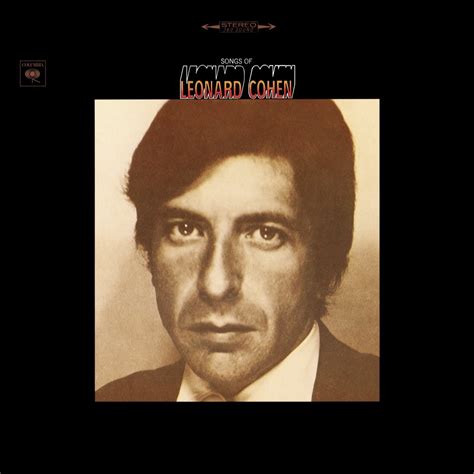
Fifty five years after its release, the Canadian poet/author’s debut as a singer-songwriter stands among the greatest lyrical records of all time.
“In his concerts, Mr. Cohen played the venerable sage, dapper in his suits and precisely angled hats. He was also sly and avuncular, making droll, deadpan comments in his sepulchral voice. He had aged to match the perspective he had brought to his lyrics since the late 1960s: a long view that stretched back to biblical and psychological archetypes and envisioned myth and history — and the mind-twisting economy of Zen koans — far more often than the everyday. Perhaps because he was already in his 30s when he set aside novels and poetry for songwriting, he was a grown-up from the start.”
Jon Pareles, ‘An Appraisal: Leonard Cohen, Master of Meanings and Incantatory Verse’, New York Times.
Enshrined as being among the definite greats is one who doesn’t start his adulthood off as a folk musician nor is he an amazing singer. Instead, his background is intrinsically tied to literature. In 1956, at the age of twenty-two, Leonard Cohen embarked on his rise to fame through his poetry collection Let Us Compare Mythologies. Between 1957 and 1966, he buried his head not with which music notes work best or what instrument should he add into his songs, but rather with which word fits and what prosody should his poems follow. Many thought of him as one of the most promising writers of his generation. Some had already penned him to be the best wordsmith alongside the likes of Ted Hughes who was already acclaimed for his works in the 1960s.
No one would imagine Cohen to become one of music’s patron saints of the 1960s’ folk revival movement. Let alone lyricism.
Birth of the Album

The first edition cover for Leonard Cohen’s debut, 1956’s Let Us Compare Mythologies. Much of the poems within the collection thematically deals with the same subject matter that he would eventually cover in his debut record such as love, humanity, and religion. While his literary career is overshadowed considerably by his singer-songwriter route, his collections enjoy a bout of republishing as a result of his fame.
Whether we think of someone who’s renowned for their poetic flair in songwriting, the first name that always popped up is Bob Dylan. Being the preeminent lyricist since the 1960s, his anti-war stance, Biblical tales, and seldom-seen introspection makes him a favourite of even literature teachers. Meanwhile, the music press’s go-to artists for their storytelling and emotional, even if they might not be as overtly eloquent, includes Bruce Springstein, Joni Mitchell, and Patti Smith who rose to recognition in the 70s. Now, much of the public would cite Taylor Swift or Ed Sheeran as having decent writing even if several critics or snobbish music fans argue otherwise. The main strength behind the singer-songwriter genre is its pre-supposed sense of honesty in its lyrical content which makes many listeners relate to it.
As for someone like Leonard Cohen, it’s rare to see someone who decides to enter the music scene with a background in creative writing and literature. Usually, people like Tim Hardin or Tim Buckley, who are both seminal names back in the folk revival of the 1960s, would make albums simply as soon as it is clear that they have a natural flair at writing lyrics. They are mostly little known with a potential to skyrocket in their reputation through networking with other musicians. They do not enter the scene with an acclaimed novel like Beautiful Losers. Such ambition tends to be polarising and risks leaving the artist split between the artsy criticisms of literature and popular music’s far-reaching accessibility.
That fact deters Cohen… with little effect. For all the praises he had received back in 1966, he sees little financial success as a writer. With his teenhood spent on learning how to play an acoustic guitar and spending his time in a theatre programme, he has shown some makings of a decent musician on set. You could see that through the fast-paced Spanish playing in ‘The Stranger Song’ or ‘Teachers’ which adds tension to the ambiguous characters and their roles. Of course, he’s not the kind of individual who’s famed for his guitar skills, he simply sees it as a means to help add texture to the world that he’s crafted.
Many people have long praised his lyrical wit and Songs of Leonard Cohen is no exception to the rule. ‘Master Song’ takes on a sexual relationship through the binary feeling of subservience, often alluding even to Cohen’s sensitive Jewish heritage and his affinity with religion. ‘Winter Lady’ is akin to a fairytale which tackles unrequited love through his fantastical descriptions to his muse. “And why are you so quiet now/ Standing there in the doorway?” Quipped Cohen with a sign of haughty bitterness, “You chose your journey before/ You came upon this highway.” ‘Sisters of Mercy’ depicts an eternal gratefulness of the titular organisation through ecclesiastical language; expressing joy at their potential in spiritual renewal.
The biggest highlights in the album are ones that are drawn from Cohen’s life experiences. ‘Stories of the Street’, inspired by his journey in Havana in 1961, critiques the systematic greed and authoritarianism that permeates society. Children are already thought of by their parents with predetermined plans on birth, dreams were crushed, and hedonism runs the world. It’s in the beautiful simplicity of our existence that makes life worth living. ‘Suzanne’ and ‘So Long, Marianne’, two of his most famous songs aside from 1984’s ‘Hallelujah’, were inspired by his relationship with his two muses – one from a friend who he often visited often and another his girlfriend who commuted with him from 1960 to 1972. Sensual, cathartic, and heartfelt penetrates the two songs in their thoughts about the relationship and the imminent fading of their love.
Legacy
There are many other highlights worth touching on such as the wholesome ‘Hey, That’s No Way to Say Goodbye’ or the lamentable ending in ‘One of Us Cannot Be Wrong’. Of course, what all these songs cumulate in is an outstanding piece of long play that leaves an indelible mark on music. Praised by many as being up there with the very best of Dylan or Nick Drake, the prowess of Songs of Leonard Cohen is hard to ignore. Dylan had once said on Cohen’s songwriting that he doesn’t so much write songs as he does “prayers” in an article from Far Out Magazine.
In AllMusic, Mark Demming opined that he “worked this [music] alchemy the first time he entered a recording studio; few musicians have ever created a more remarkable or enduring debut.” The Academy of American Poets have praised Cohen’s balance between his literary talents and his fascination with folk music, having commented that his fanbase saw in him a “Renaissance man who straddles the elusive artistic borderlines.” As far back as in 1973, Nancy B. Wetherell inferred that Cohen possesses such a strong grasp in his wordings in his music that he is suitable for literature students to learn about to better understand Modernist poets. (1973, 553) That’s how much respect he managed to garner for his talent and it’s no surprise for the likes of the late David Berman to have drawn favourable comparisons to him.
Songs of Leonard Cohen, to this day, is lauded by many as a highlight within the Canadian poet-singer’s eventually large discography. Until his passing in 2016, he still dabbles in traditional poetry writing although his prose experimentations are all but left behind with A Ballet of Lepers being one of his only other works to be published (albeit, posthumously in 2022). His career in music is without a doubt amongst the greatest of all time and it’s thanks to his debut that he could afford to establish a portfolio that leaves many artists jealous and in dust.


Leave a Reply