
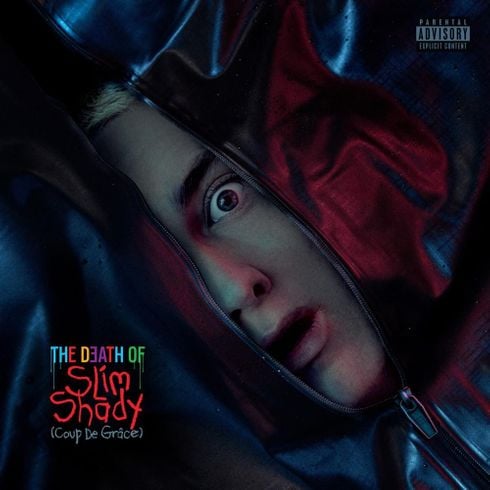
Marshall Mathers’s latest album is an outdated, edgy, gruelling mess of a midlife crisis album. At least his technical skills are as sharp as ever.
Eminem, also known as his real name Marshall Mathers, also also known as Slim Shady, is without a doubt one of the biggest names in hip hop. Throughout his near-mythic run between 1997 and 2005, he went from being a nobody of a white rapper to being one of the genre’s greatest ever artists. His rhyme and flow is imaginative beyond measure, his topics are transgressive to an awfully cartoonish level, and his image is unlike anything else in the scene. With the Slim Shady LP, Marshall Mathers LP, and The Eminem Show on his belt, he manages to strike the perfect balance between commercial success and critical reception, however divisive his bars are to many listeners.
In the next two decades however, Eminem shifted his music towards a rather weird direction. As a handful of his fan base grew up to emulate his style, his music started to take a lot more pride in his technical prowess. The sequel to the Marshall Mathers LP had one of its lead singles be about him rapping the fastest verse possible which is impressive, but its novelty wore itself out at least from my experience. Revival is a weird, weird twist of a rap rock record with its star-studded features not meshing well with some of his most forced flows and rhymes to date. And then you have his crusade against the “mumble rappers” on Kamikaze and Music to Be Murdered By where, however much the oldheads cheered him on for keeping the spirit alive, it would have been better spent on hyping up upcomers like Token.
The Death of Slim Shady (Coup de Grâce) is Mathers’s latest output, the comeback of his iconic alter ego that represents his edgiest, ballsiest shots at black comedy and horrorcore. On the surface layer, it’s not hard to see what makes Eminem so beloved among his following. With three decades under his belt, his rhyming is borderline effortless. ‘Antichrist’ and ‘Bad One’ sees him rap “wet dream” with “head shrinks”, “jesting”, “swept clean” and so on which is no laughing matter. The selected features also deserve their praises with JID popping off as usual with his alliterative flow in ‘Fuel’ and Ez Mil mixing Tagalog with English in an infectious manner on ‘Head Honcho’. I have never heard of the latter before, which is a big bummer on why Eminem didn’t put the spotlight on overlooked rappers more often.
In addition, the beats can, from time to time, be fun to vibe along with. ‘Trouble’ combines boom bap with a faded form of cymbals to give it a Gothic feeling as Eminem faces off against Slim Shady. Kudos to Fredwreck and Dem Jointz for the effort. Additionally, ‘Tobey’ has a twinkly keyboard BE built on electric guitar riffs and harsh snare fills which adds a lot to the three-way collab with BabyTron and Big Sean. Lastly, ‘Houdini’ revisits the classic beat off of ‘The Real Slim Shady’ in a way that sounds more enjoyable. Its beat is done on an accelerated rate and the harmonised vocals gives a deliberately kitschy feeling to the whole listening experience that makes it endearing.
Now, I want to take a break from the compliments for one moment which is an understatement. Let me break down the problems I have with much of the album. Firstly, if there is one development I could point out about Slim Shady, it is that his re-emergence is comparable to finding your favourite underrated actor in a chance encounter who gets themself strung up on chronic addiction. ‘Somebody Save Me’ is an attempt in sympathy regarding Enimem’s drug dependency, yet its stark difference to what might well be 95% of the records and as the outro meant that it feels too out-of-place. ‘Bad One’ mixes some pretty questionable disses sent out to “these corny white rappers” without some self-deprecation and an awful attack on André 3000’s venture into new age music. I’m not saying it as a biased fan so much as in disappointment because the least he could do is double down on the failed love 3K had with Erykah Badu.
So much of The Death of Slim Shady is transphobic for some reason! I could at least get the justification of it being edgy or provocative like in 1999, but so much of the material ages like horseshit. Tracks like ‘Brand New Dance’ are suspicious enough in its mention of Caitlyn Jenner even though it’s actually an outtake from the Encore era in 2005 based on ‘Guilty Conscience 2’. Yet, songs like ‘Evil’ or ‘Road Rage’ try to play into the largely unfounded assumption that trans people are just confused about their identity. Never mind the fact that they already realise the kind of person they want or need to be a good while ago. This gets even weirder when you take into account how one of his adopted children, Stevie, is non-binary. Regardless of however close he is to working towards his concept, it is blunt to a fault to put it lightly.
The more I think about the album and how a character like Slim Shady just wouldn’t fly in today’s world, the more I feel that the shtick should have been taken apart rather than be played straight. ‘Lucifer’ retains the edginess and while the bars didn’t feel as quotable as on classics such as ‘Like Toy Soldiers’ or ‘Lose Yourself’, it contains some nice political shots at Candace Owen and the MAGA movement. ‘Temporary’ continues to carry on Eminem’s heartfelt odes to Hailie which, in spite of its weird pauses, does work as an emotional pause thanks to frequent featured name Skylar Gray’s singing. And then you have skits like ‘Breaking News’ or ‘Fuel’ that went on an unhinged rant about either wokeness or foot fetishism respectively. Cool.
The scatterbrained quality, questionable balance between edginess and conscious commentary, and a seemingly unfocused concept gives off the impression that this record is one big episode of a mid-life crisis. At this time, Eminem’s legacy is more than well-secured as the white rapper everyone is going to think about. Unfortunately, his field is full of either copycats who hold the same stances that he sought to tear down or emcees like JID who raps with a ferociousness that gives him a run for his money. To me, this record makes a lot more sense if, instead of it being an all-too-straight takedown of Slim Shady, it is about an ageing legend who is getting left behind by the very genre he helped to make into a global phenomenon. When the album ends with his apologetic angst to his family for his fear of relapsing into his drug addiction, there is a very real fear about how a rags-to-riches icon like him could mess his entire personal life up regardless of its shoddy execution. I would rather that his records be more similar to ‘Mockingbird’ conceptually than it be a hackneyed repeat of his South Park audition draft.
To cap the whole review off, The Death of Slim Shady (Coup de Grâce) is a fascinating insight into Marshall Mathers. Whoever Slim Shady is or how he fits in today’s music scene does not matter. This album is an equivalent to a middle-aged superstar whose ambitions, however well-intended it is, crumble at the touch of modernity. His greatest artistic contribution now is that of his talent at rapping but there’s only so much he can do to carry himself with it before it just airs out into a miracle-lyrical-spiritual cliché. Yet, for all its flaws, this is a sobering highlight in Eminem’s career. I know the rapper and Slim Shady and how he makes the whole scene wild with his provocations. I don’t know who Marshall Mathers is and the full extent of his personality.
 GutterPutter
Leave a comment