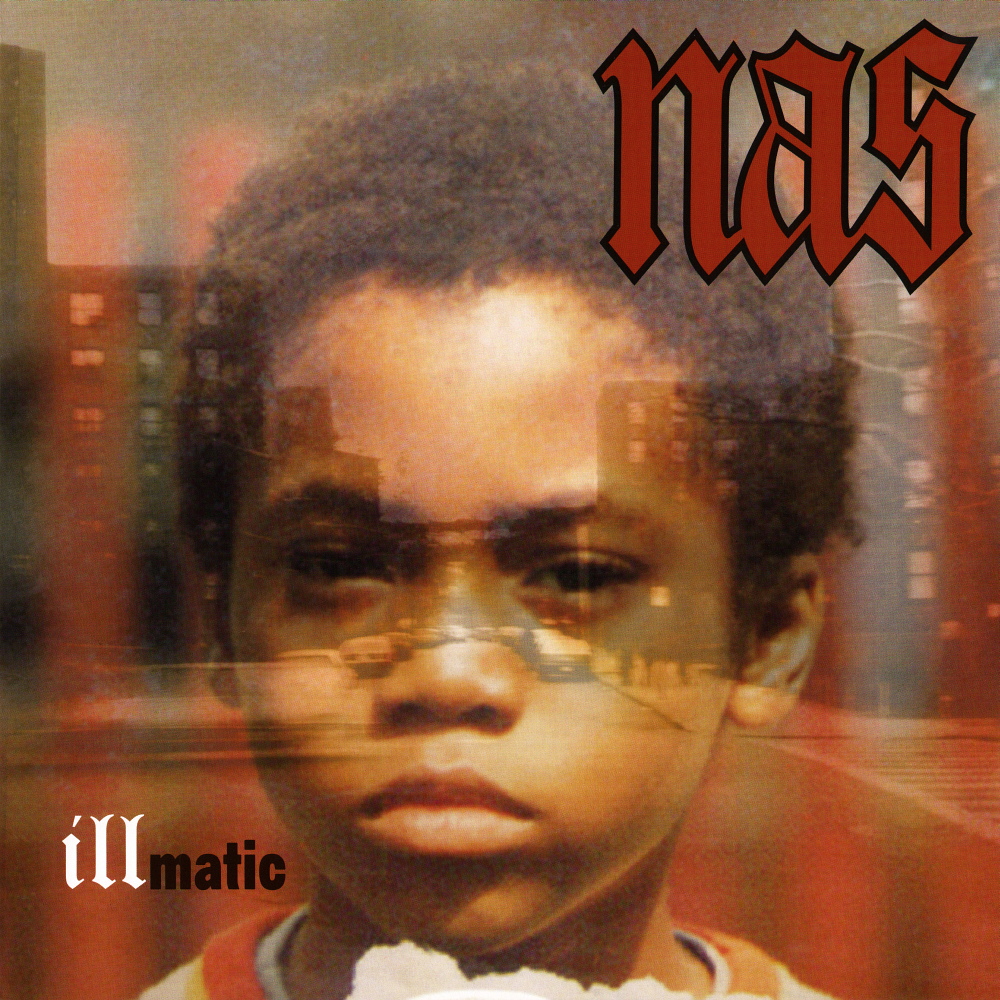
Without the standards set by Nas, hip hop would not be seen as an epic tale about the lives of young Black Americans in the post-War on Drugs period.
When Nas first came thundering in with a guest verse on Main Source’s debut album Breaking Atoms, many already hailed him as having some of the greatest bars of all time. In a posse cut ‘Live at the Barbeque’, he stole the spotlight under main emcee William ‘Large Professor’ Mitchell’s nose with iconic lines about killing Jesus, being iller than an AIDS patient, and destroying the whole of America with his rapping. A self-declared “street disciple” and “son of God”, Nas stood out as a legend at only the age of 17. Breaking Atoms was released in 1991; his breakthrough caused him to spend nearly two years getting the producers and finances needed for his own debut. In 1994, with his name signed to Columbia after an encounter with an A&R executive in Faith Newman, it was time to roll out his first full-length project. It is now seen as one of, if not, the greatest record in rap history.
Illmatic is one of the cornerstones of East Coast Hip Hop, a scene that grew to notoriety through its harsher production and a more cynical, complex type of lyricism about life in New York. Among the key pioneers of the style before Nas gets his foot at the door to greatness includes Public Enemy, one of the first major groups to be based on politics; Slick Rick, an English-born rapper whose storytelling is among one of the most crucial in the 1980s’ development; and Rakim, whose multisyllabic style of flow and rhyming have forever changed hip hop to an insane degree. Nas has not shied from naming the three as being among his greatest influences in his musical artistry. Alongside that comes the pseudo-gangsterism of Boogie Down Productions and A Tribe Called Quest’s jazzy production samples.
In addition to East Coast Hip Hop, the hardcore style of rapping is becoming popularised where the more confrontational, cocky emphasis is the means to assert dominance. Wu Tang Clan’s seminal Enter the Wu Tang (36 Chamber) in 1993 paves the way for emcees to be threatening in a way that relies less on their potential background in gangsterism. On the other end, conscious rap was already hinted at in some rap artists. Acts like De La Soul have deliberately eschewed organised crime in favour of light-hearted or introspective comments on the black community. Meanwhile, the likes of Brand Nubian have used their beliefs (like the Five-Percent Nation) to encourage wider discussions on civil rights, black empowerment, and the state of the music industry.
What makes Nas special in the case of Illmatic is that he mixes all of his influences into one distinct record that, whether we look at it as a whole or as each part, sticks out well above the others. While most of his commercial rivals like 2pac would rely on only one producer back then for their beats, Nas has a repertoire of such with Christopher ‘DJ Premier’ Martin, Leshan ‘L.E.S.’ Lewis, and Kareem ‘Q-Tip’ Fareed alongside Large Professor. This kind of diversity allows each song to stand out on its own leg. Lyrically, rhythmically, or production-wise, there is much about Illmatic that has its own unique characteristics all the while remaining cohesive in its intent.
Nas effortlessly blends his internal rhymes and masterful cadence into narratives about the difficulties of being a black New Yorker while the likes of Snoop Dogg and Ice Cube would rely on couplets to tell their stories. ‘One Love’ narrates his pen-palship with an incarcerated friend, reporting anecdotes on his unfaithful partner, disloyal friends, and the growing number of youths committing crime to stay alive. Under the xylophonic sample found by Q-Tip, there is a sinister undertone that is felt on how matter-of-fact he recalls witnessing or hearing of an acquaintance being killed – “But yo, guess who got shot in the dome-piece? / Jerome’s niece, on her way home from Jones Beach”. ‘Memory Lane (Sittin’ in Da Park)’ takes its direction towards nostalgia and the loss of innocence from growing up in Queensbridge through the more soulful samples that are reminiscent of Motown hits.
In ‘Represent’, ‘One Time 4 Your Mind’. and ‘N.Y. State of Mind’, Nas even embraces the normalisation of criminal living as a necessity to keep on living with his TEC and how he uses his skills to document life in the area. This motif of being a “thug poet” is so prominent that many academics and writers have opted to look at Illmatic as both a Dylan-esque intersection of music and literature and a sociopolitical case study. For the former, Angus Batey praises the vividness and virality of his lines and bars. Who in the scene would ever aspire to be remembered for their songwriting without remembering idioms like “sleep is the cousin of death”, “thief’s theme”, or “Afrocentric Asian”? On the other hand, Dara Waldron sees the value in the album as being emblematic of the unequal treatment many black Americans receive at the time with disproportionate arrests and drug dependency. True to the holistic and journalistic responsibility of his intent, Nas’s clear account of life on the heights of the War on Drugs.
Being hardcore, Nas does not flinch from his mic prowess in his debut. In fact, it is no doubt that much of his lyrical talent shines in the likes of ‘It Ain’t Hard To Tell’ where he drops metaphors after similes after wisdom after braggadocio. Living up to his street reporting is also that of his talent in rap battle. Utterly literary in his talents, he has no problem in barraging you with endless ways to show how he’s better than you. This is later felt in his tracks like ‘Ether’ which brew up his iconic then-rivalry with Jay-Z whom he once accused of being a biter. For a comparison with a fellow emcee, ‘Life’s a Bitch’ saw him play the role of a maturing youngster compared to AZ’s hedonistic pursuits which, by the way, is completely lit in its flow even if there is an existential dread: “‘Cause yeah, we were beginners in the hood as Five Percenters / But somethin’ must’ve got in us, ‘cause all of us turned to sinners”
As for the rest of the tracks, the ‘The World Is Yours’ is boom bap at its finest with its bass and snare drum flowing well with Nas’s appreciation of his life while keeping with him his itch for greater heights. ‘Halftime’ has its shoutout to Ill Will, Nas’s close friend who had passed away from an altercation prior to Illmatic’s release, on top of being a dope first single in his career. The last piece of the puzzle is that of ‘Genesis’ which, as the intro, sets up the whole album through the perspective of rap music as escapism from the harsh reality of street life. With the use of a sample in the 1983 film Wild Style, it is a cinematic kicker to tie in the relevance of the genre to Nas’s talent. He cannot exist as he does without it and it cannot exist as it does without him.
Thirty years later, Illmatic remains as the crown jewel of rapping. While there do exist competition for what one could consider the greatest like Kendrick Lamar’s To Pimp a Butterfly in 2015 or Madvillainy for MF DOOM, Nas has long enjoyed the longevity from being at the top. He does suffer initially from the acclaim surrounding it where many of his records fail to live up to the standards set by it like 1996’s It Was Written and even as he tried to enter the mainstream with 2001’s Stillmatic, it still haunts him for all its perfections. It was fortunate therefore that he recently struck gold in his recent string of releases like King’s Disease II and King’s Disease III. Riding alongside it is that of books like Born to Use Mics which aims to analyse the album’s content from a wide range of readings and interpretations with their own personal contexts.
I don’t think there is any need for me to talk too much about how much it sways the artistry of many rappers or producers even. It has been covered and elaborated on to death so I might as well try and sum up the aftershocks. The likes of the Notorious B.I.G. owes their success to Nas’s rapping that was planted for his scene to grow and hone its prowess. The snares and soulful samples that permeate the beats builds the ground for many East Coast rappers to work from. Contemporaries like Mobb Deep and Raekwon have featured Nas on their albums to make good use of his lyrical miracle whether it be for the grit like 1995’s The Infamous or Built 4 Cuban Links. While Nas might have said that he’s shy to the point of not promoting his album excessively, Illmatic otherwise shows that his talent allows him to make a deep cut that would last for as long as the genre exists.
As for me, what I can say from personal experience is that Nas is the final nail to the coffin in my interest in hip hop. The density of his lyricism, the suitable beats that compliment the clear scenery, the stories that bring to life the rampant crimes in some of New York’s poorest areas, they are unforgettable. I love AZ’s verse in ‘Life’s a Bitch’ for how succinct it is in describing the aspirations of any young adult or adolescent who spends their whole life in poverty. I enjoy the Shakespearean elements of Nas’s phrasings that are humanistic. Illmatic is, in so many ways, one of the greatest albums in my opinion and whether there exists a great enough record, I always can’t help but feel that the artist might have made their notes on the album themself. Give it a listen right now if you haven’t already.
 GutterPutter
Leave a comment