- Geto Boys – Grip it! On That Other Level (1989)
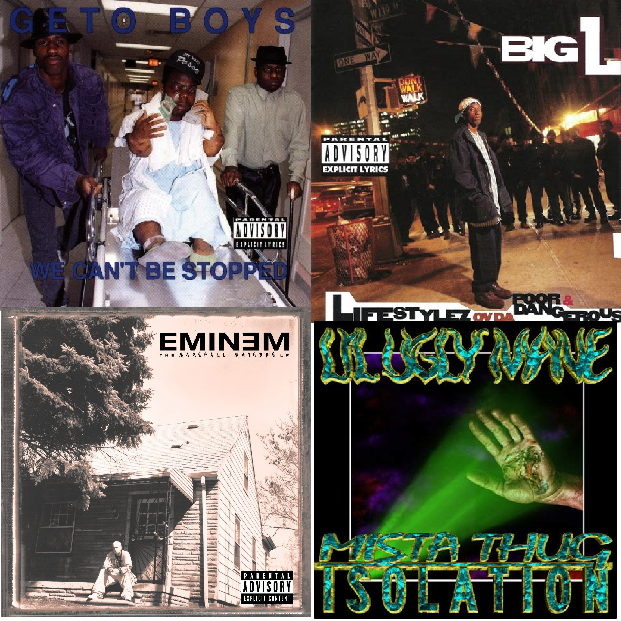
- Geto Boys – We Can’t Be Stopped (1991, most notable album from one of the pioneering acts of the 90s with its extreme take on the gangsta life)
- Insane Poetry – Grim Reality (1992)
- Ganksta N-I-P – The South Park Psycho (1992)
- Gravediggaz – 6 Feet Deep (1994)
- Brother Lynch – Season of the Siccness (1995)
- Three-6 Mafia – Mystic Stylez (1995)
- Big L – Lifestyle ov da Poor & Dangerous (1995, earned a beloved cult following for Big L’s witty delivery & visceral imagery)
- Dr. Octagon/Kool Keith – Dr. Octagonecologyst (1996)
- Dr. Dooom/Kool Keith – First Come, First Served (1999)
- Eminem – The Marshall Mathers LP (2000, seen as a turning point in granting credibility to Caucasian rappers & for putting Eminem into the mainstream spotlight for nearly two decades)
- Earl Sweatshirt – Earl (2010, mixtape)
- Lil Ugly Mane – Mista Thug Isolation (2012, revives back not only the genre into popularity, but have left a big impact on the underground southern rap scene)
- clipping. – Visions of Bodies Being Burned (2020)
Rapping have always been a battleground of street-borne wit & slang-riddled grit with its focus on improvisational bars & sample-driven beats. Through anecdotes of the harsh gangster lifestyle, there can be a lot of varieties around one’s take on the gangsta rap culture. Some, like NWA or Tupac Shakur, would frame their illicit activities in the context of social reforms & racial injustice while others, like Mobb Deep, might see in it a cautionary showcase of primal prowess. Nevertheless, the many tragedies which pervades the black community around street gang culture makes the topic inherently controversial to the conservative side of America. The confessional, rough-edged stories in many of the songs about the ghetto lifestyle have persevered to the public imagination & with that comes an explosion of content. We’re talking about new documentaries, reality shows, gossips, television shows, & films that aims to capture the nit & grit of what the emcees are trying to convey & in return, they will soon experience a rags-to-riches jump in their social ladder.
Due to the expansion of the topics in the entertainment industry to try & capitalise on the booming hip hop community, the varied takes around the direction of which the genre should take can come across as being literary. As someone who’s a bit of a geek around connecting contemporary subjects to historical matters, it reminds me in a way of the UK’s Romantic movement for its focus on social upheaval & interest in the common people (that being the impoverished black community). In the instance of mirroring, horrorcore might well be comparable to Gothicism that arose out of the movement as well. The confrontational gangster lifestyle has being taken to its most brutish, descriptions of shooting & killing at its most grotesque, & a psychological undercut is found in the narratives of the song. Even much like how the Gothic literature puts a twist on Romanticism’s love for nature through its supernatural inclusion, horrorcore would include tales that blur the line between gangsta rivalry & slasher film shenanigans.
As with many genres, there is little that we can pin down where the turning point is for the genre of horrorcore to be made. We know that hip hop as a whole is established from jazz poetry, the social & economical hardships of the American black community, & with a perchance of the experimentation of dub music & early electronica. So what of horrorcore in particular? As far back as in the 1980s, songs ranging from pop rap group like DJ Jazzy Jeff & The Fresh Prince to the hardcore Fat Boys & the Geto Boys took prompts from horror films to conjure up vividly tense encounters with the unnatural. In spite of its then-unique premise, it’s mostly thought of as being a fad & for those who does wish to push it into the wider audience are bound to be overshadowed by the more politically inclined acts. It would only be just until around 1989 when the Geto Boys released Grip It! On That Other Level – an album that fixates on graphic violence in a manner that is so transgressive that even the most ardent fan of rap would distance away from it. On its release, it earned a respectable 4 mics out of 5 from the Source which would retrospectively be revised to a full 5 mics for its influence.
Nevertheless, the follow up to Grip It! would leave an even bigger impact than its predecessor two years later in We Can’t Be Stopped where it’s home to some of the Geto Boys’ most iconic hits. ‘Mind Playing Tricks on Me’, for one example, is hailed as a monumental classic & a defining horrorcore song for its narrative around paranoia & the tension of the gangsta life with three out of four verses penned by Scarface. The shocking content in the record would proliferate with many of the fledging Southern rappers wanting to have their own take on the tropes. We’re looking mostly on the likes of Ganksta N-I-P, Insane Poetry, Three-6 Mafia, & Brother Lynch whose long involvement with pioneering the genre had finally come to a commercial fruition. Southern hip hop back then is defined by horrorcore to simply put it & until Outkast’s precarious experimentation comes knocking, the extreme show of violence does eventually come off as being off-putting.
Of course, the South of the U.S wasn’t the only part that’s hooked in to the macabre as the significantly bigger Eastern & Western scene would opt to have their own slice of the trend. Gravediggaz from New York, with the lauded producer RZA of the Wu Tang Clan fame, released 6 Feet Deep in 1994 with its most memorable hit being the darkly comedic ‘1-800 Suicide’ which is self-explanatory to say the least. Kool Keith of the Ultramagnetic MCs fame would make records that fall under the genre for its brutal storytelling concepts like Dr Octagonecologyst as Dr. Octagon or First Come, First Served as Dr. Dooom (not to be confused with MF DOOM). In spite of how recognisable the last two acts are, their following aren’t as fanatic as the likes of Big L whose freestyle wit, dextrous flow, & cartoonish demonstration of lyrical murder is second to none even now. Lifestylez ov da Poor & Dangerous was out since 1995 & since then, it’s regarded as an underground classic with highlights like ‘No Endz, No Skinz’, ‘Da Graveyard’, & ‘Put It On’. Nas mention once on how he couldn’t compare to Big L after listening to his performance on the Apollo Theater once. Unfortunately, his early demise at the turn of the century before signing to Jay-Z’s Roc-a-Fella label sees his legacy slightly stunted, but that doesn’t deter his fans from considering his works to be foundational to much of underground rap.
The story on the West Coast’ horrorcore scene is mostly carried by none other than Eminem. Most would recognise him for his strings of success in the late 1990s to the mid 2000s, but his career dates back to 1996’s Infinite which, although it debuts his tongue-twister rhymes & flow, only found mixed reactions from a handful of critics. In retrospect, some might state that it lacks the psychotic persona that makes Marshall Mathers the superstar that he is. This alter ego begins with the Slim Shady EP in 1997 which sees Eminem put out shocking songs about insanity & explicit murder which leads to him being signed in to Dr. Dre’s Aftermath Entertainment. He would then follow up on that two years later with the Slim Shady LP which catapults him to mainstream acclaim. & the ire of the more conservative Americans who criticise him for being a bad influence to the younger generation of the U.S. This doesn’t deter The Marshall Mathers LP from being released a year later to considerable praise for its maturity & growing artistry. It’s home to what is deemed to be some of Eminem’s greatest songs like ‘Kill You’ which makes it clear as day his psychopathic want to murder his most vocal haters. ‘Stan’, on the other hand, is a big contrast as it’s around a downfall of an obsessed fan which cumulates in an unforgettable, metafictional last verse which earns Mathers some of the biggest praises in his life.
With 3 out of 4 Grammy awards being won, The Marshall Mathers LP is acknowledged as being not only Eminem’s magnum opus, but also a seminal reference point for many white rappers to come. However, it’s around that point which sees horrorcore start to fade off from the hip hop community. Outkast had already left a mark then in diverting the Dirty South away from the gory details & opt to embrace the funk influence to a greater extent. Meanwhile, Eminem would find himself as being the sole representative of horrorcore as many failed to live up to the commercial intent that he has. Even then, the likes of Kanye West during the mid-2000s would distance from the hardcore lyricism in favour of the pure everyman experience which hits the mainstream audience like a storm, resulting in many competitions on all corners. By 2010, Eminem had all but abandoned the Slim Shady persona to branch out on his stylistics & once again, horrorcore is left in the dark as a very niche subgenre. Those who wanted to look into gangsta rap like Kendrick Lamar would much rather rap from an introspective point like Tupac or Nas than to push the visceral violence to its logical conclusion.
However deep into the underground horrorcore is, a certain collective in Odd Future would take up the mantle as the mainstream voice of horrorcore. The mixtape in Earl by Earl Sweatshirt in 2010 is one example of the collective’s love for the sadistic hyperbolism & members like Tyler, the Creator are shown to be able to make some pretty messed up stuff… with mixed results from the critics. It’s with Mista Thug Isolation by Lil Ugly Mane in 2012 that shows that while it may never reach the acclaim that it truly craves, horrorcore will still exist well to this day. The alien bars, fuzzy vocals, & a diverse range of beats puts the artist into the independent spotlight & while he may not revisit this particular genre again, horrorcore would once again enjoy its root-grown popularity in the underground. 5 years after the release, a retrospective review from Pitchfork gives it a rating of 8.2 & writer Andy O’Connor wrote on the album’s legacy that “[Its] brilliance is that despite its familiar influences, it sounds totally different from anything before or after it, even in Lil Ugly Mane’s own catalog.”
Now, horrorcore is mostly something that is regarded as a has-been which is more loved for birthing some of the most revered names in the scene like Eminem or Scarface than for its conventions. It’s not a genre that I do love to its fullest, but I feel like the exaggerations of violence & transgression is something to behold in its fullest. Just around a year ago, clipping. release what many would consider to be their best work in Visions of Bodies Being Burned & it captures the aural sense of one’s fear as well as it does in its lyrical content. Even Anthony Fantano gave a rating of a decent 9, loving the record for its industrial beats & avant-garde subversions on top of embodying the genre’s tropes to the tee. No one can tell for certain where the genre will go in the future, but it’s not hard to say that it’s here to stay for as long as hip hop will as a mainstream fix.
 GutterPutter
Leave a comment